Friday, October 12, 2012

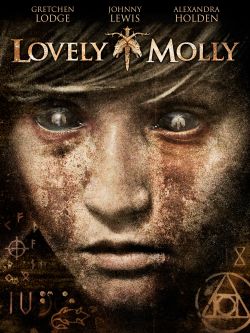
Lovely Molly. (2011) Eduardo Sánchez

Molly Rides the Horse for October Chillers.

Molly is that girl that got away. The one we'll never understand. The one who makes you smile, but if you look deep in her eyes there's a profound sense of longing and sadness. She's the one with a past, maybe the one with a habit. She's seen her fair share of trouble, maybe even caught a glimpse of a personal hell. She's reserved, mysterious, shifty, enticing. Many men have experienced a gal quite like Molly, but most have been confused when she suddenly slips away.

That's why we're blown away when we hear about her new man. He seems too normal. There's no way he can handle her. A guy with a normal job? A truck driver? What the hell does she see in him? He's no adventurer. He's got no silver spoon. His looks, too. He's only got two little pretty-boy tattoos, and not even a piercing on his face. She is getting married to him? This guy? What the hell?

Molly (Gretchen Lodge, in an unflinching debut performance) and her newlywed husband move into the home she grew up in, now a large empty shell of a place. The house has been vacant since her parents passed away, and might be perfectly suited for the newlyweds to begin their new life together. There are certain things, however, that took place in this house years ago -- things which Molly claims she can't remember -- and these things must have been truly horrific. There is probably a reason Molly blocked these memories.

The couple are awakened on one of their first nights in the home by the blaring of the house alarm. An intruder is in the kitchen. As they wander down the stairs from their bedroom, baseball bat firmly in his hands, they hear bumping sounds coming from the kitchen, which scares them back to their room, where they lock the door and wait for the police.

The cop, who will be called on again, is quite familiar with the house. He's quite familiar, too, with Molly, who he remembers as the little girl that lived there. He sweeps the house with ease; he already knows every room. It's probably a door left open, or neighborhood kids, perhaps. There's no way it could be anything more than that, right?

Before crashing back to sleep, Husband swears he locked that door.


When he leaves on a trip, Molly begins to hear more than just the casual bump in the night. The creaky old house seems to be coming alive, sometimes calling to her by name. She hears a little girl crying. She hears strange whispering sounds. She finds a light turned on in mom and dad's old room. Certain images are beginning to creep her out. In particular, images with horses seem to grab her attention, both the ones still hanging on the wall with the old family pictures, as well as the ones now forming in her head.

Perhaps these images are what pull the trigger that sends Molly from "lovely" to something other. Horse has been her problem, you see.

Director Eduardo Sánchez (The Blair Witch Project) has constructed a film where the demon is somewhere in the mental mix. Like Pop Skull, which I wrote about yesterday, a movie in which addiction is the new Jason, drugs are the serial killer -- Lovely Molly leaves us debating the very nature of true horror. What's worse? A guy with an axe that chases half-clothed teenagers around? Or a horrifying reality -- a psychological makeup we can't decipher?

As her issues continue to build and Molly gets more freaked out and destructive, her husband and sister see it as a pure drug abuse issue, or maybe mental illness at worst. "I love her, Hannah," Husband tells Molly's sister. "I just don't know how to help her." But what they see as addiction may or may not be the genuine article here... The house is beginning to smell whenever Molly has visions of her dad.

The film sometimes feels like Donnie Darko, but darker and on a very bad trip. Or if David Lynch got to make his own demonic Reality TV show, like Bob from Twin Peaks being an awful, constant presence. It can be seen as straight story (well, kinda) or as some sort of problematic metaphor (more than likely). It's more driven by narrative than the frenetic Pop Skull, but nonetheless cut from the same thematic cloth. The performances turned in are riveting, and Gretchen Lodge as the bi-polar Molly goes in an instant from blushing bride to a hideous creature, seething and writhing in the basement.

Like the girl that got away, this is one that certainly got under my skin.

Wednesday, October 10, 2012

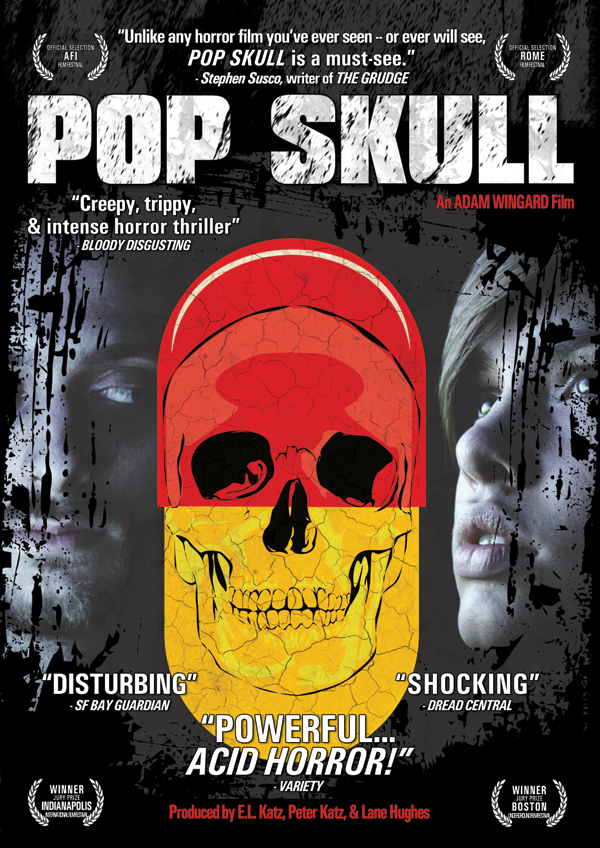
Pop Skull. (2007) Adam Wingard

The drug is the spirit in this convulsive October Chiller.

The first frame in Pop Skull is a still which reads: "WARNING: The following motion picture contains scenes which may not be suitable for individuals diagnosed with epilepsy." The warning might feel like a cheap gimmick, like any still in front of a scary movie which reads Inspired by true events -- but like the warning at the end of Gaspar Noé's I Stand Alone, that savage utterance that cried something gruesome this way comes, this warning is founded, and true, and describes an approaching onslaught not suited for the squeamish.

Convulsions? Hell, yeah. And I'm sooo envious of anyone who rode this ride on the silver screen.

Pop Skull is a deeply unnerving tour de force in contemporary low-budget filmmaking. With precision cut editing and the creepiest audio dynamics, it shows what a determined young filmmaker can do with 6,000 measly bucks. Like the greats in shoestring cinema (Eraserhead and Pi being the first that leap to mind), it utilizes pulsating imagery and an amplified texture of sound to push the extremes of a surrealist conquest on anyone who gets in its way.

Also similar to the three mentioned films, Pop Skull is the story of a man rattled in the head, unraveling at the seams, ready to uncork like DeNiro's Travis Bickle in Taxi Driver. At any moment either the film or its central character Daniel could lose all ability in distinguishing between hallucinogenic dreams and nightmare reality. The title is somewhat the plot. You never know when this skull will finally pop.


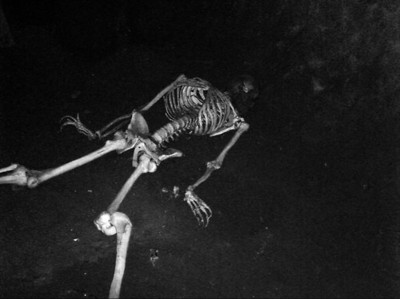
Daniel (Lane Hughes, above, more recently known as Zak in V/H/S) is an over-the-counter pill popper at the end of a long-term relationship. A guitar player with no band and going nowhere fast, Daniel sits sullenly in his parents' basement, either cranking his electric and washing away in the maze of his music, or consuming and zoning out to his purchased pills. Benadryl, Zicam, Coricidin, Dramamine, whatever he can get his hands on are bought daily, while he nervously utters to himself to get out the pharmacy door. He wants what he needs and he needs to get his fix and leave -- hopefully in peace, unquestioned, left to down it all again at night.

He's exercising that right that some of us know, the one we addicts know all too well. We think it's our right to claim our own self-destruction. The mind of an addict is full of endless possibilities which steal our joy, trading a moment's bliss for the robbing of our lives. Like so many addicts, if depression is Daniel's excuse, he's drowning out the loss of his girlfriend and blaming it on her. But the truth is that he, and we, do it no matter the reason. The pills inch their way slowly into the system, and in scenes of haunted intensity, we visit with Daniel's fears, and his terrifying ghosts. Some are imagined, some perhaps very real.

As a child Daniel was told about a murder and double-suicide that took place in his back yard before he moved in. No one knows why two guys would tie up a girl, or why the night ended with the three of them dead. Either the thought of this haunts Daniel, or he is tripping way too hard, because the events seem to unfold when he's using. He is freaked and afraid, but the pattern can't stop. Daniel faces himself all alone with the spirits in his basement -- night after night after endless, horrifying night.

There comes a point in addiction where the hole in your soul becomes the crater that was once your life. The suffering inside you leaks out, only to consume you and swallow you whole. The same blackened eyes that stare into the mirror are the chasm of all that's left; everyone's gone because you pushed or you scared them away. You'll destroy yourself, whether you want to or not, and you might take your loved ones right with you. Pop Skull is very personal to me, as I've lived through many of Daniel's harrowing scenes. I am thankful today that I've found a few ways out.

There's so much truth here to the way addiction works to change our perceptions. There's truth to the visions of ghosts we encounter in our haze. There's truth to the idea that this is a road which leads to misery, with only jail, institutions, or death at the end.

If Pop Skull and its addicted Daniel aren't the very definition of horror, then I honestly don't know what is.

Monday, October 8, 2012

Requiem. (2006) Hans-Christian Schmid

A 2006 German possession film for October Chillers.

What better way to continue rollicking in Halloween horror than a dogme-like film about an exorcism, right?

Requiem is the story of Michaela Klingler, a young and devout German Catholic suffering from epilepsy. The disease held her back a year in high school, but now that she's nineteen she wants to attend University and study like any other college-aged kid, managing the disease on her own.

Away from her small town, in a city for the first time, Michaela quickly makes her first connection in finding an acquaintance from home. She also gets her first boyfriend -- along with her first drinks, her first kiss, her first physical encounter with another. So are the voices in her head and her recurring seizures symptomatic of her going off her pills, or is this demonic oppression due to her entrance into sinful living?

As the studies get harder and end of semester papers are due, life for Michaela slowly spins out of control. The voices are calling her a slut, and have told her to no longer pray or try to touch a crucifix. She wakes up in contorted positions, and feels seizures steal the use of her hands as she desperately tries to type. She begins rejecting her priests and her doctors and even her friends. Everyone's got advice, but no one can walk in her shoes. Perhaps it's easy to understand why she makes her final decision for exorcism, when she's brought home by worried friends and faced with either priests or the institution.

The film is based on the real life 1976 exorcism of Anneliese Michel, the same girl that inspired The Exorcism of Emily Rose. While Requiem feels more realist than The Exorcism of Emily Rose, the two feel like they offer similar sketches of the same story. Whereas The Exorcism of Emily Rose functions as a horror film, Requiem tells the story in more of a psychological character study. I mentioned the dogme movement before -- Requiem feels like Breaking the Waves in places. It had that strong, fluid camera work, that somber religious feel, and an incredible actress to pull the whole thing off. No special effects, no faces jumping out of the dark, no spider crawls, no backwards masking. Actress Sandra Hüller is believable simply by the way she fills the role of this troubled girl. Her physical presence on screen stands out. It makes the film.

Much to my delight, I was able to have a bit of back and forth with director Scott Derrickson when comparing the two films. That conversation is found Here.


Cleaned up and reprinted from Halloween (2010).
Requiem is available on Netflix Instant Viewing.

Sunday, October 7, 2012

Amer. (2010) Hélène Cattet and Bruno Forzani

 A freaked out October Chiller.

Horror from Belgium, Amer instantly brought to mind two reference points that might be helpful for anyone deciding whether or not to see it.

The first is Kill Bill, which is actually more gruesome and bloodthirsty with its enjoyment of arms and heads cut off and flying through the air, drenching anything close by in the red of its blood. Amer has nothing like those barbaric scenes, although in quick instances it comes close. Where Amer is similar to Tarantino's revenge epic is in its rapid eye edits, its intensely cut visuals which are fascinating as they flicker by, and in its use of unnatural and amplified sound, an incredibly eclectic audio design. When Uma Thurman spins her head or pulls out a sword in Kill Bill, the exaggerated sound effects hail back to early Bruce Lee and 70s Kung Fu flicks; in Amer, when an eye blinks or a corpse is present, or when the victim is struggling in the clutches of her killer, the sound hails back to retro horror, mostly gialli, which the visual stylings reference, too.

The second film that so quickly springs to mind is Ti West's The House of the Devil, a guilty pleasure of mine from 2009. That film paid homage to earlier horror classics in its creepy Halloween-like score, its babysitter left alone in a large house, and Satanism lurking in the back of the script. It was set in the mid-80s and built as if it were made then, using cameras from the era and edited in the exact same fashion as those slasher flicks you saw on HBO as a teen. It's the retro-chic, throwback feel that is similar to Amer, and if you've ever enjoyed a film by Dario Argento, you're destined to love Amer.

The plot is so fucked over it is impossible to coherently describe. If it has more than fifteen lines of dialogue, well, I'll eat my hat. This is a film based strictly on sight and sound. It lives by it and dies by it, and to decipher its plot is somewhat meaningless.

But I can try.

Like the panels in a triptych, the film shows three moments in the life of heroine Ana. (Anton Bitel in his Sight & Sound review wonderfully notes that her three-lettered palindromic name reflects the film's "tripartite cyclical structure.") Each Ana is played by a different actress: Cassandra Forêt as Ana enfant, a scared innocent, perhaps aged eight or nine; hottie Charlotte Eugène Guibbaud as Ana adolescente, mid-teen and ready to sexually burst and challenge (perhaps replace) the old bag mom; and the captivating Marie Bos as Ana Adule, repressed and reacting to everything the first two Ana's have already seen.

After the death of her grandfather, his corpse laid out downstairs, Ana enfant locks herself away in her room, constantly covering the keyhole through which the family housemaid, supposed a witch, gazes in with one ugly eye. Ana eventually grazes downstairs, curious about the corpse, and takes a watch from her grandfather's hand. She breaks off a finger in the process. His eyes open, the housemaid witch reemerges, and Ana is wrapped up in her black shawl, which we see through her eyes.*

Ana adolescente walks into town with her mom. Her burgeoning sexuality is pitted against the fact that her once beautiful mother needs to get the gray out. She is heading in to get her hair dyed. As Ana waits outside with a schoolboy she's too mature for, she wanders from the salon and notices a biker gang outside. She walks provocatively in front of them, her thoughts racing with a rebel teenage eros. Her mom tracks her down and gives her a biting little slap on the face. We're never certain whether her mom is being protective or jealous. The two make their way back home.

Ana Adule returns years later to the villa where all this began. The home is dilapidated now, no one has been here or lived here for years. Ana fantasizes about the taxi driver who drives her there and some locals that take her boxes outside the home's gates. The film from this place completely explodes. One, perhaps two killers are stalking Ana, and at least one will kill her by the film's end.

The film is sexually provocative, but unlike much of contemporary horror, not a whole lot of skin is shown. You might find it here or there, but it doesn't need to be shown. It's embedded into the psyche of every element.

In moments along the way, one tone of pure color stands out and is nearly blinding. Red, green, and blue are predominant, and when they're used they seem to go on for minutes at a time. I cannot describe the creepiness of these scenes, nor can I describe the alarming mood of the sound. Like Lynch at his best, Amer influences mostly through suggestion. You're on the edge of your seat and don't always know why. Then, like Rob Zombie -- but for only seconds at a time -- you are fully introduced to the spectrum of horror that abounds.

The film is excessive, over the top, overflowing with references to Italian horror, and writhing as if possessed with atonal image and sound. It is not for the faint of heart, but not prone to the gore of, say, Suspiria. There are moments that it's all just too much to take in, and I'd be open to those who said their mind began to wander.

But it is moody more than anything, and the mood is salient terror, with a suspense that builds to a tragic climax which leaves you desirous to experience it again.


*Note the three references to eyes in that paragraph. Not since Un Chien Andalou in 1929 has an eye been so fearfully relayed. (And I just realized that Buñuel's startling plot-less short could be another apt reference for Amer.)

Cleaned up and reprinted from EUFF Screenings (2011).
Amer is available on DVD thru Netflix.

Saturday, October 6, 2012

Bride of Frankenstein. (1935) James Whale

An Image of Human Truth for October Chillers.

Four years passed between Frankenstein and its first sequel, but the story picks up on the same savage night of the supposed destruction of the creature, in a fiery inferno sending his soul back to hell.

Then again, we 21st century media-savvy types (which is pretty much everyone, more or less) know that no creature dies in a first film, no matter how much its makers want you to believe it -- no matter how hot the burning mill, no matter how many citizens saw the structure burn to ashes. We of course know that no alien, no mummy, no Jason or Freddy or Michael will be dead when the credits have left a first film's screen. You can't have a second Creature Feature if you haven't got a creature to feature.

There is genius found in moments of Bride of Frankenstein. I love how they kept the creature alive, escaping the tormenting flames in a mote below the mill. And the final act is any film lover's delight.

I also thoroughly enjoy something as simple and fun as the opening credits, which piggyback off Frankenstein's use of "?" for The Monster, using "?" once again for The Bride. There are so many moments where Bride of Frankenstein gives its all in being just as good as the original, you've got to love it for its heart alone.

Author Mary Shelley, played by Elsa Lanchester (who also plays the impressionable Bride in the outstanding final chapter), sits cozily indoors with a couple of highbrow if not caricatured gentlemen, the wind whistling and the thunder crashing outside. One of the men, claiming the status of "England's greatest sinner," considers how warm and safe it is inside the house, while an angry Jehovah viciously thunders outside. "How beautifully dramatic," he says. "The crudest savage exhibition of nature at her worst without, and we... within..." He claims his head is unbowed to the thundering God outside. But who would fear a supposed God if kicking back by a comfy fire was all it took to protect you from his wrath?

The men talk highly of the creepy chills of Mary's original Frankenstein story. They narrate over images of the film (blogged about Here), a brief recap for the sake of the audience's memory from four years before. (There were no television premiers or TiVo in 1935.) They implore Mary to share the rest of the story, so she launches into the sequel, the story of the creation of the Bride. It's an almost perfect beginning to the film.

Almost, because as her story emerges there's an immediate disconnect from the original, quite noticeable within seconds. The medium of filmmaking changed quickly in four years, the times obviously persuading director James Whale to stuff oodles of musical score in the background. It's interminable presence is constantly noticeable, a never-ending standout out like a splinter in one's thumb. It nulls the tension so easily relayed without filler in the original film.

The writing and dialogue are so dark and crisp that seeing it 80 years later and complaining about the score seems unfair. But the problems don't end with the score. We're immediately introduced to a side character, Minnie, played by Una O'Connor, used mostly for comedic effect. She is agonizingly horrible, not funny for a moment. She brings camp to a film that wishes to reject her and her whiny voice and its shrieking screams. She is truly the most awful thing in Bride of Frankenstein, and watching her made me think the person responsible for casting her hadn't seen the original. Then I found out James Whale casted her.

There's but one line that may have worked for O'Connor as a decent foreshadowing to the rest of the story: "Oh what a terrible wedding night!" she cries, in regard to the botched wedding plans of Dr. Frankenstein and his bride. But after the brittle scream that escaped the woman just moments before this interesting sentence, all you wish is that the creature had killed her when he had the chance.

The film is a much bigger production than the original, but missteps like these keep killing it when it almost gains a foothold on tension.

Bride of Frankenstein desperately tries to deal with the same gripping religious themes the first film took on, and if these particular scenes were viewed on their own they might be as meaningful and powerful as they were there. But in the context here, with attempts at humor included (and a ridiculous scene of miniature royalty in jars, only there for a 1935 special effect), scenes of the creature tied to a stake and mocked like Jesus on the cross, or of him partaking in a sort of bread and wine communion with a blind old man he calls "Friend," are short-lived, momentary, mixing horror and camp horribly and accomplishing neither one.

Bride of Frankenstein follows two basic story lines until that final, superbly cinematic moment at the film's end. The first is the creature itself, captured and kept in a dungeon in shackles, easily escaping, and left to wander the countryside until meeting the blind old man. He's generally in trouble with all mankind until once again meeting up with his insane maker.

The parallel story follows Dr. Frankenstein, who at the beginning claimed to his would-be bride he'd had enough of trying to be a mad scientist: "I've been cursed for delving into the mysteries of life." But then he's lured by a colleague, the similarly crazed Dr. Pretorius, and the two carve out the ultimate plan for a race of living creations. A female version of the creature is a necessary first step, and hopefully the two will like each other.

With the grande finale culminating in the creatures, the psychosexual, symbolic gender relations and the tensions therein, I kept wondering if the film would have worked a bit better as a short film, or perhaps by simply adding this story to the original. But that is not the answer. The films each suit their length at 70 and 75 minutes respectively, and the idea of putting the bride in the original would have ruined what is already a masterpiece.

The bottom line regarding Bride of Frankenstein is that it was either over-developed, or just plain developed wrong, even though there are moments, particularly in its end, that are triumphant.

It's a mish-mash. A hodgepodge. A motley assortment that shifts between genius and utter stupidity. But it brought us one of history's most perfectly climactic moments when the Bride is finally and awfully revealed.

Sometimes you have to wade through the gunk to get to the cinematic gusto.


Reprinted from A Black and White February (2011).

Thursday, October 4, 2012

Frankenstein. (1931) James Whale

An October Chillers Delight.

I haven't seen Frankenstein in decades, probably not since I was a prepubescent freckle-faced punk. The last time I saw it was most likely on the Saturday afternoon Son of Svengoolie show, on WFLD Chicago. It would have aired sometime in the early eighties, probably having commercial breaks featuring Svengoolie himself, the weirdo/host-in-a-coffin who had rubber chickens whipped at him every weekend and continually made references to Berwyn. (audio: "BEHR-winnn!")

Screenings like these, fun as they may be, unfortunately do more damage than good to the general perception of a film like Frankenstein. I always knew the novel, first published by Mary Shelley in 1818, was more significant than shows like Svengoolie and their like deserved. But having not seen the original film as an adult, I didn't realize what an achievement the story is on screen. It's not just a classic novel -- it's a classic in cinema, a film that obviously set a high standard not just for horror, but for motion picture Story.

Described by Shelley, both as the author and a written-in character in Bride of Frankenstein, as, "A moral lesson of the punishment that befell a mortal man who dared to emulate God," the opening scenes of Frankenstein are immediately concerned with a religious milieu much larger than an average monster movie: sin, death and the grave, the grim reaper, the cross, robbing the grave, and taking an executed man down from a cross. From there, the film compares and contrasts science and faith (spread across the film in many obvious references); immortality and the end-all mystery of death
(Dr. Frankenstein cries at one point, "Now I know what it feels like to be God!"); creation vs. recreation (is Dr. Frankenstein a creation, too? Does his Creator have an opinion on his creation?); and nature vs. nurturing (the switching of the brains, not present in the book but added into the movie, reminds us of just how little we've learned in the past eighty years about the brain and how it functions). Each of these themes are transcendent. They transcend the boundaries of time. You find themes like this in much great literature throughout history. Is it any wonder this story has been around for 190 years? How many other monster movies have come and gone since Frankenstein was originally brought to the screen?

The idea, too, that this is a monster movie intrigues me when I consider who or what the real monster might be. Is it the creator or the created? Is it the stirred up mob with their fiery torches and barking dogs, chasing an ugly, newborn giant in the woods, trapped in mob mentality, aiming their venom at the wrong object?

Does a monster even see itself as a monster -- does it recognize how it's seen? A speechless brute in this film, Frankenstein's creation can't speak for himself. But in Bride of Frankenstein, he does learn to speak in small words and phrases (contrary to the original book, where he went on for pages in philosophical musings). One of the first words the creature learns is, "Friend."

Frankenstein is a story about a blundering humanity that would rather worry about the afterlife or chase fear than connect. It's incredible how relevant this theme still fits today. In a two-party system with a judgmental church, The Monster remains that thing on which you project your worries and your fears.

With stunning cinematography that moves and brings the creature to life, and a musical approach closer to silent cinema than modern scares, Frankenstein's remarkable achievement in tension comes close to rivaling that of Murnau's Nosferatu, of the silent era. Though Orlock might be seen as a creature of blood and death and Frankenstein's Monster might be seen as a creature of death and the brain, both creatures revolve around temptations to become immortal, the idea that it is possible to be like God. Both creatures reflect the first lie told to man, their stories using thousands year-old themes, as old as the third chapter in the Book of Genesis.

I had no idea the film was this important in the canon of horror, nor could I have ever known what a great film it is even outside its genre classification. I'm glad I revisited it as an adult. I've found a new classic that I love.


Reprinted from A Black and White February (2011).

October Chillers.

October Chillers.


My, my. I have truly missed my little blog...

... and I can think of no better time to revive FILMSWEEP than this: October, the month of ghouls and ghosts.

In recent years, the importance of horror has brought on several layers of new meaning to me. But searching for meaning in this particular genre is kind of like digging for a steak in a bucket of innards. 

You might get lucky. You might find something worth chewing on. But more than likely, you're gonna have to fry whatever you find to well-done.

It is my hope over the next month to talk about a few films I've grown quite fond of, and a few of the underlying reasons lurking just beneath that new sense of fondness.

I'll be dragging a few flicks from the archives, films like Frankenstein and Bride of Frankenstein, and Amer. These should get things properly rolling again here at FILMSWEEP. And then we'll dive into more recent viewings, films I've been thinking about as potential "chillers" for this soul-sucking month. 

We'll talk about two new films out in theaters right now (The Possession and Sinister).

And then there are two in particular I can't wait to introduce into the mix - Pop Skull and Lovely Molly... These reek of unrestrained psychological horror at its finest, blending themes of addiction and loss with a descent into madness which only addiction and loss can bring. They inherently resonate with the word "horror," as I understand it, from the skeletons in my own closet and the opinions I've formed in coming out.

Life is a series of horrors. Faith stares those horrors in the face. Freedom is found in overcoming the horrific obstacles we hurdle in this unfolding tragedy we call life.

Happy October, horror film lovers. Let's have some ghoulish viewing fun.

Sunday, January 29, 2012

Top Ten 2011.

Surprise, surprise. 2011 turned out just fine.

Typically any year is fine, if you see enough films in the given year.

While I don't feel that this year's list is as strong as my 2010 Top Ten, I admit I saw less global film (and unfortunately recorded even less here at the blog). However, a strong 2011 in general made up for a lack of what I was able to get to. And as usual, I've listed what I still need to see - the films which most likely would have been strong contenders - at the bottom of the list, just to be fair.

Those who know me well, know that I love my little lists. The yearly Top Ten is no exception. I tend to make the list based on my own emotional response (the subjective), my reaction as I read other thoughts about it (the objective, or the critical), and how well the film in question fits into the great tradition before it in terms of its responsibility and deliberateness in carrying the torch.

I always over-think it and analyze the order of the list in depth until I'm able to sit down and figure out what deserves to be in its proper slot, and why. (For instance, this year's #1 beat out #2 because of each of the film's endings. I only thought about this in the past few days, after seeing each film more than six months ago.)

So.... anyway. Here we go.

The following were released either on a big screen somewhere in the US or made their first Grand Rapids appearance in 2011.

10. Midnight in Paris

Picasso, Bunuel and Cocteau (!) all make guest appearances in Woody Allen's latest, which centers around Owen Wilson, a man in love with art and nostalgia from the twenties. While not necessarily a film for the art-historically impaired, it's a story that reminds one that the time you are in - the history you are currently making - is as important as any nostalgia you desire. That we are here, and we are now, and no matter how great yesterday was, tomorrow can be even better.

9. Letters to Father Jacob

It is nice to see a Finnish film on my list for the second year in a row. This is a country I've spent some time in, and the films that come out of Finland seem to represent the repressed nature of its folk really well. This particular gem is about a minister who only wants to do that -- minister. (Yeah, that can be seen as either humble or proud, but Father Jacob is a man who wants to bless.) Blind and old, he's going to need help to continue in his calling, and the tough ex-con that comes to live with him is not excited about helping in his work. She reads letters from parishioners, and watches in doubt while he prays over their requests. This is a quiet story about the miraculous, and the response to a miracle when it's revealed -- a response which may or may not change one's agnostic approach to life. (I wrote this up for last year's EUFF here.)

8. Take Shelter

Is he losing his mind when he has dreams about an approaching storm? Is he seeing things when he sees ghost-like figures trying to snatch him or his daughter out of his house, or out of his car? Does he need more meds? Is he schizophrenic? Can he trust his wife, who has compassion on his altered state of mind? Comparisons to my all-time favorite film Ordet are certain to abound, but Take Shelter, like this year's Melancholia, isn't a film that's bringing Inger back to life. Trying to decipher the prophetic is itself like being in a continuing altered state... This film is about a brooding dread, the continually approaching storm that hangs both mentally and literally over our lives.

7. 50/50

50/50 is simply an engaging, enjoyable, comedy-driven film with two grown buddies and how they deal with each other, their issues on full display. The buddy-buddy relationship at the film's center made me laugh quite a bit, and it isn't the kind of laughter you feel guilty about later on. It's a beautiful relational film, and it captures how guys relate to one another to a "T".

6. Insidious

Cool to see horror making a return to form this year, noted in both this pick and Amer, which I've listed just in front of it. If only the makers of spat-out torture porn and rehashed gore would note these two creepy indie-style films. Insidious was made on a million dollar budget, proving that story and creativity trump money in this genre, and reminds me of Murnau's Nosferatu, the standard by which to compare even ninety years after it was made. An astral projection ghost-story narrative with some jump scares thrown in for fun bring the reality to the forefront of this "fiction." At my screening, at the end of the film the girl next to me was literally in her boyfriend's lap -- and no, they weren't making out. (She was freaked.)

5. Amer

Retro-horror laced with an intense gialli homage, I drooled a bit over this Belgium masterpiece when I wrote it up for EUFF last March. On a Top Ten where I didn't have to think straight first, Amer would probably rank as my #1 film for 2011. Its ghost story suspense launched through Kill Bill style editing builds a mood of dread and salient terror in any viewer. I have always maintained that I like the idea of a horror movie more than 99% of actual horror movies released. Amer easily falls into that 1%.

4. The Mill & the Cross

If you missed The Mill and the Cross in the theater, I don't know what to tell you. I guess you could catch it on DVD, but it'd be like watching Avatar on an iPod instead of on an IMAX screen in 3D. This is the first painting I've ever seen come to life and tell a story -- a beautiful story about the religious politics that went into its very inception. An incredible work on the big screen, the likes of which I've not seen before. My friend Steven D. Greydanus wrote a very eloquent review of why you should see it here.

3. Budrus

I wrote at length about Budrus here. It's a rare doc which I believe, were enough of the right people to see it, would bring positive change into a situation that desperately needs it. I often describe myself as pro-Palestinian with a heritage lining back through Israeli narrative. The conflict in this part of the world is never ending, but Budrus shows one way peace can be attained. This is a powerful, important work, which could bring healing to both sides of the West Bank Barrier.


2. The Tree of Life

Some of my friends have seen this two or three times on the big screen. I wish I could say the same. I just wish I could see it one more time... It blew me away when I saw it last June. If I wasn't won over to the Malick camp before, I'm certainly open to going back to his older works now. Pitt and Penn and Chastain were all perfect in this tour de force. (It seems to me that Chastain has had several of these kinds of films this year...) The Tree of Life is less like a movie, and more like a religious experience. A good one. The best religious experience you've had, and it can be repeated later on DVD. A stunning, mesmerizing, beautiful ode to the heavens.

1. Copie Conforme

The subtitle above reads "An original love story." I joke with friends that there is nothing original left in art, that there are only copies of copies, that there is "nothing new under the sun." (Which is actually what this film is about.)  I think that's mostly true, but I've not seen a story quite like Certified Copy before, a film which leaves you breathless with more questions than it has answers. In fact the mystery of the questions is the greatest strength of the experience. I've been a Binoche fan since Kieslowski's Blue, but I think this is her crowning achievement. I've been a Kiarostami fan since Taste of Cherry, but I'm persuaded there are certain artists who only improve with time. Even thinking through some of the things that take place in Certified Copy leaves me a little befuddled -- befuddled in a very good way. The film is about copies and art and marriage and relationships and love and distance and history and tears, and "he" and "she" and "what really are we". These are all the great themes that can find their way into any good story, but here they are at the peak of their form. For its take on all these themes and its ability to relay them fresh and anew, I'd rather refer to this film as Certified Original. (My full reaction was recorded here.)

With Apologies To: Of Gods and Men (responsible and mature, yes you are, but you're too much of a bore for my list)... Mesrine: Killer Instinct and Mesrine: Public Enemy No. 1  (the role Vincent Cassel was born to play - I wrote about my two UICA screenings here)...   And three stand-out documentaries: Buck, Bill Cunningham New York, and The Greatest Movie Ever Sold. The latter of which  had me in stitches.

#1 Guilty Pleasure of 2011: Bridesmaids. But the choice of the ending song, even thought of and stuck in my head right now, just kills the entire experience. Excruciating stuff.

#1 Disappointment of 2011: Melancholia. It amazes me how different people see different things, and I do enjoy spending time in someone else's brain. However, it doesn't seem to matter how much time I spend reading all the critical praise for Lars von Trier's latest. I think it does matter that he's my favorite director, and that I tend to go against the masses when I say I love pretty much any film he's released in the past two decades (aside from Melancholia). Aside from the astounding last twenty seconds, Melancholia is way too long, way too boring, and leaves me unsympathetic for its characters or their apocalypse. In fact, the film is so Last Year in Marienbad artsy-pretentious, I found myself wishing for the world to end much sooner.

The David Lynch 2011 Award: The Temptation of St. Tony. Strangest film since Eraserhead, and I'd love to suffer through it again just for its own miserable display of la weird. I wrote about this Estonian mind-job here. I'm still not convinced that it's a good film at all, but "Lynchian"? Oh, hell yeah. I'd love to see it a second time and be proven wrong about my initial assumption.

2011 Films I haven't seen, which I'll strike out as the year progresses: The Artist, Bullhead, Footnote, In DarknessMonsiur Lazhar, Margaret, The Way, Shame, The HelpTinker Tailor Soldier Spy, HugoTuesday After Christmas, Submarine, Martha Marcy May Marlene, My Joy, House of Pleasures, Poetry, Pruitt-Igoe Myth, Pina, Hell and Back Again, If a Tree Falls: A Story of the Earth Liberation Front, Undefeated, Paradise Lot 3: PurgatoryHigher Ground, A Separation, We Need to Talk About Kevin, Meek's Cutoff, The Arbor, La Quattro Volte, Extremely Loud & Incredibly Close, Moneyball, War Horse, A Better Life, My Week with Marilyn, Beginners, WarriorPutty Hill, Attack the Block.... and two personal big, big misses: The Kid with a Bike (I'm a huge fan of the Dardenne brothers, and critical talk suggests this would have made my list), and Mysteries of Lisbon, which has been on quite a few Top Tens -- but at six hours it is more an event than a film, and I highly doubt I'll have that kind of time very soon. 


And finally... The way I love to wrap things up...

Favorite Non-2011 Discoveries
(I fell in love with in 2011): 

Frankenstein, Paths of Glory, The Gospel According to St. Matthew, The Mirror, Close-Up, The Traveler, The Straight StoryTender Mercies, Get Low, (the latter two along with a rediscovery of the ever-touching, evangelical-sin story which stars Robert Duvall as The Apostle), Temple Grandin, Missing (Costa-Gavras), The Station Agent, Marwencol -- and Jim Jarmusch in general, particularly his black and whites (as I wrote about Here, Here, Here and Here). 

Saturday, June 25, 2011

The Tree of Life. (2011) Terrence Malick

A Break From June Lite.

Terrence Malick's metaphysical mind job is a film that won't be for everyone, but man, it floored me. It's the first film I've seen that will be in contention for a Top Ten spot when I put together my yearly list at the end of 2011.

I suspect that seeing The Tree of Life in the theater has a lot to do with my reaction. It's such a huge experience, made to order for the Big Screen. It's loaded with universal images, and by that I mean images of the universe; long segments are like a cosmic ode to the Creation story. Indeed, its first frame is even a quote pulled from the end of the Book of Job: "Where were you when I laid the foundations of the earth?"

But it is also universal in the Christian sense, like a Christian Universalist. It's visually striking enough to relay a fascination with the cosmos and one family's struggle within it, but ambiguous enough to avoid the pat answers a Christian movie might adhere to.

It also suggests a maternal grace that wrestles with the paternal nature of the world, that the world in itself can be beautiful to our eyes, but it can be a dangerous, disastrous place as well - and that our actions and the actions of those around us can determine how we filter the beauty of grace and the strength of nature.

And Brad Pitt, for the record, is amazing.

I doubt I'll see a better film this year, but I'm sure I'll never see another film quite like it.

Tuesday, June 21, 2011

Blow Out. (1981) Brian De Palma


I'm an audio kinda guy. Always have been. From the time I was sixteen rocking metal for Mr. Jesus; to eighteen going solo with a four-track recorder (and likely a mirror, Narcissist Little Me); to a mid-twenties tormented artiste with Swedish buddies and copious amounts of two-inch tape; to my current love of digital surround sound and the iPod on which I groove, I marvel at the possibilities of Time and Sound in a captivated sensorial type of way.

I once wrote a fifteen page college paper, probably after reading way too much John Cage, on my theory of dimensional black holes lying in-between the notes we actually hear. Diagrams and dimensions and everything. Figure 1-A between G and G-sharp. The paper got an A, with one word from the prof on the cover of my report: "Brilliant!"

I guess I tricked good ol' Professor Brubaker. With that kind of ability, perhaps I should have stayed in school.

I wrote and toured my own songs but also worked in sound solely for others, and I remain fascinated by everything from the chord structures and rhythmic stylings of Radiohead and Blonde Redhead, to the vocalizations of Bon Iver and Iron & Wine, to the layered synth meanderings of Mates of State and The Knife, to the unzipped-pants-rawk of the somewhat spiritually downtrodden Black Rebel Motorcycle Club and Starflyer 59.

I was destined to, at the very least, appreciate Blow Out, a film that is essentially about sound. It's about an audio guy with a political conspiracy on his hands and proof of the Reality on tape. (Those who visit here often enough also know I have a thing for Reality. Capital "R.")

I was destined to appreciate this film.

However.

For a film about sound, it sure has some crappy sounds in it. There are some awfully dated moments when background filler sounds like early 80s Spirogyra, a schmaltz-like fusion with half-distorted guitar licks sprung out of 70's-era porn.

And, it's a lot to wade through to get to those final mesmerizing fifteen minutes of pure pop movie bliss. Sure, the ending is killer. But there's a lot of filler to get to the killer.

I don't really get why this is the De Palma film everyone seems to love. It's -- eeh, it's OK. As I've noted in all my De Palma adventures over the course of the past few weeks, the cinematographic style is in moments as self-aware as it is astounding; certain shots are a visual feast. One in particular that stands out spins our eyes around a room where John Travolta discovers all his tapes have been altered. He frantically tears through tape after tape that he's backed up from an original, only to find all of his tapes mysteriously erased. But we only see him poking in and out of frame in his maddening hunt. The camera continually spins in 360 showing us the room, the blanked-out evidence, with Travolta caught in the chaos of his loss and the sounds of all the tape machines, each having been erased with a different mechanical sound. Stylistically, the shot is a great choice, but it ends with a greater exclamation point. We cut to an edit from above, a God's Eye on Travolta, looking down on a defeated man exiting the room, the tapes still playing blanked-out white noise, tape and audio equipment all over the floor.

Travolta as sound man Jack Terry is actually pretty good, and in moments, his sidekick Sally (Nancy Allen with a voice like a feminine abrasive) brings a nice chemistry to their scenes together. They met when he saved her, nearly drowned after the car she was in had a tire blown out and was thrown from a bridge; we learn as we go that a presidential candidate was also in the car with Sally. The tire was no accident, there are tapes with a shot ringing out. The candidate is dead. Sally and Jack could be next.

But are these real characters, like Roger Ebert wrote in his four-star 1981 review? Or are they, to borrow a phrase from a recent article in cineaction, animated simulacra, characters which seem real but serve the simpler purpose of advancing a film's trajectory?

In terms of story, the trajectory feels to me kind of like a dot. Once the blow out takes place, probably around twenty minutes in, it's mostly the same story from there to the end of the film. Little surprise happens. No big reveals. The conspiracy theory at the heart of the story is fun, but by today's conspiracy theory standards, it's actually a little bit tame.

What may save a good portion of the film in my mind is that I love the idea of conspiracy in and of itself. I'm inclined to believe that the media is its own message, and the message is often false. I thoroughly enjoy the stuff of juicy unknowns: the Zapruder tape, the 9/11 documentaries, secret societies and the X-Files. I am certain there's always more going on behind the scenes than we know, and at its best, Blow Out shows exactly how a political cover-up might take place in real time. In that aspect the film is golden.

But once again, even though Travolta is decent in this role, I find myself watching a De Palma film where characters are suffering from under-exposure. Not that we don't see them enough, but they're used so much in advancing the plot that we never know them enough to care about their lives. De Palma, ever masterful on the visual level, injects an incredible amount of style into the film - just not enough to trick me into believing that his style is his substance.

Thursday, June 16, 2011

Dressed To Kill. (1980) Brian De Palma


Essentially, this is the story about a woman in a one-day affair, along with a hooker, a transvestite, a psychologist, a cop, and a nerdy teenage brainiac. These people would never meet at a party, they'd never share a drink at a bar. In fact, nerdy teenager is too young for a drink anyway. Stuffing such a vast blend into one cuu-razy story (and all of the characters' juvenile plasticity) makes the film only worth a look if you're doing a Brian De Palma month like I am. But at this point, I am starting to wish I'd just dedicated the month to Hitchcock.

It's not a very good film at all, but if you'd like to see the best parts of it watch the very first murder scene, and then fast forward to about fifty-eight minutes, the moment when De Palma's signature split screen shows up, and man, does it ever. The use of a TV in two separate rooms combined with excellent design and placement of the shot brings another magical De Palma moment.

Sadly, as in The Fury, the magic is only momentary. A Scooby Doo wrap-up and a chiller thriller finale (ripped straight from the end of Carrie -- hey! That worked, let's do it again) finally pushes Dressed To Kill into the bowels of complete nauseousness.

. . .

As one travels through De Palma's back catalog, you see things that suggest a fascination with the dark side, in particular, the vile nature of exploitative sex.

BFI's review of De Palma's second film but first theatrical release, Murder à la Mod (1968), a film I have yet to see, "Finds various young women... being auditioned by their boyfriend (the offscreen voice is De Palma's own) for a skin flick he's got to make to pay for his divorce." How interesting even in the early part of his career that De Palma's actual voice is being heard; one could say that his "voice" is heard through many of the rest of his films as well. The themes which captivated him early on are scattered throughout his work, never suggestively. Manipulation and bartering through sex, often leading to murder, began early in his oeuvre and continue through much of his career:

In Sisters it was a brutal murder by butcher knife the morning after a one night stand; Obsession leaves us with the idea that incest might be more biologically natural than we'd once thought; Blow Out, blogged here tomorrow, tells of a politician's affair resulting in death; in Scarface (blu-ray coming out this September), most of the sex is gift wrapped like an exchange, quid pro quo; Femme Fatale creates the kind of sex that is so enrapturing one can actually thieve off another's body in the process; Body Double and The Black Dahlia both lens prostitution and pornography in a "cool," glorifying manner, while dealing out a sad end for those who participate in such activities. (These two films want their cake and eat it, too.)

Sex isn't respected or honored in the context of these stories. It's always, "You got it, I want it, I've got this to give if I can get it."

After watching too much De Palma, you sometimes feel you need a cold shower. And just hope that nothing like the picture above gets you while you're in there.

Resembling Carrie, the opening scene of Dressed to Kill is that of a naked woman in the shower. But in comparing the two films, you can actually feel the more shameless way Dressed to Kill is shot. Whereas the opening shower scene in Carrie set the viewer up for an introduction to the innocence and confusion of its lead, a similar scene in Dressed to Kill is hyper-sexualized, focusing blatantly on Angie Dickinson's breasts - she's looking turned on by the bar of soap. The tone is utterly gratuitous, so over the top that it's ridiculous to watch, like an even worse Nine 1/2 Weeks, spiced up with murder so double your fun.

But, Reality Check: This film, and many from the director, are not supposed to be a reflection of reality.

So what are we watching? And why?

I guess we are fascinated by stories about people who do that sinful or immoral thing we're not supposed to. Sleep around. Commit murder. Make love in the shower with your bar of soap.

I am personally fascinated by the lens itself, the way it relays image to our eyes and, from there, straight into the soul. I am not persuaded that all stories are really good for us unless we're willing to challenge them, to pick them apart and take them on.

Dressed to Kill, in that sense, feels like voyeurism and a waste of time. Hardcore De Palma fans will find plenty to absorb in the way the camera draws us in, the split screens at the middle, the intrigue over sex, despair and murder.

That we're fascinated by some sort of code that's broken, some sort of gate we're not supposed to go through, makes the watching feel like a lonely fellow addicted to pornography. It's the thing that he can't have that he obsesses over. He's engulfed in it, addicted to it, willing to give his eyes to that thing that escapes him.

We are a strange bird, us humans. We've built the greatest means for entertainment. We can bask in a million different stories at which we'll marvel. But for some of us it always comes back to those things we just can't have: an affair, a cover-up, a murder.

Seems kinda boring when you think about it like that.

Monday, June 13, 2011

The Fury. (1978) Brian De Palma


This film is a disaster, a far cry from the other horror/paranormal film De Palma directed only two years before, Carrie. The Fury is overstuffed with people, plots and scenes that only exist to get to other scenes, you know, the ones with the action. It's a frustrating viewing experience because it borrows from everywhere and can't settle into any groove or decide what it actually wants to be. Is it a spy film? Is it a film about ESP? Is it a comedy? Is it horror, a drama or a farce? A very rare film can be all of these at once; The Fury is not that film. I wanted to stand up and shout at it, "For crying out loud, pick a side! Any side."

Flashes of De Palma's brilliance are found in pieces lying in the wreckage. One brilliant flash in particular has main character Gillian (Amy Irving, luminous as always as she switches gears from a witness to the paranormal in Carrie to the one who is the paranormal here), tripping on the stairs - her mentor grabs her by the hand to steady her and she instantly has a premonition, gripping his hand which begins to bleed, her thoughts racing to other events that she can see due to him touching her. We see her thoughts as though she stands against a black and white screen behind her. Brilliant "premonition technique" in scenes like this and an engaging-as-always score create masterful moments in this otherwise mess of a film.

Kirk Douglas, who I raved about a few weeks ago when I saw Paths of Glory, is the spy that lost his son, but he looks lost, and he's miserable to watch in a script that goes all over the place and loses itself in its maze. It was interesting to see him at the age he was here, though, and compare him to his son these days. In my head, I kept thinking I was seeing Michael.

It was nice to see Chicago in the seventies, though, and there was at least one very funny line: "I told you we should have moved to Melrose Park."

But really. What an awful mess of a film. All the depth I found in Carrie is not found here. And whereas Carrie had a bombastic, gut-wrenching ending, I had a hard time making it to the end of this cluttered wreck.

Wednesday, June 8, 2011

Carrie. (1976) Brian De Palma


A standard in horror - 70s b-grade type, but still riffed on three decades later - Carrie probes the rich themes you'll find in any great film, regardless of genre. To limit Carrie to "horror talk" oversimplifies it; the film is loaded with deep, storybook emotion, which makes its terrifying grand finale more memorable. Many films have tried to borrow from Carrie over the years, usually with less appeal, due to the fact that they aim for the style of it without focusing on much of the very substance.

Seeing a crime on the street brings less emotion than seeing a loved one involved in the same crime. Seeing a kid get hurt in a high school football game is harsh, of course! - but seeing your kid hurt in that same game will send you into a state of sheer panic. Human nature suggests we are driven by something deeper, something that resonates inside - not just what we see on a day to day basis. The more our emotions are involved in the life of another, the more seeing that person's suffering will hit us where it actually hurts.

It's the same way in the movies.

Stories have grounded us in each other's lives since oral tradition around the caveman's fire. We bond to one another through the stories of our lives, and the meaningful stories we make up, too. Sharing stories is to our emotional well-being what eating, drinking, and breathing is to us physically. It's a part of the fabric of our being that has extended through thousands of years; it's how humans relate, how we care.

It's for this reason that much of what horror peddles, we simply don't care about. The genre creates a lot of schlock with very little heart. I've often said that I'm a fan of the idea of horror more than a fan of most of the films themselves. Monsters, killing sprees, butcher knives and masks often feel like a glossy item on sale in a window, but when you walk inside you find out there's no store. I have always liked to refer to films like these as "empty scented boxes."

After going back to Carrie, a film which has become one of my favorites from repeated viewings, I noticed a few things that stand out, things which bring deeper meaning, getting us involved long before the carnage that later stamps the film as horror:

Competition. Folks often remember the first scene of Carrie as the locker-room scene, but this is misremembering. The locker-room scene is actually the second scene in the film, which the credits and music play over and which ends with Carrie's first terrifying exposure to her period. The very first scene in the film is on an outdoor volleyball court, one high school team of girls pitted against another in gym, with Carrie unable to help and eventually losing the game for her team when the ball is intentionally hit hard in her direction. The girls exit, her team having lost, one of them swatting Carrie with her baseball cap, another telling her she eats shit.

It's a perfect representation of the pissing contests of girly high school histrionics. Remember the teen girls in your high school hallway that used to scratch at each other like cats in the alleyway? The high school girl in De Palma's film represents puffed up pride from the outside in, the idea that image is better, that beauty is all that matters and that it really is only skin deep. (Think: Mean Girls, but less cute.)

It is no mistake that the very first scene in Carrie is that of cat fighting high school girls caught up in stuck up contests of the exterior. The film seems to suggest that the tragedy at the end could have been stopped from the beginning if it weren't for the need some feel to be seen as better than others, and not just be seen as better, but to constantly expose how others are worse (whether it is actually true or not) - through humiliation, verbal abuse and insults. It's the lie that says we're better than someone else because we can find "fault" in them, instead of looking at ourselves. It's a leap in logic which is a strong historically in the nature of man. It goes back to Cain and Abel, who, rather than celebrating and embracing their differences, chose instead to out-do each other for God's supposed approval.

My point about the competitive nature that sets the events of Carrie in motion sets the framework for much of the following:

Cruelty. It's certainly fair to say that in Carrie, personal competition in the introductory scene also leads to the following scene of utter cruelty. Witness scene number two, the aforementioned naked and half-dressed locker-room scene, where innocence and eroticism, symbolized in the nature of the room itself (any room of naked females eroticizes a scene to the mind of a man), melds as one in Carrie's own body, where, in the words of her own mom, she becomes a woman by receiving her first period.

But the cruelty comes from every angle: Carrie's mom has been cruel enough to not explain the nature of the changes in her body; Carrie lives with constant cruel taunts from the popular crowd; and when she notices the blood between her legs while in the shower, she freaks out, berserk with a gripping fear that something in her body is terribly wrong. It is also cruel that she should even have to see it this way, when in fact the blood is evidence that something is right in her body, perfectly normal. Having no clue of what's happening to her, she screams and shrieks and begs the girls for help. The mob backs her into the shower, throwing tampons and chanting for her to, "Plug it up!" She has no idea what this even means.

The cruel nature of everyone surrounding Carrie's life creates an internal tension, isolating her at first. But when put to the boiling point in Carrie it will bring out a torrential wave of wrath.

Isolation. Carrie is symbolic of the kind of person that has nowhere to go but inward. She has been burnt, used for laughs, and is obviously neglected by her mom. She is cut off from help from anyone outside of herself. She turns to books about science and miracles to try to figure out her uncanny and uncomfortable telekinesis, which seems to be growing stronger in puberty.

The Absence of Men. There is only one man present in the film, and he is a wimp - the principal, a pushover, a blundering rolypoly leader. When Carrie needs a man to simply speak her name, he isn't even up to this simple task. Other males in the film are either ignorant, immature, or horny teenagers with no knowledge of what it takes to be a man. De Palma's high school world portrays the need for a strong man to bring balance to all the chaos and cruelty.

Tommy Ross, the boy who takes her to prom, seems decent enough for a big headed jock, but even he, in his eventual kindness, is too little, too late to the task of saving this world. He's as close to a man as the film is going to get, but he's caught up in the moment too much like a boy to be able to make a man's kind of difference.

One has to wonder where all the real men are.

Spiritual Abuse. Carrie's mom uses Biblical-type language, most of which isn't contextually Biblical and a good portion just thrown in from left field. "The raven was loosed by Eve, and the raven was sin and the first sin was intercourse"?

She makes Carrie repeat this mantra while smacking her in the face with some sort of guide to the "Good Book." It's hard to say exactly what her religious point is, ever, but most of the time she's a power hungry accuser, ensnaring everyone in guilt, heaping her own brand of legalism on top. Whatever she is, whether some kind of Christian or not (pictures of the Last Supper and crucifixes are all over the house, so one is led to believe this is some kind of Christian cult mentality), the word and deed reeks of nothing but abuse. She's a feminine prototype foreshadowing of David Koresh, and will usher in the same Waco-like destruction.

Looking at the description I just wrote, one has to wonder whether she is for Satan and not God.

Justice, wrath or revenge? What happens when Carrie finally does blow her lid, using her powers to wreak havoc on the students and faculty at Prom? Was it premeditated? It doesn't seem so. It looks nothing like the coolly malevolent kids of Gus Van Sant's Elephant, who have planned out the Columbine-like deaths of their peers at school. Carrie, in that awful onslaught, has the look of a zombie, half-crazed or from another world, as if possession has taken over. But we know it's still her.

The vindictive thought has to have crossed her mind already - with her incredible skills in telekinesis she could wipe out her people problems in one fell swoop. The thought of total annihilation has to have already entered her mind. Does this incredibly wrong act seem somehow justified? If she would have lived and been brought to court, would she have been declared temporarily insane or given the death chair?

The viewer knows her story before we see her cruel act, which changes everything about the nature of what we see. We identify with the need for justice, but we end up involved in her revenge. If we celebrate the revenge, we're implicated along with her whether we understand her background or not. The scene of wrath is so effective (aside from the greatest De Palma use of a split screen on record) because we've already traveled some hard road with Carrie. We've seen through her eyes, we've rooted for her both at home and at school. Other horror stories might come up with similar scenarios for the killing scene itself, but it is rare that an audience cares. Carrie is rooted in traditional deep story structure, and Story keeps us involved.

Guilt Complex. In post-traumatic stress, Sue, in her dreams, is scarred forever. Her mother, who believes in nothing more than the hope and the power of human will, is of little help to her battle tattered psyche. Sue was a part of the second-scene locker-room romp, and after Carrie and her boyfriend Tommy has probably grown the most in the film. By the end, she is one of the good guys and not one of the bad. But she will be scarred by layers of guilt forever. This is what happens when a good person gets lost in competitive back biting, cruelty, isolationism and the lot, regardless of her early role in it and her attempt to create something better.

. . .

The wonderful (now retro) creepy background musical stylings, and sound effects ripped straight from the shower scene in Psycho (Aii! Aii!), aid the split screen use at the film's tragic end; these brush strokes combined with Sissy Spacek herself all play a role in how the film throttles the eye with relentless imagery, using sound and creative acting technique to charge ahead hard. It is the imagery one is left with.

But none of that would reach us more than any other horror film out there were it not for the deep delving of the initial horror story.

Friday, June 3, 2011

Obsession. (1976) Brian De Palma


I'm surprised to say that I really, really enjoyed this, even watching it on YouTube on my chest*. If it were shown on as retro-fun in the big city (I'll bet it's been featured in more than a few midnight screenings over the years), I'd be interested in checking it out the way it was meant to be seen - on film.

I saw two basic things when watching Obsession: De Palma honing his craft, fine tuning his skills, and switching from Rear Window and Psycho to Notorious and Vertigo in the way he created tension through lensing, long silences, and the use of a beautifully overwrought score.

It's basically the story of a wealthy land developer, Michael Courtland (Cliff Robertson), happily married, whose wife and daughter are kidnapped and held for ransom -- but in a botched police sting the two are involved in an accident, their bodies never recovered. Years later in Florence, Courtland runs into his wife's doppelganger (or -- ?), in the church where he originally met his wife. He instantly falls in love. He can't take his eyes off her, gazing at how closely she resembles his wife, looking as vibrant and young as over a decade ago. It's as if the same woman somehow made her way to Italy, and she hasn't aged a bit in all these years. He follows her everywhere, in the beginning very close to a silent stalking (think: Vertigo). Eventually he gets a dinner date, and puts his plans in motion to bring her back to the states and marry her.

De Palma seems to have a thing for actresses who plays two characters in the same film. French Canadian actress Geneviève Bujold, as Courtland's wife and then the Italian doppelganger, was in her early thirties when Obsession was released, and she has an overwhelming beauty, a mysterious kind of attractiveness that would give any man butterflies in the gut. As a guy, I could continue to talk about that, but I won't say too much more. There's a fine line between being captivated and being a pig, and there are threads on the IMDB message boards that already dig into what certain men think about Geneviève. I find this kind of talk worthless, but acknowledge how much easier it is to watch any film - ever - which has a woman whose beauty transcends time.

Obsession didn't have the same second-half nosedive that I noted in De Palma's earlier film, Sisters. The nosedive here was only in the final fifteen or twenty minutes. But the more I think about how outlandish Obsession became, the more it reminded me of exactly why I liked the first half hour of Sisters. In his review, Ebert referred the film's "overwrought excess," which he relished as its own reward in Obsession. I tend to agree with him, and after Obsession I'm understanding even more the early De Palma comparisons to a contemporary film maverick, Quentin Tarantino. Excessive, overloaded, always over-indulgent but coolly slick, and eye-popping to look at, these kinds of films are hypnotic to watch. Image for image's sake.

I've been wading through the De Palma oeuvre and I've spoken excitedly about returning to Carrie very soon. It's interesting that I consider the entire second half of Sisters to be a nosedive, and the final twenty minutes of Obsession to be, well, not exactly a nosedive, but definitely koo koo, a trip to la-la land -- but I can't wait to see the ending of Carrie again for the first time in many years. It's as if in that film, everything came together for De Palma, from his crazed need for parallel story telling made to suit different perspectives in split screen edits, to a splash or two of the gore he seems to love to gross out his audience with, to his need to finally (Finally!) bring about the most bombastic and traumatic ending one can see. Once De Palma started firing on all cylinders, he made a film like Carrie and also several amazing movies that followed.

It's a joy to watch these films in order as De Palma progresses in his craft.

* This is the first time I remember watching an entire film this way. While it obviously isn't the preferred method for viewing Obsession (or much else), I made it work, and here's how: turn every light out completely, lie down on your back in total darkness - maybe with a blanket, maybe in bed (but don't fall asleep) - put the laptop on a pillow on your chest and use the Earbuds from your iPod for sound. The sound is phenomenal, and the Wifi streaming to a point these days where it works just fine. On my chest, that close to my face, even my small Dell Notebook made me feel like I was in a theater (although you can easily tell the difference between digital on the Net and film), but I can't stress highly enough how great the sound is, and with Obsession, the sound is huge to the feel of the film. YouTube was the only way I could track down Obsession, which isn't available through Netflix. I normally only use my iPod or a laptop for documentaries, and even then it's rare (like on the four-hour train between Grand Rapids and Chicago), but I bent my movie-watching rules to make it work for this film, and honestly, it worked great!

Wednesday, June 1, 2011

Sisters. (1973) Brian De Palma


With persistent references to Read Window and Psycho and an over-indulgent soundtrack which accentuates dread-fueled moments of shock, Sisters was to the 1970s what Final Analysis might have later been to the 90s, or a worse version of Shutter Island might have been to last year. They are films which either rip off or pay homage to Hitch; they borrow and steal with a wink and a nod. But if you're going to steal, why not steal from the best?

It seems like a reasonable question. But if you steal from the best, your work will be remembered for not being the best, but rather a copycat, a reflection or a recurrence. You're the student who wishes he could be as good as the master while he eyes the master's every move.

Such is the fate of the first half hour of Sisters, by Brian De Palma, the director who would make a decades-long career out of tipping his hat to Hitchcock.

The rest of the film is such a nosedive that it wouldn't be fair to even remotely compare it to Hitch. But it is a spectacular nosedive to observe, teetering on the brink between utter stupidity and that phrase that b-movie house managers love, that loathsome phrase, "admirable flop."

The story starts out with some usual Hitch-like moral probings - in this case, situational ethics on a "Peeping Tom" television game show and the more-highly-debated-37-years-ago topic of interracial relationships, seen when a normal black man beds a white woman, a model. This could have been fertile ground in which to dig, except that the man, the only black in the film, is killed off rather quickly from the start. (Bad De Palma!)

At the point of said death the film completely switches gears. We know that if the possibility for rich topics were there for digging before, we're certainly not going to be digging now. We're jolted instead into split screen viewing, murder, and movie sibling psychoanalysis. Things turn somewhat predictable in nature, and when events aren't predictable, they're still predictably dumb. Margot Kidder (later Christopher Reeves' Lois Lane), who plays twin sisters Danielle and Dominique and is the only interesting person in the film, gets traded in for a poorly acted newspaper reporter and an out of nowhere Private Eye, of which the film quarter-bakes the former and nearly forgets about the latter. They should have called this The Descent rather than Sisters - it would have perfectly summed up the script, the acting, the trajectory, and audience interest.

There were, however, a couple of Bests:

Best use of a hideaway bed, ever. Best birthday cake surprise ("Whoops!"). Best fake fake blood I've seen in quite a while. Best non-authentic looking archival asylum footage.

The first viewing in my "June Lite" month has only reinforced my initial bias towards De Palma. There is little doubt this is going to be a fun month, as long as I remember the eye candy I'm in for. There's little protein in this diet, lots of sweet stuff involved, but I'm certain there will be unforgettable moments as I continue forward on the timeline of these films. (I personally can't wait to return to Carrie, Scarface and The Untouchables again.)

But like the split screens De Palma is known for - a technique I actually kinda dig - Sisters can be divided exactly in half. Most of the first half is interesting, retro-chic, suspenseful and creepy. The unraveling of the second half turns the whole of the film into a laughable, ludicrous mess of a wreck, as predictable as a train on tracks headed over a cliff.

June Lite. (2011)


I hate to pick on Brian De Palma. I really do. I like his films, the ones I've seen anyway, so I feel kinda bad taking a month to chronologically focus on his output while I refer to the ordeal as "June Lite."

I guess there are two reasons why I chose to use June like this:

1. I'm currently taking on other artistic endeavors and don't have time for much in-depth writing in my reactions to film. I'm taking this month off to simply go "lite."

2. De Palma's films perfectly cater to my need to be "lite" for a little while. While fun in terms of style and form, the films give me little to actually chew over, nothing much to think about in depth. I don't find much "spiritual significance" or nourishment in De Palma films, but I know several of the movies are stylistic showpieces, great for eye candy, and that's fine for me right now. They are exactly what I need at this point in time - I can watch as many as I want, and not feel the need to think or write too much.

So my concentration on De Palma this month will give me a reprieve from thinking! - while not losing ground with those all important two words: Film and Fun. There are sixteen De Palma films I'd like to get to. We'll see whether that goal can be achieved.