Saturday, April 30, 2011
The Cyclist. (1987) Mohsen Makhmalbaf
As soon as you pop in KINO's "Kimstim" DVD of The Cyclist, you get a warbled sound on the Menu, not unlike an old warped vinyl record, needle dragging across the lines on a turntable where the music feels not only dated but like it needs a shot of Pepto Bismol. I first saw this film on one of the most beat up VHS tapes one can encounter, from the barely discernible exterior title to the scratched and mangled tape inside, so this was a perfect way to revisit the film, which I recently did, and once again I was enthralled.
The Cyclist, a 79 minute Iranian film from 1987, is Makhmalbaf's retelling of an event he witnessed in childhood, but while the story is personal he also opts for it to be told in a social and somewhat political manner. It's about an Afghan refugee named Nasim, whose wife is dying and needs an extended stay in the hospital. A former bicycling champion in his home country, Nasim is now broke and has to figure out a way to pay for her health care. The work he is doing barely pays the bills they already have. He meets a gangster type who makes a living placing bets. He urges the desperate Nasim to involve himself in a wager that he can ride his bike for seven days straight. The event will be promoted for all to see.
The film didn't make the cut on our Top 100 for this year, but placed at number 50 on our list from 2010. After recently seeing Certified Copy (which I blogged Here) and hearing quite a bit of discussion about Close-Up over the years at A&F (a film which is partially based on The Cyclist and holds its position on our current list), I decided to revisit The Cyclist before diving into and blogging Close-Up, which I'll be aiming to write about tomorrow. The former is generally known as paving the way for the latter, Close-Up being the critically recognized film. What I had forgotten is what a great movie The Cyclist still is.
The film is a love story at heart. It's about the lengths Nasim goes to in order to save the spouse he loves. It is a hyper-expressionist film that in some ways hearkens back to the best of Murnau - the passion dramatically expressed in silent cinema is very similar to the feel of The Cyclist. The cinematography is also excellent as it captures all the drama on display, the drama being the hope-filled enjoyable kind. Elements of the downtrodden are certainly present, but the story itself is exciting and just plain fun.
Watching Nasim as he bicycles to save his wife's life, watching him sweat and nearly fall, watching him evade people and objects thrown in his path, in a state somewhere between utter exhaustion and the dream state of a fever, is a one man sporting event akin to the 15 rounds of boxing in the original Rocky. A big difference being that the "punches" here are mental and emotional, as well as physical, as he rides round and round in circles. His thoughts race back to his love in a hospital bed, his heart aches to save her and he knows this is the only way.
The crowds show up, growing exponentially each day. Tickets are sold. The gamblers and the feel of crime is a constant shadow over the event. Government officials see the display as a kind of threat. Vendors and palm readers and an ambulance are just within reach... Nasim splashes buckets of water on his face to keep from falling asleep and falling off his bike. Riots break out around him, nearly knocking him over as he bikes through a crowd of angry protesters. There is a referee constantly present, and many gambling over the event. Cheating with attempts to knock him off the bike becomes normal life for Nasim to deal with.
He eats on the bike. He drinks on the bike. He pees on the bike. He carries his son on the bike. He yawns and falls asleep and is awakened by the crowd on his bike. He even takes a phone call on his bike. He grows faint and his vision goes blurry; he thinks of his wife and saves himself from total collapse. He sweats and weeps and gets a cold and freezes at night. All of these things he does on his bike. He dreams that he's asleep while still awake and riding his bike.
Amidst the crowd of money-grubbing vendors and gamblers and those just there to be entertained, there are quite a few acts of friendship and kindness toward Nasim. There are acts of grace that is the kind of charm Iranian cinema is known for. And the final act is spectacular. This is a film that carries its weight in hope.
The soundtrack of the DVD is a little warbly, but not as warbly as the Menu might lead you to believe, and I think it actually adds to the charm of the tale. The transfer ain't so great but absolutely worth wading through for the story itself. This is a film where story transcends form, that is, the form of the transfer and not the film itself.
As more and more Americans find it difficult to navigate the health care system, and as employment continues to be replaced by uninsured jobs for the "temp" worker, this film becomes more relevant than it was at the time of its release. The lengths one goes to in finding a job and getting insured, or what one would do to save a loved one whose health is jeopardized by inflated health care costs, are issues of greater prevalence every day. America in 1987 wasn't nearly as close to Iran in 1987 as is the 2011 version of the American dream.
Tuesday, April 26, 2011
The Mirror. (1975) Andrei Tarkovsky
Over the past week or so, I've been studying what is commonly referred to as Tarkovsky's most personal film, The Mirror.
I say "studying" because I've gone back since my first viewing and watched bits and pieces of it here and there -- thank God for the DVD! -- and read quite a bit about this fascinating film on various blogs around the web. Somewhere in the house I've got a copy of Tarkovsky's book, Sculpting in Time. I wonder if that might be a good reference for carving out an understanding of this film, too. The montage, which he often referred to in the book as the "rhythm" of a film, seems very different in The Mirror than in the other Tarkovskys I've seen. (Solaris, Andrei Rublev, Offret and Stalker.)
And, for many, that's a good thing. One of the largest complaints about those other films is in regard to their deliberate, snail-like pacing. In a sort of hindsight reaction to the rapid cuts of his filmic forefather Eisenstein (in The Odessa Staircase, for instance), Tarkovsky is well known for long, drawn out scenes and an extremely slow tempo where a shot can reach eternal proportions and a cut can take several minutes to get to. It's either mesmerizing or frustrating depending on the viewer. Tarkovsky felt that the cut was a false reality, and in his attempt at truth, an ideal he held in the highest regard, he widely employed the long take, a sometimes agonizing approach in which emotions are reached not through the manipulation of the edit but rather the truth of the reality depicted (perhaps most famous in this three minute railroad sequence from Stalker).
And yet I can use a word like "agonizing" as easily as I can use words like "enriching" and "rewarding." I really appreciate Tarkovsky's ability to slow down our pulse, giving us space to think and breathe, helping us seep gently into the layers of one of his films. In the digital age we rarely have a chance to consider reality, and the rapid edit goes hand in hand with a lot of CGI. I've sat and counted 1.2 seconds between edits in many frustrating movie houses. Our culture despises patience but it is patience that always pays off. Tarkovsky created films that teach from their image as well as their philosophy.
One of the things all Tarkovskys have in common with each other is that they are a complete visual euphoria. And while Tarkovsky seemed to steer clear of overt metaphor, the images conveyed in his films constantly point to an unknown Creator. "Through the image is sustained an awareness of the infinite: the eternal within the finite, the spiritual within matter, the limitless given form," he has said. The Mirror is certainly no different in this regard. From a bottle tipping from a table for an unseen reason to several flurrying portions of mystical montage, viewers are transported into a greater awareness of life; there is more than just the physical that meets the eye. Tarkovsky employs tricks in the mis-en-scène as well as tricks in scene blocking and the lensing. It's a visual feast -- not scopophilic, but transitory.
It is for this reason one can make it through The Mirror for the first time. If it weren't for these visual flourishes, the film would be lost on us at once. The Mirror is visual poetry, with autobiographical details that won't ever be fully understood by anyone in the audience. This is why people who love the film say they've seen it ten, perhaps fifteen times, and that they get something new out of it every time they sit and watch. This is Tarkovsky on Tarkovsky, full stream of consciousness, and he gets away with it because of the film's Eye.
It has something to do with three periods of time: pre-World War II, the actual time of war itself, and the Russian recovery from the war all the way into the sixties. There is nothing chronological about the way these periods are rendered. They pop up sporadically at will. Archived film, newsreels, also pop up wherever they want, some of the grainy black and white images astounding. The most memorable images being soldiers in a time of war, or a man on a chair in the air on one of the very first flights in a balloon.
The film follows a few main characters that seem to stand in for Tarkovsky as a boy, with his mother and lover always close by (lead actress Margarita Terekhova playing both roles). We see into all their lives in a non-linear story in which random moments of their existence play out. The time the barn burned down and all they could do was watch. The time the kids got in trouble in their battle training. The time that lady came over instead of mom coming home. The time the water ran out in the shower. A good portion, if autobiographical, is also a jaunt into childhood memories, ones that won't be forgotten because they're preserved on film forever.
The film is punctuated by philosophical poetry, the narrator asking the important questions about life. Wind and nature are a constant source of reflection as if we should meditate on these elements daily. Quite a few times I was reminded that my favorite director Lars von Trier dedicated his movie Antichrist to Andrei Tarkovsky. Going back to The Mirror, you can see where von Trier borrows, how he playfully uses the methods that have been passed down to him from the Russian master. And you can see why he holds the Russian master in highest esteem.
If you're not prepared to simply bask in the visual elements, I think The Mirror can be a frustrating trip for a first-time viewer. If you're not at all familiar with Tarkovsky's work, it will undoubtedly be a point of frustration. While the film is surreal, I still can't put meaning to it the way I can with a film like, say, Eraserhead, where I have loved for years to dip into the tiny details and drag the symbolism out of the film. Eraserhead remains in my mind a surreal work of art from which I continue to take away personal reflections.
So The Mirror, to me, is an incredible achievement, an expansive and majestic work of art, and yet I cannot derive much meaning from it in my first few days with it. This is Tarkovsky's own reflection and perhaps only he fully understands it. But it reminded me of the greatness of his entire body of work, and I find myself in the wake of The Mirror wanting to revisit the four I've seen very soon. And perhaps I'll add a few I haven't seen to the list.
Saturday, April 23, 2011
Marwencol. (2010) Jeff Malmberg
Story and Imagination as forces for healing and redemption are greatly displayed in this perfectly paced doc about a 38 year-old man and his Barbies.
After being attacked and dragged outside a bar where he was beaten and kicked until laying on the ground unconscious, Mark Hogancamp spent 40 days in a hospital, the first nine in a coma after which he relearned how to eat, write and how to walk. He literally had his brains bashed in in that bar fight, losing all of his memory after the attack. He woke up not remembering a thing about his past - about his life, about his talents in drawing, his alcoholism or his ex-wife. Going back through his journals to discover himself he found a horror story of a life gone awry; realizing what he had become but what he still couldn't recall felt like something from a Stephen King novel.
The drawings in the journals are just as horrifying as the words he reads. Pictures of Mark clinging desperately to two large letters reading "AA," and other drawings of himself being tortured by his drink. There is no doubt he was lost, enslaved. He was desperate, and according to his drawings and words, he knew it.
Unable to physically draw due to the nature of his post-attack brain function, and unable to mentally draw on any memories in his past, Mark, ever the artist, turns his back yard into a set for miniatures where WWII heroes and SS soldiers, Nazis and Barbies form a town in his brain called Marwencol. It is here that Mark's imagination replaces his memory, filling in the gaps of his memory banks for a therapeutic session of storybook photography. Many of the dolls are based on real-life people in Mark's life, in fact the name of the town stands for Mark, Wendy and Colleen, the latter two being the first girls he had a crush on in returning to his "second half of life."
The photos he comes up with are amazing.
Mark takes these miniatures and creates grandiose stories, stories of survival, war and love - drama queen stories where the girl drops her man for Steve McQueen, stories of bloodshed and tears and riots and revolts. He's front and center in most of the tales, his own miniature alter-ego bumping up daily with the town's folk. The women he's liked in real life are present too. He hugs and kisses the dolls sometimes. It's a little bit creepy.
The general underlying theme of the story is that Marwencol is a town striving for peace, that Mark and the soldiers and Barbies live there together and they'll fight off any Nazis that plot to take over. Marwencol is always under the gun. The forces are always out there, ever looming over the town for their chance to seize it at any moment. It's up to Mark and his friends and the 27 Barbies to make sure Marwencol is safe for today and tomorrow.
The town's battles are an obvious stand-in for the trauma Mark has experienced in real life. Likewise the drama between some of the Barbies and their boyfriends seems to function as a gateway to Mark's loneliness and isolation. The film is quite rewarding as Mark opens up; we get to see his thought process as he builds sets and photos it all. Thousands of photos are stored away, photos that will later be dragged out when Mark is invited to a gallery in New York. Perhaps with these artists he'll finally find a place to fit in.
Director Malmberg does a brilliant job in simply staying out of the way. We see the story develop from Mark's initial beating to the hospital stay to the design of the sets and the photographing of Marwencol, all the way to the gallery in New York where Mark's town and its stories hit the public. There are a couple of surprises along the way, including the reason for the beating. And it's a shocker. It's one of those things you might need a moment to think about, and when you really consider all you've seen it makes sense, but then, hmm, it doesn't.
Like Stevie or Prodigal Sons, or maybe a not so violent but still artistically relevant Tarnation, Marwencol is a documentary that studies one person, his unique and beautiful mind, his actions and a path that is only his. It's insightful to see into the mind of someone else, to take a break from yourself and relish another. In Marwencol, it's like studying about that guy on the street you've seen every day for years. It's an interesting trip into the mind of a man wrestling with fallout and transcending his creation.
Monday, April 18, 2011
Paris, Texas. (1984) Wim Wenders
Weary, dizzy, and bone-dry dehydrated, a catatonic sunburned bearded stranger steps out of the Texas desert into a bar. He's been wandering in the scorching sun, apparently going nowhere, headed for a destination perhaps long forgotten. But for what he needs now, alcohol will not suffice. If he can't find some water in this dingy little dive there's really no question that he will die.
He stumbles across the darkened room to an ice box to quench his thirst. His dry, dusty mouth is quickly relieved in crunching the cubes, but immediately upon swallowing his body falters. He crashes to the floor and passes out. Upon waking, he's under the care of a cigar toting German doctor who finds his ID and makes a phone call to his brother in L.A. We learn he's been missing four years. His brother comes to collect him, but by the time he gets there, the wanderer is gone, traversing the desert terrain yet again.
Working with only the first half of a full script and shooting in chronological order, Wim Wenders, in these opening scenes where a man tries to help his drifting brother, draws us patiently into all the themes that will gently unfold in this story of a man who trails back to his lost son. It's the Prodigal dad returning home from a mysterious wasteland of the heart. Then again, it's the Prodigal husband who recklessly wandered away, leaving the ruins of a relationship in the dust. The desert can be a physical place, but it can symbolize an interior condition, too.
Travis, the bearded wanderer, will soon be shaving and meeting his eight year-old son Hunter for the first time since the boy was four. What happened during those years is anyone's guess, but Hunter has been staying with his uncle, the brother now saving Travis, meaning Travis will soon be reintroduced to his boy. But picture an eight year-old who already has a daddy and mommy, being introduced to a man that they're both hailing as long, lost dad.
In a cute scene capturing eight year-old Hunter trying to come to terms with all this, he explains to a friend how he now has two dads. "Who is that guy? You know him?" asks his friend. Hunter: "Yeah, he's my father's brother... No, they're both brothers... No, they're both -- they're both fathers... Aw, just forget it."
It will take some time for the two to fully bond, and there is still the question of the past four years, the desert wandering, and the missing mom. What happened to her? What actually happened to them? What is that awful event that Travis won't talk about that brought them to the point of losing their son? The bonding continues, and the two begin working toward some answers, but not before we meet a screaming, mad prophet standing over a highway insulting the traffic flowing below. In one of the greatest scenes in the film, this soapbox traffic-hating apocalyptist comes from out of nowhere, like a fire-breathing turn-or-burn preacher on acid. His sermon seems to launch Travis and son on a road trip to their source, and Travis will finally give his story as a reflection in an isolated confessional. There are believable, tender, heart wrenching scenes at the end of this story. Bring some Kleenex. You have been forewarned.
Paris, Texas functions as a place where land is owned, but it is ground no one in the story has been on. The idea reminds me of the words of another Wenders title, Faraway, So Close -- We're not always meant to be together, and some mistakes can't be undone. Restoration isn't always possible; we can only do our best with what we have, living daily to take care of the present. Paris, Texas feels more like an idea than a title or a location or a purchase of land. The film of this title is like a longing for home, but perhaps it's a place we can't go.
Born to Be Wild. (2011) David Lickley
This is an IMAX 3D film currently in theaters. Narrated by Morgan Freeman, it is in the wild but no penguins this time. Instead we have baby elephants in Kenya and orphaned orangutans taken care of by humans in the rainforests of Borneo.
This is easily the deepest, richest 3D experience I've seen. Yes, that includes Avatar -- because this is reality, and you can see these lands for miles. Truly an inspiring work, I felt like I had visited these countries through this masterfully made nature film.
I know Herzog has a documentary coming out in this format (not sure if it is supposed to go on IMAX screens), but I hadn't really considered how well suited 3D is for a documentary feature. Here, it really drives home a wealth of visuals in a world that escapes most of us.
Certainly a rewarding little info-piece of a film, but I didn't walk away without reservations for recommending it, mostly due to its length and the cost to get into the theater. More Here.
Saturday, April 16, 2011
Certified Copy. (2011) Abbas Kiarostami
Hauntingly beautiful with devastating dialogue, Kiarostami's first film shot far from his original home in Iran is so vibrant and full of life -- its foils, its struggles, its yearnings -- that it needs to be seen more than once to fully digest everything it launches at the viewer. It's THE ONE the film buff waits for as he wades through hundreds to finally arrive here. It's THE ONE film buffs will talk about years from now, and average moviegoers won't have seen.
It was seen by many at Cannes last year, and it was there that Juliette Binoche, amidst applause and mumbled groans at the predictability of it all, took home the Best Actress award for her role, the latest in an endless amount of roles the committed star was born to play. She carries the film like it will live or die on her shoulders, her every facial gesture as amazing as always, and though I've said it before I'll gladly say it again: she has taken her talents to an amazing new level. To see Binoche in practically any film is to see the Best of the Best, and as the years go on she ages perfectly with time. With time, she simply ascends.
IMDB reports that her character in the film is named Elle, but I don't know where they got that. It's not in the film I saw. For the purposes of Kiarostami's original idea for Certified Copy, I'll simply call her "She."
We find She with her skateboarder-looking teenager at a book signing in Tuscany. The esteemed author is British middle-aged James Miller (William Shimell, carried in the film by La Binoche) who has authored "Certified Copy," a book about artifice and art. As the two take a jaunt around the outskirts of Tuscany, the film begins to model the ideas of the book in its majestic cinematography, in the locations the two choose to visit, and in the dialogue and interaction between the characters themselves, whose relationship is completely transformed (think: the shifts in perspective of Persona, but replacing the lesbian tendencies with marriage struggles). She and James discuss life, art, artifice, outright fraud, aging, parenthood, problems and the frustrations they immediately have with one another. They discuss these things like they're going to fall in love or punch each other at any moment. It's as if they've known each other for years, caught up in romance and intolerance, and as such the film feels like a more original, more masterful Before Sunrise or a Tuscany-replacing-Tokyo Lost in Translation. The dialogue and chemistry between She and James is of the highest calibre you will find in a film. Binoche can give you eight emotions in eleven seconds, every single one of them tearing a hole in your heart.
Kiarostami is the master behind the lens, taking us into mirrors, windshields, alleyways and marriage ceremonies. He shifts the film's perspective as our persectives on the two leads shift. There's a playful sense that we're being tormented by an illusion, a reflection, or a glance in the mirror at ourselves. Every shot in the film is poetry, a walk through Tuscany aiding all the beauty found here.
As they continue their walk and as they talk they shed layers, most notably demonstrated in the removal of Binoche's bra in a church bathroom. I know that last thought looks a little weird when you read it -- it is as tasteful and perfect a metaphor as anything in Haneke's Code Unknown. (Which is yet another incredible film rendering the capabilities of Binoche's codes.) There's a shift in the way She begins looking at him, and a shift in the way we look at her. She is more than a walk around Tuscany. The role she's now taken is fully engaging.
The film ends with church bells ringing, an interesting choice for an Iranian filmmaker set free of the constraints of Iran. There's also a final choice that is perhaps left open to interpretation, but most will interpret as full tragedy. It is easily one of the most gripping finales you will see on a screen this year, and yet no words are spoken, a decision is made, and that's it. The bells ring out through the credits.
I've seen the ending twice, both times with small audiences, and I was amazed that no one could get up to leave the theater. They sat through the entire credits sequence, which is not in English, bells continuing to ring out, as if they'd just witnessed an honest, raw, devastating choice, like a couple's split that has left a child whiplashed, wounded by their delusions, their (in)sincerity about themselves, and the nature of greed and how it affects all parties in a Union.
Thursday, April 14, 2011
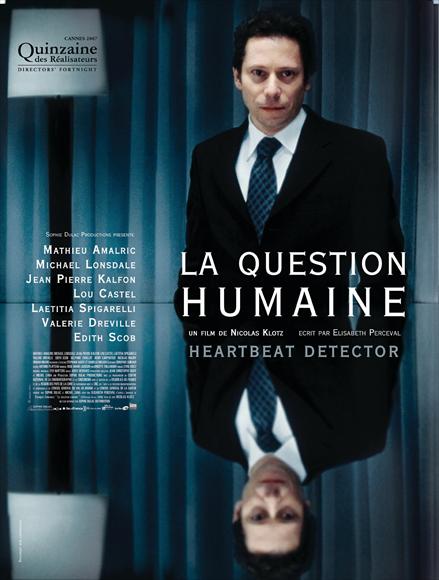
Heartbeat Detector. (2007) Nicolas Klotz
It begins with Simon Kessler, the human resources psychologist, who is asked to get to better know his company's alcoholic and despondent CEO, Mathias Jüst -- to monitor his behavior and report back to Karl Rose, the vice president. Simon gets the novel idea to begin an orchestral program that was attempted a few years back with the goal of getting Jüst involved on his violin playing with any blue or white collar worker willing to be involved.
The film plummets some ground that hit me personally pretty hard. There's a political back text that becomes front and center in the film's second half that anyone who reviews the film will talk about, that of European disillusion even sixty years after WWII, and how corporations and their employees still have to stare those days in the face and work in the midst of it. I found that aspect interesting, very much so, but it's not what got my heart pumping. What got to me was director Nicolas Klotz's ability to place all forms of music in the heart of the film, a music we very quickly learn that neither Jüst nor Simon can relate to. Because they can't relate to much of anything or anyone, really. It's amazing how much communication it takes to put the right pieces in place to run a company, and how you can create wealth like moving chess pieces on a business platform -- you can seemingly have it all and still be an unrelatable miserable grouch who has slipped through the cracks -- you've forgotten the importance of breaking through your own isolated humanity, that it is misery to be trapped and alone, and yet even those in business at the top of their game can fall into this horrible life pattern.
Jüst cannot gain even a simple pleasure from listening to music he created in the past. He says it physically pains him, and we see it bring him to the point of tears. As he slowly descends into a pit of isolation we see Simon trying to put the social program together for employees who don't really want to have a part of it. But it doesn't end at the workplace for Simon. Klotz gives us so many chances to peek into the life of the company psychologist who attends raves and drinks and dances the night away and has a girlfriend that could beautifully sing to him if only he'd stop and listen and quit trying to bed her instead. The music that permeates the film -- from classical to latin flavored to house and then simple soundtrack filler -- can be heard by any viewer as touching in some way. One of the film's secondary ideas, the one that got to me, was watching this character in the midst of it all, unable to join in the song of life because he is trapped in his own isolation. His heart won't thump to the vibrant sounds around him. It's sad that there can be such beauty around us every day, and many times we just let it go by, barely noticed, the art we can't connect with because we're so revved up in consuming it.
Then again, maybe I just liked that theme because I spent seventeen years in music that took me all over the globe, and I haven't touched an instrument in months.
The film is on our Top 100 at A&F, probably more for the political and spiritual text I mentioned, and there's been some great writing done on it already. We've been discussing the film Here (and some of us Here), and I highly recommend my friend Michael Leary's review Here, and my friend Darren Hughes's very visual review Here. It's always a joy to read any of these guys. When they get their thoughts down to words it is a stirring, emotive experience.
Thursday, April 7, 2011
The Searchers. (1956) John Ford
I had a poor reaction to this film but I've been talked into seeing that my reaction might have been steered that direction -- that perhaps the whole point of it is having that bad reaction. So, I guess, I can respect that, but it's not a fun experience. I've been told I'm not alone in that initial response, so perhaps I'll try it again in a few years. But about thirty minutes in, the dialogue and acting become so cliched that I'm simply assuming (for now) that I don't get it and this film is not to my tastes. That's not to say that tastes can't change over time. I think they do. But for now, my response to The Searchers is pretty much blechth.
The Peter Bogdanovich commentary on the DVD does help explain all the love. It's simply not a love I currently share.
Tuesday, April 5, 2011
Get Low. (2010) Aaron Schneider
Get Low, a reference to a person going six feet under, is built partially from an event in the 1930s where a backwoods codger planned his own living funeral, mythologized in Schneider's film to probe the meaning of being redeemed.
And what does it mean to be redeemed?
I use the term purely in the Christian sense, because the film so closely aligns itself with that worldview. Many films have plots and characters which draw on themes of "redemption". While misguided about redemption from the standpoint of southern faith, the crotchety old man played by Robert Duvall in Get Low is still looking, in the Christian sense, to be redeemed.
For forty years Felix Bush (Duvall) has hidden himself away in his cabin deep in the woods in Tennessee, a mysterious geezer-hermit with all kinds of legends that the locals just love to chew on. He's like the neighbor lady I saw as a kid who used the hose to water her driveway and gave away soup on Halloween. We were never quite sure what her story was, but man, could we make some up.
Stylin' on a stagecoach, Bush heads into town one day, shotgun in hand, to visit the fellows at the funeral home. He tells them (one of which is Bill Murray and his oh-so-30s moustache) that he wants to plan a funeral. His funeral. Right now, while he's still alive. He wants to invite all the townspeople to tell a few of the tales about him, live it up, party on, and celebrate his demise. He's putting his land in a lottery to be collected at the time of his death, the raffle winner being announced at the funeral.
After Mr. Bush gets a decent haircut and makes the announcement over the radio, the event turns into the talk of the town. In such a remote setting, it will surely be the event of the year. Maybe the event of a quite a few years.
But it is apparently more than a fun get-together for nutty old Mr. Bush. It seems he's got something he wants to talk about at the big show. Something deep and dark that he's buried in those woods, hidden away for the past forty years. Rumors around town are that he killed a man, maybe two or three. We meet Sissy Spacek as an old flame: "We had a go," he wryly tells the funeral guys. There's something about this relationship that is a mystery. The two come from a place where grunts and glances are as good as any words. The spaces between their words are filled with a background we can only guess at.
This is one of those stories where this is about that. We might be looking at the tall tale of a kooky backwoods flea scratcher, but the film is actually about preparing your heart for what's later by clearing your schedule and making amends now -- and if you can't make amends, at least setting some stories straight. The heart of Get Low is as good as anything in the story, and it's a reason I look forward to seeing it again very soon. (If I had seen it before the end of last year, it would have given me serious pause in trying to pick a Top Ten without it being somewhere on the list.)
Since I've borrowed the idea of this being about that from Rob Bell, I might as well go ahead and say that I just finished reading "Love Wins" (soon twice, and I'll most likely blog the book here soon), and that the timing on reading the book and seeing the film together is about as satisfying an arts experience as one can get. The two would make a great double billing. First read "Love Wins," and then see Get Low. Then ask yourself:
Did Mr. Bush repent to God? Has he atoned for his sins? Is repenting to your fellow man enough? Isn't it enough in some Christian circles? Are words really EVER enough? Is the action of the words in confession to a thousand townsfolk any better than the action of building a house of worship years ago? If someone somehow stumbles on truth and amazingly gets the actions right, coming from a pure and contrite heart, but doesn't actually get their words to the right source, has that person really made atonement for their sin? Did King David have a Jesus to repent to? Did Cain get to pray the "sinner's prayer"?
We have a character in Mr. Bush that's desperate to make peace in the world before he moves on to the next one, whatever that is. The question is more about having God's peace correct a long standing situation here and now then it is worrying about the fires of hell. Guilt has eaten away at the crotchety old man for forty years, and he needs to out this thing now, and not just for himself. It's a character doing the right human thing, the right, honorable Christian thing, while not necessarily in the confines of Christianity. That said, there seems to be an understanding that what he is doing, he is doing for peace, for reconciliation. He lives surrounded by God's beauty all the time. These backwoods types breathe God's air every day. He has watched the land around him every day for forty years and knows that the corrections he needs to make in the flesh have vast, earth shattering, heavenly implications.
This is a gorgeous film, with a wonderful, subdued soundtrack. Gosh, that bluegrass music lingering quietly in the background is fun. My grandpa was a bluegrass player in Mississippi. This stuff gets to me on a personal basis as a part of the family tree I've always enjoyed. I was a musician on the rock road for many years, but the roots of bluegrass must be where it all started for me. Somewhere inside this boy who loves the big cities and crowded night life is a backwoods red dirt finger-picker just longing for a banjo at heart.
Sunday, April 3, 2011
The Gospel According to St. Matthew. (1964)
Pier Paolo Pasolini
I'll preface my reaction to Pasolini's Gospel rendition by stating that I'm already a huge fan of this story, have been my whole life, which is probably obvious if know me or have read something here before. The Gospel is a story I'm willing to base my life on, but at times I feel it's a cosmic gamble of sorts -- one plus one rather seems to equal two, so in the grand scheme of things the Story makes the most sense. I don't deal well with the collective baggage of contemporary Christianity, but I like the Christ story. I hope that such a beautiful thing can also be the Truth (capital "T"), but I'm willing to follow this narrative understanding of the Universe as opposed to quite a few bullet- and power-point sermons blithely spoken across the land on many Sunday morning gatherings in the US.
I'm not always a fan of the Gospel story when it is portrayed in film. I can't say it's usually done well in this format. I am, however, a huge fan of at least three Jesus films which have really sunk themselves into the core of my understanding of life: The Miracle Maker, which I wrote about Here and is #26 on this year's Top 100, is the first one that comes to mind. Artistically created with stop-motion puppetry animation, it is that rare version of the Gospel that appeals to both young and old, a perfect introduction for children that's also suited to the tastes of appreciative adults.
I also have a tremendous amount of respect for The Passion of the Christ, Mel Gibson's bloody, raw, visceral and some say anti-Semitic rendering of Christ's final few hours (and a film I scooped years ago in putting up the first review on the net), and The Last Temptation of Christ, a fictional psychological retelling of the Gospel which got inside the head of Jesus to figure out how he managed mentally as God lodged in human flesh -- the struggle ingrained in a psyche that is fully man and yet fully God, Jehova wrapped in the skin of original sin.
These are the three that have stuck with me so far. Many more that I can't name come to mind as films that I'd rather not remember -- usually low budget features made by serious minded but artistically defunct evangelicals. My friend Matt, who is an expert in this field, would probably recommend quite a few solid films that I've never even heard of. He specializes in Jesus films and blogs about them Here. It is through his recommendation, and quite a few others at the A&F community that I finally took a chance on The Gospel According to St. Matthew.
This is not the family friendly introduction to Jesus in The Miracle Maker, nor is it the deeply probing psychological profile study of The Last Temptation of Christ. Neither is it anything as violent and visually gripping as The Passion of the Christ -- the grande finale of the crucifixion scene itself is rendered as bloodless in Pasolini's film. It is, however, a version that I think stands out from the rest. Quite a few unforgettable moments bring visuals to scenes that have lived in the heads of Christians for years. But the film has a slow, meditative, challenging nature to it, and it is old, which may present problems to contemporary viewers.
I'm no film scholar, so it would be hard for me to relate what the film meant to anyone who saw it in the mid-sixties, but viewing it now is in some moments like taking in a large scale art school project. Long, static scenes of silence with a roving camera in close-up travels from face to face in large gatherings of people. Shots like this are held for excruciating lengths of time, which can lead one into a sleepy mode of movie watching. I have several friends that love the film, who say they fell asleep the first time they tried to view it.
It's also shot in black and white, captured mostly outdoors, and at times feels like Ingmar Bergman got involved with the project, though this is a larger scale film than you'd find in Bergman's productions. But the Bergman mention is apt -- it gets at what I was trying to describe earlier when I mentioned art school.
None of this is to say it is a bad film. It isn't. It's an epic, sprawling, majestic piece of cinema. But let this serve as a warning for what you're getting into when you sit down with The Gospel According to St. Matthew. There are moments that will surely try any reasonable viewer's patience, combined with moments which shed a unique light on the story of Christ, perhaps not present or told like this in other Gospel films.
There are more than a few haunting moments: the visit from the Magi brings about Herod the Great's Massacre of the Innocents, depicted here as soldiers chasing down scores of women and children to spear and cut the heads off of their newborn or very young sons; Jesus on his knees praying and fasting in the desert and wrestling with the chaos of temptation over control of the world; John the Baptist baptising Jesus before being imprisoned and having his head laid out on a literal chopping block; and of course the Sermon on the Mount, which I believe this film is known for, laid out in a montage which takes place over several days and nights and locations -- suggesting the sermons were steadily repeated over time.
After the calling of his disciples, a grotesque figure approaches them, a leper asking Jesus for healing. Only words are spoken in this amazing, miraculous scene where the healing is shown as instantaneous, and it is perfect. It's stunning to be suddenly presented with a normal looking man after seeing him at first in his ugly deformed state. As would be the usual, Jesus asks him not to tell anyone, but the man, of course, immediately attracts a large, questioning and excited crowd.
Christ's Triumphal Entry into Jerusalem on the back of a lowly mule is another moment that absolutely mesmerizes. There must have been hundreds of extras. They're all waving palm branches as they should, and throwing down garments for the path of their approaching King. The expectation and the excitement is that Christ will soon be setting them free from a life under Roman rule. There is joyous fervor here, electricity fills the air. They are intoxicated at the thought of their oppressor finally "getting theirs", though many in the crowd will turn on Jesus in just a few days. The Triumphal Entry in this version leads Christ straight into the temple, where the greatest confrontation yet is going to take place.
This is the scene where Jesus is the liberator of the religiously oppressed, the spiritually abused. His roughback moment of turning over tables in the temple is a pivotal, highly charged moment. He doesn't stop and create a whip first -- rendered here, it is a rash, quick moment of righteous anger. He screams that the temple is made for worship, now being made into a den of thieves, and immediately all of the scribes and Pharisees see what he's done and the commoners rush into the house of worship. The children immediately exalt him, and it is perhaps here where we see his glowing smile in the film, a moment of the sheer satisfaction at what he's just done and the pleasure he gets from the mouths of children. They are waving their palm branches and shouting, "Hosanna to the Son of David!" It is clear in Pasolini's version -- and it seems to make a lot of sense when you think about it -- that this is the final blow in a conspiracy surrounding his approaching imminent death. The scribes and Pharisees can't believe their eyes at what he's just done on their turf. Their plot to have him dead and gone is ratcheted up another notch. Things will not be the same from this point forward.
The Jesus of Pasolini's film is serious, solemn. Aside from the satisfaction with the children in the temple, he really doesn't smile very much. This Jesus isn't the hippie rocker messiah of Jesus Christ, Superstar. He doesn't smile at his own parables or laugh when he teaches, as he did in other filmed versions of the story. He doesn't seem amused with himself or his stories at all. This is a Jesus who clearly understands the solemn nature of his messianic mission. He knows his role in the world, he knows the sacrifice he is here to make. He knows the political forces he is in conflict with and can see to the core of their religious hypocrisy. He calls them out on it in quite a few searing scenes where he preaches outside their walls and windows, blasting them as vipers ensconced in the allure of religious power and wealth. (As an aside, the Jesus of Pasolini's film, actor Enrique Irazoqui, did stop in for a few brief appearances on the A&F forum beginning Here.)
The crucifixion, as I've said, is bloodless, but the power of Christ even from the cross is onscreen. As Jesus screams in agony that God has forsaken him, an earthquake rockets through the city, pummeling several buildings along the way. We don't see the temple vale torn in two, but can surmise that it happened in this moment. And of course, there's a resurrection (and an assumed ascension), unique to a film created by a Marxist-atheist, showing that Pasolini really was interested in the story itself, and the movement that ensued and changed the world.
One of the other things I find interesting is that if Pasolini was an atheist who read the four Canonical gospels and suddenly found himself interested in the Jesus story, why does he include the prophesies that authenticate it as Reality? The wise men from the east telling Herod that the baby will be born in Bethlehem; a narrator that points out the prophesy "Out of Egypt I have called my Son"; Jesus in many moments showing the parallels between the words of Old Testament prophets and the actions surrounding his life. Prophesy and its fulfilment is loaded into the film, illustrating the director's poetic sensibilities in front of his Marxist-atheist worldview. I wonder if the Story had any greater impact on him, or any of the other actors or workers involved, than simply the making of a great Italian art epic.
Overall, the film is solid, perhaps a masterpiece in its day, but too artsy and neo-realist for today's average movie goer. The kid that loves Scott Pilgrim vs. The World (these poor gamer teens just don't know any better) will find the film dry, tedious, old and "boring." I can't say the same. The further I got into it, the deeper and richer the film became for me, to where at the end I could only admit that it is a "classic." But as far as the Jesus story goes for contemporary audiences, I'd still list the other films I mentioned before this.
Thursday, March 31, 2011
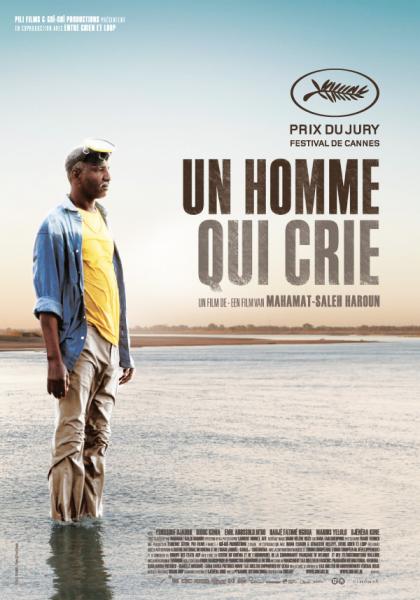
A Screaming Man. (2010) Mahamat-Saleh Haroun
Often when I choose to see a foreign film it's simply out of a curiosity to peek into another culture. Other times I'm looking for global ideas in storytelling, the kind of ideas that stray from the control of western culture. A Screaming Man caters to both of these needs, packing a realist family drama in an artistically shot film, capturing Chad and its land and culture in an absorbing film.
The simple story almost feels like an Old Testament tale, like Abraham, Moses or Joseph -- stories which can be told in a few quick chapters but have been expounded on for generations.
Adam, a former champion swimmer now referred to as "Champ," now pushing sixty, works as a pool attendant at a N'Djamena hotel. He and his son Abdel share the responsibility of the place each day. They go home to mom Mariam at night, who feeds them well and looks after the family's emotional well being. The country is in the throes of a civil war and the military has begun asking families to volunteer -- which in Adam's case would mean signing up his son -- or contribute money to crush the rising rebellion. It is assumed that every family will at some point contribute something. Adam doesn't have any money that he can give.
When new owners take over the hotel and Adam's friend, a long-time chef is let go, change is obviously in the works. Adam is told that the job of pool attendant should be done by one person, there's no need for both him and his son. He's informed that Abdel will be permanently taking over the job, and that he will now being wearing a uniform outside the hotel as the gatekeeper. He goes into a deep, dark depression. The pool has been his life. He sits at the gate opening and closing it for cars that come and honk at him, pulling him out of a zoned state. He is crushed.
In the moment of crisis Adam makes a decision regarding the fate of his son that will ensure he'll be back in his old position. It's not too long before he regrets what he's done, but it is too late. He asks his friend David, the ex-chef, whether he believes in God. Some transgressions might be rectified in the next life but can't be taken care of in this one. Sometimes a lapse in judgment cannot be recovered. This is a film about a decent man who has lived moral life, wrecked by one wrong move. It's about the guilt and consequences of dealing with that one mistake you can never get over.
It is also a film with a very strong crescendo. It might seem like it's very simple when it begins. It seems like it's only got a few tricks left at the half-way point. But the final frames of the story are pointed, as we observe Adam only trying to recover and put the pieces back in place. To compare the opening scene of Adam and Abdel hugging and frolicking in the pool with the final scenes of devastating consequence is a reminder that life can turn on us fast, that we need to guard every choice as fragile and choose wisely in every decision.
Sunday, March 27, 2011
The Colors of the Mountain. (2011)
Carlos César Arbeláez
This strong debut from director Carlos César Arbeláez hasn't been released yet in its home country, Colombia. It is only beginning to crawl around the festival circuit; Film Movement scooped it up rather quickly. I'm glad they did, I hope they're able to put it in as many US theaters as they can. A war story where war is off-screen, the film centers on childhood innocence, capturing breathtaking mountainside cinematography that would be scrumptiously suited to the big screen.In remote Colombian villages, families of farmers who peacefully tend the land are forced to choose between military forces and the guerrilla rebels endlessly fighting outside their homes. Manuel, pushing his eighth birthday, has witnessed horrors no kid should be subjected to, the worst being psychological -- a constant fear that dad will soon be carted away to the fight. While milking a cow or working the land, if dad sees the approaching rebels, he hides, and mom tells the group he's gone for the day in town. The rebels tell her to make sure he gets to an upcoming meeting. He never makes it to a meeting in town.
Manuel has his own obsession -- soccer -- and he gets together with other school-skipping kids for constant play. The kids have designed a sort of league, Manuel thinking his team can take on anyone around the village. When his parents celebrate his eighth birthday, Manuel gets a gorgeous professional looking soccer ball in place of the slosh ball they've been kicking around. The kids on his team are amazed and can't wait to give it a whirl. Trekking off for a jaunt of sport, they note the guerrillas already camped in the mountainside location where they play. They decide it might be best to wait until later.
The villages are trying to prosper and live normally, keeping order and hope for all the families. Though the last school teacher was chased off by the rebels, a new hire is excited about the possibility of educating these kids. She settles into her living quarters in the school, lining up all the kids to meet them, first through fifth grade. She puts up with political graffiti on the side of her school and the fact that when she's not around, the building is used for rebel meetings. In her youthful zeal she has no idea she's walking into a hopeless situation.
When a neighbor loses grip on a cow running through the soccer field, all will know in no uncertain terms that this field has been recently mined. Years ago, the military used the place strategically and the rebels need to make sure they cannot land a chopper or walk here again. In a turn of events, the new soccer ball will sit there at the end of the field under a large tree, with the children unable to pick it up for fear of being blown to bits. It sits there for days as they make plans on how to get it. It becomes an obsession, the need to get that ball that glares at them from the end of the field.
Being kids, having that more reckless mentality of a child's mind, they will no doubt attempt to get it. There are several intense, gruelling scenes of Manuel and his friends hanging from the tree, navigating the minefield in order to grasp that childhood object of desire. At one point Manuel's albino friend loses his much needed glasses trying to grab the ball. It's awful to think of him facing his parents -- the loss of glasses being a secondary crime to him being in the minefield in the first place.
The soccer ball and a view of life through Manuel's eyes are center at the heart of this story. In many ways, the film is reminiscent of Majid Majidi's Children of Heaven, though in the Iranian masterpiece the brother's search, that thing in jeopardy, was his sister's shoes. The Colors of the Mountain doesn't get the chance to be as tender as a Majidi film though, because there are always rebels on the land, explosions in the distance, helicopters overhead -- the interruption of normal life by an encroaching war that will not go away. This is a hard, stern look at the life of war-torn children who can no longer grasp at even the simplest of life's pleasures.
Saturday, March 26, 2011
Two Missed Cocos.
I missed both of these rom-fem biopics in the theater setting. Released almost exactly a year apart, I remember that I wanted to see them but couldn't fix my schedule to get to either one.
Coco Before Chanel, which made its theatrical run two years ago, is about Coco Chanel's life from maybe her late teens into her early thirties. It is an excellent setup for the second film, Coco Chanel & Igor Stravinsky, a film which had its theatrical run last summer, about a later more ordered time in Chanel's life.
I recently caught the DVDs within a few days of each other, and found that seeing them chronologically -- which applies to the release dates as well as the timeline of Chanel's life -- is best. The second film is far more compelling artistically, strengthening my theory about watching the two in this way: they build from a somewhat average but entertaining first film to an incredible climax in the wonderfully rendered latter film, the two time periods of Chanel's life bleeding together like you're taking in a four-hour film or a mini-series.
This is going to be short and sweet, but I wanted to put the experience down now so I can fondly look back on it later. Here are just a few paragraphs on each:
Here we have Audrey Tautou (whom I adore) as the ambitious Coco Chanel, beginning in a run down orphanage as a forgotten little girl and quickly making a living as a music hall chanteuse. She's in business with her sister -- the two have several numbers they've put together -- but we immediately see that it's all about survival. The gigs are less about the singing and more about a demeaning and sexist meat market. Approached by men constantly, Coco points to the whores on the other side of the bar. She's in survival mode but she's not going to stoop to that level. The irony being that later, when she ends up a rich mistress, it isn't very different from a whore's existence except for a lavish lifestyle living with a single wealthy john.
As a mistress Coco gets to live in a mansion, though she's initially tucked away in a room upstairs to avoid any visiting socialites. Too empowered to be hidden for long, she meets the wealthiest in a burgeoning capitalist culture making hats for rich women and working on their outfits for social gatherings. This is how her talent fully emerges; she goes from being a commodity to filling consumerist desires. It's the beginning of a fashion empire originally launched from a room shamefully hidden away in the house of one who would buy her affections. The man, who lacks generosity and compassion, she grows to detest and later pity. She leaves him for her first real love, Boy, who is smitten by her unbroken nature and overpowering gaze.
She's a character a viewer can begin to hope for, and root for. She will find love, but then she'll quietly obsess over it, lose it, and make a move toward business where she'll trade in any emotional hopes for thriving financially. Her change sets us up for the second film where she is colder, calloused, totally financially independent, and able to exploit whoever or whatever she wants.
This is a good if not great film that has a few moments of emotional tug. When you see what Chanel went through for the nature of survival, it's sometimes a bit sad to watch. Tautou retains her typical ability of lifting the material to meet her acting abilities, but I'd recommend Coco Before Chanel only if you're planning to see both films.
Coco Before Chanel, which made its theatrical run two years ago, is about Coco Chanel's life from maybe her late teens into her early thirties. It is an excellent setup for the second film, Coco Chanel & Igor Stravinsky, a film which had its theatrical run last summer, about a later more ordered time in Chanel's life.
I recently caught the DVDs within a few days of each other, and found that seeing them chronologically -- which applies to the release dates as well as the timeline of Chanel's life -- is best. The second film is far more compelling artistically, strengthening my theory about watching the two in this way: they build from a somewhat average but entertaining first film to an incredible climax in the wonderfully rendered latter film, the two time periods of Chanel's life bleeding together like you're taking in a four-hour film or a mini-series.
This is going to be short and sweet, but I wanted to put the experience down now so I can fondly look back on it later. Here are just a few paragraphs on each:
Coco Before Chanel. (2009) Anne Fontaine
Here we have Audrey Tautou (whom I adore) as the ambitious Coco Chanel, beginning in a run down orphanage as a forgotten little girl and quickly making a living as a music hall chanteuse. She's in business with her sister -- the two have several numbers they've put together -- but we immediately see that it's all about survival. The gigs are less about the singing and more about a demeaning and sexist meat market. Approached by men constantly, Coco points to the whores on the other side of the bar. She's in survival mode but she's not going to stoop to that level. The irony being that later, when she ends up a rich mistress, it isn't very different from a whore's existence except for a lavish lifestyle living with a single wealthy john.
As a mistress Coco gets to live in a mansion, though she's initially tucked away in a room upstairs to avoid any visiting socialites. Too empowered to be hidden for long, she meets the wealthiest in a burgeoning capitalist culture making hats for rich women and working on their outfits for social gatherings. This is how her talent fully emerges; she goes from being a commodity to filling consumerist desires. It's the beginning of a fashion empire originally launched from a room shamefully hidden away in the house of one who would buy her affections. The man, who lacks generosity and compassion, she grows to detest and later pity. She leaves him for her first real love, Boy, who is smitten by her unbroken nature and overpowering gaze.
She's a character a viewer can begin to hope for, and root for. She will find love, but then she'll quietly obsess over it, lose it, and make a move toward business where she'll trade in any emotional hopes for thriving financially. Her change sets us up for the second film where she is colder, calloused, totally financially independent, and able to exploit whoever or whatever she wants.
This is a good if not great film that has a few moments of emotional tug. When you see what Chanel went through for the nature of survival, it's sometimes a bit sad to watch. Tautou retains her typical ability of lifting the material to meet her acting abilities, but I'd recommend Coco Before Chanel only if you're planning to see both films.
Coco Chanel & Igor Stravinsky. (2010) Jan Kounen
There are a couple of reasons I really fell in love with this film, which in moments is a stylistic rush, at other times downright sexy.
In the first twenty minutes a life-long historical bewilderment I've had is relayed with incredible force. It's an orchestral concert, with Chanel in the audience. The date is May 29, 1913. If you're a classical music aficionado you recognize this as the date of the riots over the premier of "The Rite of Spring," at Théâtre des Champs-Élysées in Paris.
Stravinski's music drew unsuspecting listeners into a fury. They simply weren't ready for the atonality of this art. Chanel, cutting edge in the fashion industry and now a sophisticated urban bourgeoise, immediately finds in Stravinski's music a force to connect with. Here are two people ahead of their time, mindful of the arts and driven by their creative passion. Only their egos are bigger than their passion, and no moral or marriage will keep them apart.
Coco Chanel & Igor Stravinsky turns into a smoldering story of raw unemotional sexuality, unhinging the erotic nature of these otherwise restrained characters (think: Henry and June or The Lover). Anna Mouglalis is a completely different Coco than Audrey Tautou -- rightfully so, since it's a person at a different stage in her life. (Don't most of us completely change every ten or fifteen years?) Whatever she once was, whatever she is now, captured in this film is an onscreen siren, one which any man would simultaneously fear, obsess over and ache for. I haven't seen a spitfire woman so smoking red-hot since Giovanna Mezzogiorno in the first half of Vincere.
The film is a visual delight filled with greater splashes of nuance than Coco Before Chanel. It captures Chanel's household, where the two end up living -- along with Stravinsky's wife and children -- with visual passion and a tension that matches the affair. Coco's cool and collected nature is coldly amazing, but from the first film we've seen all the roughened stages setting this callousness in place; she builds an empire on the concepts of female empowerment and beauty but closes herself behind walls of accumulated power, commodities, and isolation.
In the first twenty minutes a life-long historical bewilderment I've had is relayed with incredible force. It's an orchestral concert, with Chanel in the audience. The date is May 29, 1913. If you're a classical music aficionado you recognize this as the date of the riots over the premier of "The Rite of Spring," at Théâtre des Champs-Élysées in Paris.
Stravinski's music drew unsuspecting listeners into a fury. They simply weren't ready for the atonality of this art. Chanel, cutting edge in the fashion industry and now a sophisticated urban bourgeoise, immediately finds in Stravinski's music a force to connect with. Here are two people ahead of their time, mindful of the arts and driven by their creative passion. Only their egos are bigger than their passion, and no moral or marriage will keep them apart.
Coco Chanel & Igor Stravinsky turns into a smoldering story of raw unemotional sexuality, unhinging the erotic nature of these otherwise restrained characters (think: Henry and June or The Lover). Anna Mouglalis is a completely different Coco than Audrey Tautou -- rightfully so, since it's a person at a different stage in her life. (Don't most of us completely change every ten or fifteen years?) Whatever she once was, whatever she is now, captured in this film is an onscreen siren, one which any man would simultaneously fear, obsess over and ache for. I haven't seen a spitfire woman so smoking red-hot since Giovanna Mezzogiorno in the first half of Vincere.
The film is a visual delight filled with greater splashes of nuance than Coco Before Chanel. It captures Chanel's household, where the two end up living -- along with Stravinsky's wife and children -- with visual passion and a tension that matches the affair. Coco's cool and collected nature is coldly amazing, but from the first film we've seen all the roughened stages setting this callousness in place; she builds an empire on the concepts of female empowerment and beauty but closes herself behind walls of accumulated power, commodities, and isolation.
Wednesday, March 23, 2011
Devil. (2010) John Erick Dowdle
Bojana Novakovic dragged to hell... again.
I know I said the intended use of the rest of March would be set aside for catching up with a few foreign films I hadn't gotten around to, but this little horror/thriller morality tale completely took me by surprise. I popped it in tonight looking only for a quick fix, a bit of lighter fare, but, wow, wish I'd seen this one in the theater. Great little film ripped straight out of I Peter 5:8. M. Night is responsible for the story -- what, has this guy been digging into the Good Book lately? He'd better keep it up. It's certainly better stuff than his last two films.
I put up a speed of a bullet post with possible light spoilers at A&F; if you want to check out a "Reaction on the Fly," it is Here.
EUFF Wrap. (2011)
I was once again grateful to get to so many new films from Europe this year. The fest, made of people who are typically used to members being local, was quite accomodating in helping me obtain tickets over the phone when Ticketmaster couldn't figure out how to make it work for a non-local. The people at the Siskel have always been good to me, and it's nice to feel that kind of warmth from the classiest place to see a film in the Chicago area.
I do feel like I hit a few of the wrong films this year; my Reactions here at Filmsweep were sometimes a mere "Blah," and in other places serious contempt (especially toward the two Swedish films, which as a big fan of the country's films I admit I react against harder). But if it weren't for EUFF, I wouldn't have seen Amer and Letters to Father Jacob on the big screen, where they were both riveting in their own ways and larger than life. I also scooped Korkoro and Trust Me, turning in the first English language write-ups available on the web.
I missed two films I had tickets for: a documentary on the French New Wave called Two In the Wave, which just became available on Netflix, and Danish film Applause, starring Paprika Steen as an actor coming out of rehab -- a film which Ebert loved, and one that I was sad to have had to pass up. But you can't hit 'em all, and that is a film that won't escape a future DVD release.
Thanks again to the Siskel Film Center (great pic of their location above). They'll be launching their Asian showcase in April. Meantime, I hope to fill out the month catching recently released foreigns, which of course I'll shout out about here at the blog.
Tuesday, March 22, 2011
Letters to Father Jacob. (2009) Klaus Härö
This is a moving little Finnish film, wonderfully made, that reminds me a bit of Babette's Feast, or perhaps the recent Lourdes.
It's about Leila, a woman who has spent twelve years locked away behind bars. She's suddenly pardoned and due to be released and she can't quite figure out why. She argues with the warden that she's supposed to be a "lifer," that she shouldn't be going anywhere, that she was destined to live out her days in jail. She doesn't have anywhere to go anyway, except the one place the warden suggests: she should live with an elderly retired priest named Father Jacob in a remote parsonage in the Finnish countryside. There she will care for his needs and live a life of quiet in the old home.
When she arrives she is clear about what she will or won't do. "I don't do windows," is one of her first phrases to Jacob. She's surprised that Father Jacob is blind, and so old, and that the only thing he wants, the only job he actually desires from her is to read the letters he receives on a daily basis in the mail and dictate as he gently responds.
The letters are from parishioners Jacob has known throughout the course of his ministry. They are petitions for prayer from those who struggle with all kinds of things -- drunken spouses, sick children, depression, and more. They are sent because folks know Jacob is an honorable man; they know he will intercede on their behalf, and if their story is relayed, they know the holy man's words will reach God's heart.
Leila, agnostic but perhaps thinking herself an atheist, humors Jacob and reads the letters. The notes, she believes, can't be better than religious hope -- there's no God to answer Jacob's prayers. But in small moments she is touched by his relentless compassion. He answers every letter he receives and petitions God for help on a daily basis. She sees his dedication even if she thinks it's all for naught.
A third character, the mailman, arrives on bicycle with the letters. Leila waits outside for him every day, gathering the envelopes and sometimes throwing a few out. You might think this is where the love story is going to take place, Leila and the mailman, the mailman and Leila. But Letters to Father Jacob isn't a film about earthly love. He's scared of her. He knows she's an ex-con and immediately puts up walls, avoiding her at all costs, bicycling away from the parsonage when he sees her waiting for him out front. He even goes so far as to stop bringing the mail. When she catches him in a criminal act and nearly beats the fuzz out of him (Leila is no small woman), things in their relationship go from strained to total avoidance.
But Leila is of a hardened type that is well adjusted to these kinds of relationships. She's probably created them a few times before. Constantly unimpressed, sometimes brash and too much to the point, she doesn't joke, barely laughs, and puts up with others rather than enjoying them. Perhaps she has not enjoyed any day with or without anyone else for a long, long time. She's had time to think about her crime during those twelve years incarcerated, and the thinking and constant guilt have eaten away at her soul. She functions in her day to day routines, but any joy of living was sucked out of her a long time ago.
Kaarina Hazard as Leila was nominated for a Jussi, the Finnish equivalent of the Oscar, and she is perfect in this unglamorous role. Heikki Nousiainen as Father Jacob won the Jussi for the Best Actor award. The two together, the caring and compassionate old preacher and the uncaring and dispassionate ex-con, end up digging thoroughly into each other's backgrounds and psyches, and each are going to learn something valuable about their own self as well as the other.
A miracle or two will take place before the end of the film, but we can't be certain how much it changes Leila's outlook on life. This might be more like real life than any miraculous event that suddenly changes everything about her. We all see miracles all the time, but most will go unnoticed.
With its deep, lovely visuals of the interiors and exteriors of the abandoned church they live by, this is one of those quiet films of subtle nuance that you really want to see on the big screen. But unless you live near a big city you probably won't get that chance. That's a sad fact, but as luck would have it the DVD was just released earlier this month, and the film is available through Netflix. One way or another, I highly encourage you to track it down.
My friend Nathan from Cinema Truth wrote an excellent review that sheds light on the film's Bressonian qualities. It is posted on my buddy Jeffrey Overstreet's site, Looking Closer. I highly encourage you to delve more into Letters to Father Jacob -- that enlightening review is posted Here.
Monday, March 21, 2011
Trust Me. (2010) Johan Kling
This is the second seriously awful Swedish film I saw at this year's EUFF -- two out of two for me, which is highly disappointing since Sweden remains the country I've traveled to most outside of America, a country known for some stellar filmmaking. (Bergman, anyone?)
Older filmmaking aside, Sweden's output in recent years has throttled me. Even in the last decade it has become the country I've most looked forward to for masterpiece films that relay wonderfully human stories: Lukas Moodysson (Together, Lilya 4-Ever), Roy Andersson (Songs From the Second Floor), Mikael Håfström (Evil), Tomas Alfredson (Four Shades of Brown, Let the Right One In), and lately Daniel Alfredson and Niels Arden Oplev (The Millennium Trilogy, now being created for US audiences by David Fincher). These are all accomplished directors with great films that, if you still haven't seen, I encourage you to track down the DVDs.
It's just too bad that the two I've seen this year don't live up to any of the films listed above, the largest problem being that nothing happens in these films! Behind Blue Skies, which I railed against Here, is still a step above Trust Me, a film I like the original title for much better. ("Puss" would directly translate as "Kiss." Don't know why that needed to be changed. Actually neither one of the titles makes much sense in the context of a film that barely has a kiss or a lack of trust. Yet I digress.)
The movie reminded me of TV's "Glee." OK, fine, I'm no fan of the wretched boob tube and I've never seen an episode of "Glee," but I've seen its horribly artificial, vacuous and trite commercials, and that whole mess still seems better than the bulk of Trust Me, which has no comedy, no intensity -- no real mood for that matter -- but is a monotony of nothingness which isn't Jarmuschian and intending to be a "cool kind of nothingness," but really wanting to be something. And it isn't.
To give details about the plot would almost pretend that this is a script that actually exists. I prefer to think that the script is pretend and the whole film experience never happened.
But, alas --
It's about a youthful theater group in which most of the actors, for reasons unexplained, don't want to be there, and the building's landlord, for even more unexplained reasons, no longer wants the group on the premises. He's trying to figure out a way to evict them, and of course he will or the story won't be able to progress, and of course it won't work or the story won't get to a happy ending.
The stiff-necked actors and the people that work around the theater are, of course, all in love with someone who is in love with someone else, and the director, of course, can't quite bring things up to speed to get the next play ready for opening night. She's the only one who cares about the production, and even she is unhinged when learning of her fiance's affair with a member in the cast who is, yep, you guessed it, with child. His.
There's a stage gun that will no doubt get used, various pictures taken that will no doubt be revealed, and a mysterious hole in the wall where people watch people take off their clothes. There's also a bum who lives on the premises, unknown to all, and he stinks and the stink is often misunderstood as, well, something else that stinks that I guess is supposed to be funny.
And then there's the fat girl. Unappreciated, unloved, the film gets her drunk and laid backstage, and for one glorious moment you think things in her unnoticed life might begin to turn around. Sadly, they don't. The film seems to hate her, and it reminds me that I never saw a fat girl in all my years in Sweden.
The actors in Trust Me can't bring life to this lifeless script. How would they be able to? There might be some fine actors here, but they've got nothing to work with in such a sap headed story that can't make up its mind whether it wants to be a comedy or a drama, and seriously fails at both.
As if legitimizing Trust Me, some in the EUFF crowd attempted to break into a half-hearted applause at the end, at which I cleared my throat quite loudly, even unexpectedly to myself, and realized that the world is starving for something that matters. If it's Trust Me that fills that hole, we're in greater danger than I thought. We're like the humans strung up in The Matrix and the machines have taken over. Hopefully the machines are kind enough to send "Glee" reruns to our decaying brain cells while we lie there like zombies not even existing.
Sunday, March 20, 2011
The Temptation of St. Tony. (2009) Veiko Õunpuu
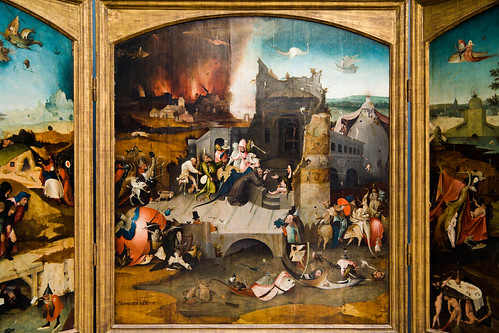
Like an art school project that got too deep for its own good, created in black and white flourishes and wearing its baffling abstract influences on its sleeve (Tarr, Lynch), The Temptation of St. Tony was described by EUFF as, "A Euro-modern riff on Bosch’s painting, The Temptation of St. Anthony."
Here is an image of the triptych, widely regarded as a powerful work about a tormented soul urged to participate in sin. However, if you've seen the film, the painting itself might produce a sort of shrugging of the shoulders. Nevertheless:
I don't know if I got all that out of the screening I attended, but this seriously strange film is at least as busy as the painting with a cast of odd, indecipherable characters who each bring a temptation or two to central frizzy-haired Henry Spencer-like character, Tony.
There are moments early on when the film is darkly humorous, and rather enjoyably so. It seems like this is going to be a trippy, fun ride. A worn-out looking Tony, leading a funeral procession for his deceased dad with a small band ensemble (big bass drum, out of tune horns) takes mourners on a dirge through an Estonian countryside only to witness one of the strangest car wrecks you'll ever see, a solo accident crashing the car straight into the Baltic, apparently causing another death. The procession obviously notices, stops for a gaper's delay, shrugs the event off, and continues in their mournful march. It's a laughable moment of irony and inhumanity, perfectly setting the tone for all the events Tony's about to be thrust into.
Continuing in a mode of black comedy, a few minutes later at a business dinner the cast is approached by a bum who stares in through the window at either the elegant meal, or the people at the table, or perhaps their wine bottle which he wants. They are all put off, grossed out by the transient and not knowing how to handle the situation. Tony picks up the bottle, walks outside, gives it to the man, who empties it of its contents and saves it with a bag of recyclables he's been carrying all along. Scenes like this provoke ironic laughs, but they rarely show up again as the film envelops us in its non-linear redundancy.
Tony himself is a good-natured fellow, constantly thrown into artificial situations that no one would know how to handle. The fact that some of the situations make no sense, in a film that makes very little sense, actually brings film viewers out of the experience itself and into the realization that we are watching a movie, and at points just waiting for it to end.
The film divides itself into six parts, represented by Roman numerals, small black letters against a large white backdrop. It continues to follow the considerate Tony, who seems to live in two alternate universes, one with his wife and daughter and the other with a girlfriend he's left the family to be with. In one of the more interesting scenes which probably lasts about twenty minutes and could be turned into an outstanding short film, Tony is silently followed in a dream-like state, camera behind him ala the Dardennes, and he ends up in a cabaret nightclub called the Golden Age where all of the most perfect Lynchian elements come to life. These elements are already suited for the strange and surreal nighttime club experience anyway (think: Betty and Rita at the Club Silencio performance in Mulholland Drive, or anyone in Twin Peaks who had a dream experience with The Red Room of the Black Lodge). The scene extends itself into a cannibalistic nightmare, suggesting man's ability to trounce on another (for any number of reasons), the whole thing witnessed through the eyes of a now shocked Tony. It is seriously an excellent scene, and is easily the scene in the film that puts director Õunpuu on the global map.
I don't want to oversell this film though. It is tedious to sit through, a nightmare in its own right. Of interest in the theater were the loud yawns coming from a young female viewer behind me who obviously wanted everyone at the Siskel to know how thoroughly bored she was with the whole thing (and I honestly can't say that I blame her), countered by the protests coming from an older woman in front of me who was upset about the rude yawning behind us. (Can't say that I blame her, either.) I probably agree more with the woman sitting in back of me than the frustrated lady in front.
But Õunpuu has created something worth discussion here, I'm just not sure I know the crowd that would be interested in discussing it. When I was a kid, a group of film nerds and I loved digging into Eraserhead, constantly fidgeting with the material in attempt to solve the riddle of its mystery. They were always fun discussions, often leading to red faces, heated arguments. I'm not certain that type of discussion could be attempted with St. Tony, because I'm not sure there are any real life parallels you can drag out from all these enigmatic visuals. There are a few moments, though, where the visuals are wildly fun, confrontational and chaotic in a certain sense -- but you wade through much filler to find the golden nuggets.
This was the official Estonian submission for Academy Awards consideration but it didn't make the shortlist for final nomination. Compared to a film like Dogtooth, which can be seen from so many different perspectives, I can see why St. Tony didn't make the cut. While unique and absurd, it is overly long and at times quite forced, and other perspectives will be hard to come by because really any one perspective might be difficult. I will, however, keep my eyes peeled for any future film by Õunpuu, who has an obvious talent for visuals but might need to corral that wild narrative, at least enough to give the audience an idea of what's going on.
Wednesday, March 16, 2011
Fear Me Not. (2008) Kristian Levring
Just a few sentences on a solid DVD I caught between EUFF screenings.
I've been a fan of director Kristian Levring since his knockout desert survivalist film, The King is Alive (Dogme film #3), where passengers on a broken down tour bus present "King Lear" in the sands of a wasteland terrene -- and his Conrad "Heart of Darkness" allusion, The Intended, a trip of a film which I was lucky enough to see on the big screen years ago. (Thanks, Facets!)
I've also loved Ulrich Thomsen in practically everything I've seen him in: Festen (Also known as The Celebration, which was dogme film #1 and a perfect launch to the movement); Per Fly's The Inheritance, another near masterpiece; the original Brothers, long before Tobey Maguire and Natalie Portman even heard of it; and a small unknown film called Adam's Apples, which is a great reference for Fear Me Not. These are just a few of the films I've loved him in, and they're probably the easiest to track down. Seriously, I don't think I've seen Thomsen in a stinker.
I've also often bragged about Paprika Steen (no stranger to the dogme movement, as seen Here), whom I have a date with this weekend (the Danish film Applause -- thanks, EUFF!).
It would seem that the combination of many of my favorite artists teaming up for Fear Me Not would create a film perfectly suited to my tastes.
After seeing it, that assumption about sums it up.
It's an excellent film, though perhaps not perfect. Levring actually held back where I wished for greater tension, something he's certainly not had a problem with in the past. However, the story itself is quite intriguing and applicable today to many floating around in the haze of modern "medicine."
Thomsen plays modern day business man, Mikael, who is sliding backwards on the social scale; a mid-life crisis, perhaps, or a breakdown. He might be dealing with depression, not wanting to admit it, or perhaps he's just feeling more aloof, disconnected from the real world when all he does is work, work, work. He's like the guy from Ecclesiastes with two hands full that needs a third hand to grasp for more.
We catch him at the beginning of a leave of absence from work. His wife, Sigrid (Steen), seems a little worried about his lack of desire to go back. His brother-in-law mentions a clinical trial for a new pill of some sort, an anti-depressant, and without hesitation Mikael signs up for the deal. The rest of the story follows how this drug makes Mikael feel stronger at first, but then brings hallucinations that he often drags into reality, hallucinations that get him into trouble.
For instance, sitting at the doctor's office awaiting an appointment regarding the use of the new med, he believes other patients are getting into a ruckus of sorts, and as he leaps into the fray and punches out a man it's revealed that the ruckus never happened, but his blow to the man's face did. He just punched out an innocent man in the doctor's office. Perhaps that's a reason to discontinue the drug.
The trial is cut short due to some other patient reactions, and Mikael, with a four month supply, tells his brother-in-law he has thrown all the meds in the garbage. Which at one point he even does. Too bad, that like a dog back to his own vomit, he heads out to the garbage truck and picks through the trash to get his pills.
At some point it's no longer hallucinations that are putting Mikael over the edge. We actually see his personality change. And to his own detriment he begins chronicling these changes in a journal on his laptop. He becomes abusive to people in and outside of the family, he becomes evasive to people's concerns and outright confrontational when challenged. He hurts several people with terrible schemes hatched out of his head, and we're curious to know why he can't see how horribly the drug has made him.
There is a reveal in Fear Me Not about twenty minutes toward the end of the film that is mind boggling. It at once reverses everything we've understood to this point, and feels like an entire reboot of the film. From that point on, anything can happen, which is a shot of adrenaline at just the right moment.
For fans of this director or these actors or for fans of Scandinavian cinema in general, it is definitely a film worth tracking down. For those who haven't made inroads into Danish cinema quite yet, I might still recommend something like Festen first. But this is one more film from a part of the world that seems to explode with very great, very real and human stories. It's a film that addresses the situation of successful men today as well as how some make it in this world, enhancing themselves, but sometimes the enhancement is destabilizing.
Ulrich Thomsen has nothing to fear except for... fearing himself.
I've been a fan of director Kristian Levring since his knockout desert survivalist film, The King is Alive (Dogme film #3), where passengers on a broken down tour bus present "King Lear" in the sands of a wasteland terrene -- and his Conrad "Heart of Darkness" allusion, The Intended, a trip of a film which I was lucky enough to see on the big screen years ago. (Thanks, Facets!)
I've also loved Ulrich Thomsen in practically everything I've seen him in: Festen (Also known as The Celebration, which was dogme film #1 and a perfect launch to the movement); Per Fly's The Inheritance, another near masterpiece; the original Brothers, long before Tobey Maguire and Natalie Portman even heard of it; and a small unknown film called Adam's Apples, which is a great reference for Fear Me Not. These are just a few of the films I've loved him in, and they're probably the easiest to track down. Seriously, I don't think I've seen Thomsen in a stinker.
I've also often bragged about Paprika Steen (no stranger to the dogme movement, as seen Here), whom I have a date with this weekend (the Danish film Applause -- thanks, EUFF!).
It would seem that the combination of many of my favorite artists teaming up for Fear Me Not would create a film perfectly suited to my tastes.
After seeing it, that assumption about sums it up.
It's an excellent film, though perhaps not perfect. Levring actually held back where I wished for greater tension, something he's certainly not had a problem with in the past. However, the story itself is quite intriguing and applicable today to many floating around in the haze of modern "medicine."
Thomsen plays modern day business man, Mikael, who is sliding backwards on the social scale; a mid-life crisis, perhaps, or a breakdown. He might be dealing with depression, not wanting to admit it, or perhaps he's just feeling more aloof, disconnected from the real world when all he does is work, work, work. He's like the guy from Ecclesiastes with two hands full that needs a third hand to grasp for more.
We catch him at the beginning of a leave of absence from work. His wife, Sigrid (Steen), seems a little worried about his lack of desire to go back. His brother-in-law mentions a clinical trial for a new pill of some sort, an anti-depressant, and without hesitation Mikael signs up for the deal. The rest of the story follows how this drug makes Mikael feel stronger at first, but then brings hallucinations that he often drags into reality, hallucinations that get him into trouble.
For instance, sitting at the doctor's office awaiting an appointment regarding the use of the new med, he believes other patients are getting into a ruckus of sorts, and as he leaps into the fray and punches out a man it's revealed that the ruckus never happened, but his blow to the man's face did. He just punched out an innocent man in the doctor's office. Perhaps that's a reason to discontinue the drug.
The trial is cut short due to some other patient reactions, and Mikael, with a four month supply, tells his brother-in-law he has thrown all the meds in the garbage. Which at one point he even does. Too bad, that like a dog back to his own vomit, he heads out to the garbage truck and picks through the trash to get his pills.
At some point it's no longer hallucinations that are putting Mikael over the edge. We actually see his personality change. And to his own detriment he begins chronicling these changes in a journal on his laptop. He becomes abusive to people in and outside of the family, he becomes evasive to people's concerns and outright confrontational when challenged. He hurts several people with terrible schemes hatched out of his head, and we're curious to know why he can't see how horribly the drug has made him.
There is a reveal in Fear Me Not about twenty minutes toward the end of the film that is mind boggling. It at once reverses everything we've understood to this point, and feels like an entire reboot of the film. From that point on, anything can happen, which is a shot of adrenaline at just the right moment.
For fans of this director or these actors or for fans of Scandinavian cinema in general, it is definitely a film worth tracking down. For those who haven't made inroads into Danish cinema quite yet, I might still recommend something like Festen first. But this is one more film from a part of the world that seems to explode with very great, very real and human stories. It's a film that addresses the situation of successful men today as well as how some make it in this world, enhancing themselves, but sometimes the enhancement is destabilizing.
Friday, March 11, 2011
The Army of Crime. (2009) Robert Guédiguian
There's a fine line between resistance and terrorism, and that's just one of the ideas explored in Robert Guédiguian's latest French pseudo-reality melodrama, The Army of Crime, the second French WWII film screening this week at Chicago's EUFF. France in 1943 is a country rolling over. They have declared neutrality, but it's a declaration built on nice thoughts, meaningless words. Intimidated citizens are pushed into collaboration with the occupying regime, forced to aid in the transportation of Jews and minorities on cattle cars to Auschwitz. Even the police are involved in the capture and torture of civilians to obtain information about the resistance. It must have been a confusing time to know the right, moral way to resist -- if such a notion of resistance even existed. If you kill a countryman in order to save other countrymen, is the act considered allegiance to France or terrorism? If you throw a grenade into a roomful of Nazi soldiers with wives and other young girls present, have you served your country or only added to an already endless volume of innocent blood?
Like The Battle of Algiers, the 1966 masterpiece which flips the French from its neutral role in Guédiguian's film to the role of outright oppressor (and is even referenced quite a few times here, most notably in a scene where an escapee flees only to be tripped in the street), The Army of Crime explores the idea that resistance absolutely isn't futile, that it's a necessity, but a muddled affair. As Robert McNamara points out in The Fog of War, in order to do good, you may have to engage in acts of evil.
The resistance, represented here as a makeshift group of immigrants, are aware of the choices they make daily; the ramifications of their actions will be considered by some heroic, by others dangerous and degenerate. Whether they're a resistance force or a terrorist group isn't just based on the perspective of the side you're on, but often a question of how far you're willing to go for the sake of your own freedom -- the morality of immoral acts, so to speak -- and though I'm not crazy about this film, that's a theme I always find intriguing.
The group's leader is Armenian-born Missak Manouchian, a woodworker and political activist, a poet and a pacifist. At first a conscientious objector to the very idea of a war, he's not someone you might consider leading the laborer division of the Parisian Resistance. But after throwing a grenade into a group of marching SS soldiers, he lead the ragtag group on 30 brutal operations against the Nazis. He goes against his objections over killing because he's in a situation outside the laws of morality.
The operations become more and more elaborate, the group hoping for attention among the citizens and in the press. No matter what feats they boldly pull off, they'll have a harder time getting in with the press. The Germans are a little too smart for that. One of the best ways to understand the Germans' knowledge of the power of the media is to listen to the radio, often heard as a break between scenes:
"When a train derails or locomotives are destroyed, that isn't one less train for the Germans, it means the French will go without," the man on the radio announces. "When a power station or a dam is bombed, when saboteurs blow up a transformer or cut power cables, French workers go idle, French housewives lack electricity, French craftsmen have to down tools..."
The obvious point that these terrorist are really hurting the French.
Later: "Near Chalon-sur-Saône, 18 dead and 32 wounded in an attack. In Grenoble, a terrific explosion causes 1,500 casualties. In Bourg-en-Bresse, pillaging during General Dobenet's funeral. This is the work of foreign terrorists, nearly all Jews. Armenians, Polish Jews, Red Spaniards... We shall answer violence with fair but merciless repression..."
Although spoken in French and riding the airwaves over France, it's obvious where these words are coming from. The news has just reported, blamed, and planned an assaultive attack all at once.
I purposefully called the film a melodrama based on a part of the definition of the word, "emphasizing plot/action at the expense of characterization." It's not a film that is going to stick with me, but it wasn't the worst experience either. But where it attempts at characterization it clearly fails, and it loves to continuously ride along its repetitious plot.
Maybe it's a general feeling I have of being tired with WWII movies, but I found The Army of Crime long winded and lacking in interest. I barely made it through. After taking forty-five minutes to finally set the proper characters in place, the film becomes a basic "Spy vs Spy" routine. They plan, they bomb, the shoot, they plan more, they bomb and shoot more, they get caught, they get tortured, they make more plans and bomb and shoot more until getting caught finally, once and for all. The film tries to dip into the waters of a love story for a moment or two toward the end, but by the time it gets there we're too bored to care. And when the end credits roll and the director admits he had to alter certain events, that it was "necessary to recount this modern legend to help us live here and now," I kinda didn't get it and felt the whole thing was a giant waste of time.
WWII was a horror words cannot even express. The more we study it, we simply know it. We're glad it's no longer with us and we hope to never go back to that kind of a world. I understand that films like this are supposed to be a reminder to us of a world we hope to never go back to, but lately I feel like these films are done to death, that there's a new one on the market every month. And by "on the market," I mean just that. There are so many films that need to make money from these atrocities; they claim to want us to remember so that we never forget, but they feel like the same panhandler you see on the street every day.
The problem with The Army of Crime is that brings nothing new to the genre, and it is a genre that, unfortunately for this film, is beginning to look more mechanical than heartfelt. It's not a good or a bad film, in fact the intentions behind it may have been quite good. The timing, maybe not so much in a film world that is currently saturated with the same stories.
Subscribe to:
Posts (Atom)


.jpg)