What better way to continue rollicking in Halloween horror than a dogme-like film about an exorcism, right?
Requiem is the story of Michaela Klingler, a young and devout German Catholic suffering from epilepsy. The disease held her back a year in high school, but now that she's nineteen she wants to attend University and study like any other college-aged kid, managing the disease on her own.
Away from her small town, in a city for the first time Michaela quickly makes her first connection in finding an acquaintance from home. She also gets her first boyfriend -- her first drinks, her first kiss, her first physical encounter with another. So are the voices in her head and her recurring seizures symptomatic of her going off her pills, or is this demonic oppression due to her entrance into sinful living?
As the studies get harder and end of semester papers are due, life for Michaela slowly spins out of control. The voices are calling her a slut, and have told her to no longer pray or try to touch a crucifix. She wakes up in contorted positions, and feels seizures steal the use of her hands as she tries desperately to type. She begins rejecting her priests and her doctors and even her friends -- everyone's got advice, but no one can walk in her shoes. Perhaps it's easy to understand why she makes her final decision for exorcism, when she's brought home by worried friends and faced with either the priests or the institution.
The film is based on the real life 1976 exorcism of Anneliese Michel, the same girl that inspired The Exorcism of Emily Rose. While Requiem feels more realist than The Exorcism of Emily Rose, the two feel like they offer similar sketches of the same story. Whereas The Exorcism of Emily Rose functions as a horror film, Requiem tells the story in more of a psychological character study. I mentioned the dogme movement before -- Requiem feels like Breaking the Waves in places. It had that strong, fluid camera work, that somber religious feel, and an incredible actress to pull the whole thing off. No special effects, no faces jumping out of the dark, no spider crawls, no backwards masking. Actress Sandra Hüller is believable simply by the way she fills the role of this troubled girl. Her physical presence on screen stands out. It makes the film.
Much to my delight, I was able to have a bit of back and forth with director Scott Derrickson when comparing the two films. That conversation is found Here.
Sunday, October 31, 2010
Saturday, October 23, 2010
The Changeling. (1980) Peter Medak
It's too bad, too, because it starts off as a chilling blast, rather reminiscent of The Haunting (1963, Robert Wise), a coldly creepy film that I'll stop right now and mention: if you haven't seen The Haunting, then that is your UFHHF. It is arguably the medium's finest ghost story in history.
But if The Changeling wanted to imitate The Haunting, it only wanted to do so for thirty or forty minutes. For that amount of time it rides the tails of that film well: Banging pipes and stuck notes on the piano, dreamy sequences of a drowned boy in the tub and a door that slowly creaks open by itself -- these things hearken back to Wise's masterpiece in well-done and similar fashion. A frightening mood is created in the mystery of what's not shown and in the fear-inducing sounds (a topic I'll delve more into when I sit down to write about Eraserhead next week). Sometimes it's best to let the viewer's imagination run wild, and that's accomplished with flair in the first half of The Changeling.
The problem, then, is in the second half explanation, which rather feels like an old Christian rock song in which the third verse makes certain it straightens out all the problems the writer created in the first two. The mystery is gone, some of it even beginning to feel like algebra, and the sound has lost its impressionable weight; the clanging and banging that takes place in the second half of the film lacks any curiosity that the first half generated. The ghost begins acting a little strange, too, and the people trying to help the ghost are kind of stuck in the middle. A lot of the details of the riddle's answers feel cheap. Then the ghost gets really really mad -- again for what reason, we can't precisely tell, although it is a child ghost, so maybe it's some kind of adolescent temper tantrum -- and he wipes out his place of residence, the only place where there are people who want to help him, the place where they live, too.
Not a whole lot of sense is made in the second half of the film, and the story's choice to leave the house and pursue a public figure -- the guy the ghost is REALLY mad at -- is awful.
Of course George C. Scott brought an excellent performance to a film that could have been better. His presence did lift the material, and I think one could say that about quite a few of his films.
There are so many films, especially in horror, that stack the deck in the front only to fail to deliver in the end. They're the most frustrating kind of film because you don't really want to pick on them after you initially liked them in the beginning. The Changeling is one such film. It deserves to be picked on harder than I'm picking on it here, but I just can't pick any harder.
Out of the gate, it could have been great, but I took the bait and it waffled.
Friday, October 22, 2010
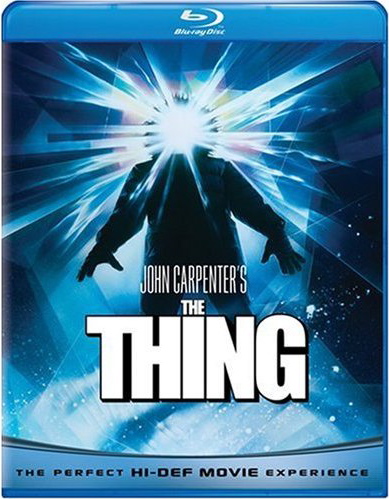
The Thing. (1982) John Carpenter
This is the first time I've seen The Thing, and apart from some very 80s looking effects, it drew me in. It's a fun and creepy monster movie that functions as much in the realm of nail-biting thriller as it does in cringe-inducing horror. Seeing it now and knowing it has somehow survived the test of time, I can't imagine how much cooler it must have been to see it in its day. But few did see it -- it came out two weeks after E.T., and for its poor timing it suffered at the box office.
Time has smiled kindly on The Thing, however, and a cult following seems to champion the film as a sort of b-movie horror staple. I don't know that this is a b-movie, per se, as much as it's simply a film that caught on years after its FX wore out. (But I'd still rather see this again than much of the current CGI garbage that dominates modern film, the horror genre in particular.)
The story follows a group of twelve scientists in the Antarctic who run into a virus-like alien that can graft copies of itself in the shape of another being. That is, it latches onto something or someone, destroys them, and incorporates its DNA to form itself in their image. The scientists, although typically quite drunk, remain very educated, and figure out what's happening relatively quickly. But the knowledge of what's happening is no comfort. If anything, knowledge in this case leads to greater panic. You don't know if the man you once worked with is still himself, or if the "thing" has taken over.
So half of the fun is the paranoia involved, and that strand of the story is why the film transcends its time. Kurt Russell, looking like a mix between Bad Blake and late period Jim Morrison, is especially fun to watch as he distrusts everyone and everything around him. The method he comes up with in testing the blood of all the men provides one of the greatest jolts in the film, and that jolt, from a blood sample in a petri dish, was perhaps the most fun jolt I've had this year.
I didn't even realize that a prequel to The Thing will be out soon. I've gotta say, I'm looking forward to seeing where they go with it.
Tuesday, October 19, 2010
Jacob's Ladder. (1990) Adrian Lyne
Every year, October seems to creep up and get me. I find myself caught up in the Halloween spirit and wandering (yet again) to the horror genre. It's been happening for several years and hopefully climaxed last year when I ended up far gone into the French New Wave of horror, a grotesque movement of unrestrained decadence that rivals any of the so-called "torture porn" films created in Asia or the U.S.
Films like 13 Tzameti, ils, Sheitan, Martyrs, À l'intérieur (Inside), Frontière(s), Calvaire, and Vinyan probably left me a bit slack-jawed and dazed, hoping to only see reruns of "The Golden Girls" or "Eight is Enough." They're brutal films that follow up older Euro-horror like
I Stand Alone, Irréversible, and Haute Tension, some of which aren't even officially in the the horror canon but can nevertheless be labelled horrifying and grotesque. Last year was a hard year for me, the perfect year for October's horror fest to fully jar the envelope of my senses. It was a year and an October that don't need to be repeated.
This year I've decided not to go that route, a route that had me ending with Strangers and Vacancy and Wolf Creek. Not that all the films I watched last year were awful. They weren't. But they were all grotesque, and maybe only reserved for that one October in life.
So this year as October's personal horror fest creeps its way to me again, I find myself meandering back to classics, even alterna-classics of the genre. Not classics like Vampyr or Nosferatu -- I've seen those classics quite enough. I guess Jacob's Ladder would qualify as a great example of the kind of alterna-classic horror I'm trying to describe. It really isn't a horror film at all. But there are elements of tense horror in its downright terrifying moments of suspense. It is also a film that stands the test of time. Twenty years after its initial release, its non-linear command of the senses is as strong and sharp as when it was made.
The story follows Vietnam vet Jacob Singer, who having returned from active duty is slowly losing his mind. I've never been much of a Tim Robbins fan -- he's an actor I've seen countless times who just kind of remains "out there" for me -- but he is riveting as Singer, wandering from scene to scene, one moment with his wife and children, the next supposedly separated from them and living with his girlfriend, and always somehow strangely still in Vietnam -- we're never actually sure where he is until the final reveal, which is solid but no pre-fall M. Night splendor.
As he starts to form beliefs about his wandering existential crisis, he thinks he's losing his mind in one moment, and in another, he flat-out believes he's in hell. The first astounding ten minutes ease the viewer straight into Singer and his story. A great foreshadowing takes place -- on the subway he looks up at two advertisements. One reads about being "Crazy in New York," the other about life being "Hell" when you're on drugs. This movie feels like it's on drugs, and most movies that attempt this aren't able to make it work. Jacob's Ladder makes it work, and it works you over in nightmare fashion.
I'm diving into a few films like this for this year's personal October fest. Some, like Donnie Darko, The Shining and Eraserhead I've seen a hundred times each and still find them perplexing and fun with each additional viewing. Others, like The Changeling (Peter Medak, 1980) and The Thing (John Carpenter, 1982), will be quite new to me. If I've seen them, I don't really remember it. I was only ten and twelve years-old when they came out! But they're films I've heard good things about in recommendation from folks I can trust. It's good to have folks you can trust when you're a film buff.
It feels like 2010 is going to bring me great viewing and Halloween fun. Hope yours is safe and excellent, too.
Saturday, October 9, 2010
Non-lollipop Docs.
Catfish. (2010) Henry Joost and Ariel Schulman
There's a moment in the middle of Catfish when it hits you that the film could go practically anywhere. It's a fun moment because you're never really certain where you stand with the film anyway. Is it a documentary? A prankumentary? A fuck-u-mentary? What kind of a "mentary" is this?
With Exit Through the Gift Shop and I'm Still Here, 2010 has already given its fair share of new school thought that says, "I am going to tell my story whether it's true or not. I hope you enjoy the story." It was a blast of artistic irony and comedy in Banksy's hilarious offering Exit Through the Gift Shop. It was insufferable, miserable, a life gone wrong and right in your face in I'm Still Here. Catfish differs from both of these. It's neither a comedic delight nor an assaultive mess, but for what it's worth, I think I actually smiled through the entire first half of it.
The moment I mentioned is so much fun because you realize that honestly, at this point in the story, anything can happen, which is weird to think in a documentary-style film. We don't normally think that a monster or a serial killer is going to pop out of the woods during a Michael Moore film. We don't think an ATF helicopter might descend on an investigative Errol Morris-type scene of some young men from NYC driving in upper peninsula Michigan at night. A deer might cross their path, and they might hit it and wreck their rental -- but surely that'd be found in a Herzog doc -- not here. Right?
What really amazed me at the end of Catfish was the division of emotions segregated inside me as I watched from beginning to end. I followed the main character Nev from surprise and astonishment, to amazement and infatuation, to fear, to discovery and back to fear (a different kind), to identifying with another, to sadness and wonderment and finally astonishment again -- all in 94 minutes. Many movies do this. They play with our emotions and take us on a roller coaster ride of feeling. But for some reason in Catfish it feels like each emotion is its own chapter. It's divided so clearly it feels like the emotions are running the show.
And perhaps they are. Perhaps there's more manipulation here than at first we were led to believe. But I don't think it matters, if we surrender to the story. All art is a lie, yes? All art has to lie a little to get to a form of truth.
So Catfish is a story, whether truth or lie, that kind of piggy backs off The Social Network, a social myth of sorts, fusing into a first person My Kid Could Paint That (a great docu-DVD rental, see below), and kind of rounding off as a make-up session after all the dumb Immatures just exploded on an ego-fueled reality show. It's the story of a talented eight year-old painter, maybe. Or maybe it's the story of painter girl's 19 year-old sister, who is just too good to be true. (Note the forum.) It is definitely a story of internet sociality and deceit, but above all it's about dealing with that great big Hole -- that needing, searching Hole you've felt when something was stolen from you, or when a relationship falls apart. It's the -- "what happened?" that's left unanswered, trying to find out where things went wrong.
It's that nagging need to figure out just how you were duped, and why. Film it in DV and send it from New York City to Michigan, cuz that's really what Catfish is about.
Freakonomics. (2010) Full list of directors Here.
The trailer for this one looked like so much fun that I made a trip to the local library and got the New York Times Bestseller. The Revised and Expanded Edition of Freakonomics has been sitting next to my toilet for close to two months through several renewals. It is perfect bathroom reading, but I've often found myself asking why I should care about its insights -- it is insightful, don't get me wrong. It just seems that a lot of work has been put into reading data and studying incentives that would otherwise be trumped by common sense.
The movie version, directed by various excellent filmmakers, turns out to be a light doc, mostly happy with a shade or two of gray. Nothing wrong with that, it's good to think happy thoughts sometimes, but again, while some of the insights are interesting, I remain unconvinced they have much to do with a deeper level of Me.
I'm going to go ahead and spoil this one, so if you don't want the knowledge of the insights in Freakonomics, don't read on. However, if you're somewhat familiar with the book or have caught a glimpse of the trailer, you already know everything that's in the film, so honestly, this is no big deal:
1. Real estate agents would rather have a bird in the hand than two in the bush.
2. No matter what you name your kid, he or she may or may not succeed.
3. Some sumo wrestlers have been known to cheat.
4. You can potty train a child with M&Ms. (DUH! I have done this.)
5. Population curves as a result of Roe v. Wade have even effected percentages of criminality in the early 90s.
6. You can bribe some 9th graders to do well in school. Others, you can't.
The film is simple, but fun. I like the concentration on incentives and don't think I've seen it covered like this before, but I have a hard time thinking that a rogue economist like Steven D. Levitt can't come up with anything more interesting.
Even with its simplicity and inability to part from the topics of the book, I recommend the film based on its different directors -- all admired for previous documentary work -- and out of the sheer fun the movie has with itself. It's like going back to school with the coolest teacher on campus and letting his brain run free combining sociology with economics.
My Kid Could Paint That. (2007) Amir Bar-Lev
Much like this year's Exit Through the Gift Shop, My Kid Could Paint That is about art and its authentic value: its birthing process, its original purity, and the ability of a seller to exploit it. In particular, the film may ask why some are willing to spend so much on what's passed off as art -- a problematic issue in My Kid Could Paint That because we're discussing the abstract art of a four year-old. Can four year-olds even think in abstract terms?
This is the perplexing story of real-life child prodigy Marla Olmstead, the story of a kid and her paintings which confound the adult mind. If everything is as true as reported and she's receiving no artistic guidance from dad -- something which may never actually be known -- she's been confounding even her parents since she first started using dad's professional paints and easels to begin working at age three. This kid's got incredible talent if everything as represented here is true.
(Big "If.")
Her first painting sold for $250. A few years later and she's now sold around $300,000 -- which mom and dad wisely put in a college fund.
The story starts out easy enough. Marla made a few paintings, a local New York art dealer saw them at a coffee house and decided to host a show to see if they would sell. They did. When people began learning about the child behind the art, the demand went through the roof to the point where Marla would never be able to meet the demand. Local press picked all this up, and the New York Times ran a story on it as well. Soon Marla and her paintings were featured in Time Magazine, on CBS and the BBC, as well as newscasts around the globe.
Her dad enjoyed all the attention Marla was getting, but mom's reception was more tepid, realizing the fickle nature of the media -- that in an age of instant fame there's usually a backlash, a turning against the thing that gave someone (even a four year-old) their fifteen minutes. What she didn't realize was how ugly this was going to be.
When "60 Minutes" covered the story on one of their weekly segments, they raised questions that, in my opinion, haven't been answered, but are heartbreaking nonetheless. They brought on a child psychologist who questioned whether Marla could truly have been the sole creator of these paintings, or whether the paintings we see her doing alone are inferior compared to the times when she's off camera with her (artist) dad.
Am I really a cynic if I agree with the "60 Minutes" segment? The paintings Marla did look too advanced, with too many styles. Even after her parents produced a five hour video showing Marla working on a painting ("Ocean") from beginning to end, I have to admit it wasn't as good as many of the other paintings already sold. This is one of those times where I hope that my cynicism is wrong, however, it looks to me like the paintings were doctored by dad.
But what does it matter? Are people buying these paintings for their end result alone, or only because they know a four year-old created them? Wouldn't they be just as beautiful and valuable if they were made by the daughter and father together? And in a way, aren't they? As her coach, dad provided Marla with all the paints and supplies she needed. He was a great assistant to her, the kind any professional would desire.
Beauty is beauty, but not in the eyes of all.
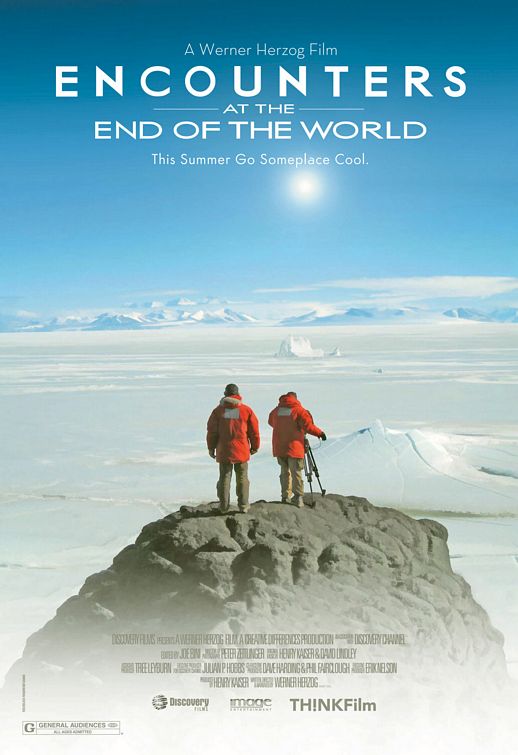
Encounters at the End of the World. (2007) Werner Herzog
Encounters at the End of the World is the third Herzog for which I've given a perfect Netflix 5/5 stars. I may as well go ahead and just share my Herzogian Netflix ratings:
5.0/5 Stroszek
5.0/5 Fitzcarraldo
5.0/5 Encounters at the End of the World
4.5/5 Aguirre: The Wrath of God
4.5/5 Grizzly Man
4.0/5 The Enigma of Kasper Hauser
3.5/5 Nosferatu the Vampyre
3.0/5 The White Diamond
3.0/5 Rescue Dawn
3.0/5 My Best Fiend: Klaus Kinski
1.5/5 Bad Lieutenant: Port of Call New Orleans
1.0/5 Wild Blue Yonder
I am on a huge Herzog kick as of late. I've been trying to see at least one of his films a month. I think he may be becoming one of my all-time favorite directors. If not that, he easily ranks as one of my favorite all-time personalities!
Encounters at the End of the World hits on so many amazing levels. Herzog takes what would by some other filmmaker be a great documentary on nature, specifically the Antarctic, and turns it into a study not only of nature itself, but of the people who study the nature -- they being just as interesting as it. And that easily sums up exactly why I've fallen so in love with this guy as of late. He loves studying and digging into and talking about people, he loves filming them and hearing their stories (especially when their stories are outrageous, which I'm sure he encourages, and probably even encourages them to exaggerate). It has been mentioned how fascinated he is with nature, and the struggle within that framework to wrestle its adversity into film. But he's also fascinated by the nature of man, and mankind itself, and how to express some of man's strangest thoughts and actions.
It is such a huge turn-on to see this in so many Herzog films. Think about it: How many directors are actually so interested in others that that is exactly what they want to display? Many filmmakers want to create something big and grande, and be known for it, and that's fine. Herzog finds the big and grande in everyone around him, and puts it on display, and in doing so he also becomes big and grande with his subjects.
So like with Timothy Treadwell in Grizzly Man and Bruno S. in The Enigma of Kasper Hauser and Stroszek, Herzog once again ends up in an odd location -- here, the south pole -- and the film becomes a nature film for PBS that's as much about the odd scientists (and divers and welders and physicists) as it is about the location itself. And all of these people are so odd and worth probing -- so worth checking out for their oddities -- they just kind of slid south of civilization, all the way down to the south pole.
So not only do we get shots of an underwater life that is more alien than anything in a sci-fi film (riffed on when the scientists sit around watching the old horror film Them), not only do we get to ponder a penguin that we can't stop as he blatantly journeys to his own demise, not only do we get boot camp for survival training and learn how to keep our group alive in a white-out (hilarious scene!), and explore volcanoes and the deepest parts of the coldest oceans on earth, but we get to explore the hearts of the travelers, to find out what makes them tick. To see through their eyes, and as it is mentioned more than once, to let the Universe discover its importance through their consciousness.
It is filled with danger, deep thoughts, ironies, humor, and those typical Herzogian moments of the completely bizarre Other.
It also seems to lack some of the scenes from other Herzog films that we've had cynical takes on before -- the Treadwell death tape that remains as the "white elephant" in Grizzly Man's empty room, or the cave behind the Guyanese falls that he couldn't possibly show for cultural reasons in The White Diamond. Encounters feels so close to Herzog's heart that the idea of a lie or a trick is held at a distance; we feel these tender scenes and he really wants to earn our trust, which may be difficult considering we've had the rug pulled out before.
For me, it worked. I fell in and trusted him completely this time. He was far too convincing for me to doubt, even an inch. The doc is an incredible study on man, animal, and life on the planet in general. Even in the final few scenes we delve into quantum physics, a search for ultimate reality, which for this crew is a desire for God.
Most of my film buddies aren't readily in agreement with me on the 5/5 greatness of Encounters at the End of the World, but I was able to fuel some fiery thoughts Here, where local A&F conversation was scrumptious.
Tuesday, October 5, 2010
The Social Network. (2010) David Fincher
Layered performances and electrifying dialogue make this one of the best U.S. releases this year. Trent Reznor's pulsating score cranks it up even another notch. Fincher and writer Aaron Sorkin have created a masterpiece of post-modern cinema, a creation myth of the social order, perfectly capturing the need for human connectivity against egos that feed into betrayal and isolation.
Jesse Eisenberg, Andrew Garfield, Justin Timberlake and Rooney Mara (who will be our American "girl with the dragon tattoo" -- and I'm hoping Reznor will show up with her in that film, too) relate a thrilling drama with fast talking characters representing the strange paradoxes found in social connectivity on the web, where you can be a jackass if you want to, but it's not the wild wild west, and your actions have consequences that might stalk you.
My friend Steve Greydanus has written an unbelievably good review, a reaction that's as fun to read as the film is to watch. There are no heavy spoilers, and it's well worth a look either before or after you've seen the film. You can find his review Here.
Monday, October 4, 2010
Let Me In. (2010) Matt Reeves
I stand corrected on both counts. The remake does capture the essence of the original (which may present its own problems, and I'll get into that later), and whether audiences are lapping it up is really impossible to gauge, but critics and bloggers and film lovers in general seem quite smitten with it so far.
Not that Let Me In doesn't have its fair share of problems. It does. But it's a pretty damn fine film, and for me to admit it -- (when I originally heard the remake was even planned, I blurted out, "This is frickin' disgusting. Is there nothing sacred anymore?") -- makes it a monumental achievement, at least in my book. I don't go easy when America plunders the finest movies of other nations. It goes back to my belief that film energizes us to become global. That if we can't go to another country, we can at least understand another country through film. I see it as not just a good side effect from viewing foreign titles, but rather the responsibility of anyone who considers theirself cultured. Remakes in general defeat this purpose by offering films that cover-up the need to see the original in its land and in its language -- hence, why it's amazing I'm able to admit how well done the remake is here.
More than once I've read that Let Me In kept the essence of the original by becoming a shot by shot remake. That is as false as false statements get. There were similarities, sure, but an entire sub-plot is gone, traded in for a cop and a general tightening of a few core figures. Other scenes are indeed "roughed up" a bit for American fans of the horror genre.
But Let Me In has a huge problem with pacing. Yeah, they're trying very hard, probably too hard to get the pacing of the original. But the Swedish version was an extremely quiet film. As such, it was in tradition with much Scandinavian cinema, film from a land where people are typically more casual and reserved and a whole lot more peaceful than some of us in the crazy states. For the pacing of the dialogue to be understood as inherently Swedish makes the similar pacing of the remake's dialogue a little clunky when you consider that most American teens don't talk like this. (Sentence. Space. Sentence. More space. etc.)
The biggest problem is that the spaces are now loaded with music that throws this subdued style of dialogue completely off. At times the dialogue is forced. It's slower and quieter than normal American teenagers would be, wherein the original had a very natural (Swedish) flow. The score, filled with over the top tension and huge leading tones trying to steer and sway emotion, actually gets in the way and makes itself all too noticeable.
I realize that even as I pick on the score it's my own problem because I typically like subdued Swedish films more, anyway. It won't be a huge problem for the folks that show up to see the film in the theater. If anything, the biggest problem that US moviegoers will face is that they'll think the film is too slow. And that's an OK beef. They won't have fully grasped that they're seeing an art house film with horror, not a horror film with a touch of art.
Still, if I I left the theater and said the remake wasn't interesting, it'd be a lie. I guess I'm wondering whether I found it interesting because I know the original so well and, while I was impressed, I was comparing the films the whole time -- or whether Let Me In really is a good film, as stylistically created and well acted as the original. Haven't figured out my answer to that one yet.
I suppose I should celebrate that a wider audience has been exposed to a great story, a story that puts the Twilight stories to shame. (I haven't seen any of those films but seeing the trailers is enough to convince me.) I'm still wondering about the U.S. reaction, though. Will the horror fans that show up know they've encountered a great story when they finally see one?
Saturday, October 2, 2010
I'm Still Here. (2010) Casey Affleck
This film is no fun in so many different ways.
It's no fun to watch a good actor destroy himself. Yes, I said "himself," and not simply his career. A part of a seemingly decent person dies here, whether they want to pass it off as fiction or not.
And it's not even fun as a gag, even when you're in on the joke and know the punch line.
Like wimpy freshman in the senior locker room, Affleck and Phoenix let the cat out of the bag last week. Tail ducked firmly between their legs, the Big Reveal was something I've known all along -- that none of this was real. Or, at least it wasn't real for them. We don't know who they duped in the process of capturing their "fictional" lives, or what it may have cost them in terms of friendships and acquaintances.
A famous Emerson quote says, "A cynic can chill or dishearten with a single word." Taken to greater proportions, a film maker can chill and dishearten the masses with a single cynical film.
The project may have started out as a rush, the adrenaline of being the only ones in on the Big Bad Secret. But to pull this off, wouldn't Phoenix have needed to actually smell like alcohol and not just simply act drunk? The lies may have been conceived as an art stunt (which apparently didn't work too well), but there's truth to be found even in the greatest of lies, and after watching this vapid prankumentary even with the knowledge that it's a facade, I still think Phoenix had fun throwing up on himself. What he did in falling apart, he did well. With hookers, booze and drugs. Let the campaign to cover-up begin. They can say it was for art, but I think not.
The real problem, however, is that anyone, anywhere can do this. It doesn't take talent, it simply takes a pulse. I've done it, I've pulled apart years of foundation I once laid -- and when I did it, I did it for real. Didn't have the press or media to run to and say, "It was all a trick! Forgive me and restore me, pleeeeeeze!!" All it takes is an ID with proof that you're 21 or older and anyone can do what's done here. Get a friend or family member to film it and maybe you can make a better film than this.
Friday, October 1, 2010
Wall Street. (1987) Oliver Stone
I might be the last person on the face of the earth to see Wall Street, but I'm certain I won't be the last to appreciate it.
I was only seventeen when it came out. I'd probably only been to two or three R-rated movies, and by the time it hit video, it never really appealed to me. But this is one case where I'm glad I missed it when it first came out. Viewing it for the first time as an adult brings more depth to the story than I would have understood as a teen.
The sequel is now out, twenty-three years after the first film was made. I guess I decided to see Wall Street just to find out whether the sequel would be worth a trip to the theater. Time will tell regarding the sequel, which will obviously have to stand on its own strength -- however, I'm glad the sequel exists if only that it got me moving in the direction of seeing the first film.
If you missed it before, it's definitely one to track down. If you saw it as a kid, you need to dig into it as an adult. If it's been a few years, it might be one to revisit.
It really is a fascinating story about how money changes us and has the ability to corrupt. I don't think many of us would agree with its character whose motto is, "Greed is good." But things are different now than they were in 1985. We see the world in a bit of a different light. We actually see the world every day in far greater ability than we were able to twenty years ago, and greed today may mean something entirely different than it did in the mid-80s.
It's a high-level drama with some outrageous scheming, but has truths about human nature that make for excellent thought. It was well worth the time invested.
Wednesday, September 29, 2010
Red Riding: In the Year of Our Lord 1983. (2010) Anand Tucker
A redemption of sorts makes its way into the final chapter of the Red Riding trilogy. The films wrap up in resolute fashion, and while I'm a tad underwhelmed at how the stories resolve, I'm still convinced this is a trilogy I want to revisit. In fact, I'd like to have it on my shelf. I'm certain a second viewing is in order. The trilogy screams to be seen more than once.
Most of the things we've not understood are given an answer in 1983, but the answer feels like Agent Dale Cooper turning into Bob at the end of Twin Peaks. With characters like the "wolf," the "owl," the "badger" -- and constant murmurs about a murder location that's "under the carpets" -- there's just enough of a Lynchian edge to send the neurons in your brain scrambling.
The more I think about it, the Twin Peaks comparison is decent. Originally a TV show about the murder of Laura Palmer, a high school senior, with FBI investigations and small town eccentricities, the end of the second season (and the series) left us with Cooper staring in the mirror, the killer staring back. It was a haunting image, never clearly resolved, a decent introduction to the main investigator in 1983.
The finale is the most emotionally invested of the three. The investigator cop, Maurice Jobson, who we've seen mostly as a supporting character, steps into the light in a leading role. He wrestles with the corruption he's witnessed, things he's evaded or taken part in, the killer that's running free due to the force's cover-up. To face these things and make it right he'd have to confront the entire institution. He wants out, but there doesn't seem to be a good out for him. The force has actually enabled a serial killer (or two) by thwarting past investigations for friends that they protect. Jobson's unseen role in 1974 is brought to the surface here -- we watch as he tries to reboot from his part in all the wrong. He won't find absolution, but maybe he can put a stop to the insanity once and for all. It would still be a sort of redemption for him, but for any character in Red Ridintg, absolution is far away.
And of course, Jobson's story is only one of several stories that intertwine and weave together a tapestry of characters who have all been profoundly affected by the murders and cover-ups. The strength of Red Riding as a whole is that it isn't one neat story, but a bunch of messy ones webbed together.
A climactic, over the top, slow motion scene toward the end will leave some stunned, and others pondering movie manipulation. I left the scene somewhere in the middle, but can't wait to see it again.
While I picked on 1974 for its inferior 16mm and applauded 1980 for its standard 35mm, having seen the final film in DV format is rather telling. When digital was first pushed in dogme films years ago, I loved it. It revolutionized indie filmmaking long before Youtube was conceived. Over the years it has gradually worn down with people like Michael Mann, unable to locate its strengths. I am no fan of the digital setting in 1983, especially the way reflected light brings these horizontal, ugly lines across the screen, which is all too noticeable and happens throughout the film. However, watching the three together as a whole rather redeems the use of the finale's digital. It is sleek, compared to the retro use of old-school devices in 1974. Understood this way, time seems to travel from retro to modern as the years of the series progress. While I'm not a fan of the way the digital was used here, I can understand it in context with the rest of the films, and even appreciate the artistic attempts at creativity.
Wednesday, September 22, 2010
Red Riding: In the Year of Our Lord 1980. (2010) James Marsh
What I felt lacking in 1974 was nearly perfectly resolved in 1980. The trilogy is starting to only look right when seen as one unified story. Watching only one of the films will lead to disappointment -- they're meant to be seen as one, in order to be seen right. As I progress to the final film, I'm finding the best descriptor to be "Inceptionesque," except that when you go back through the Red Riding labyrnthian mind-benders you find they're actually better than last summer's blockbuster. All the pieces here fit and form a puzzle, not a million little pieces left on the floor.
I call it "near perfect" resolution only because we still don't have a clear idea of who 1974's child killer was, or the why behind the brutal slayings. Also, 1974 still unravels from a femme fatale relationship that is beyond reasonable belief; it's an over the top layer that seemed out of step with the rest of the story. But so many unanswered questions in that film, many of which would have been left behind in lesser productions, become plot points in 1980, resolving tension from both films in the most satisfying of ways.
As I had to explain the words "near perfect," I feel I now must qualify the word "satisfying." There's really nothing satisfying about the resolution other than story choices which bring clear and concise closure to events we'd thought long forgotten. Now that we're actually aware of who the bad guys are, it's rather squeamish to view the final scenes. "Satisfying" fits in a film way, but in a human way? No. But that's somewhat the point. We're not watching film noir, but in many ways it feels like it. In this world, corruption and darkness lurk around every corner -- even next to a police station in broad daylight.
Whereas in 1974 we followed young and cocky journalist Eddie Dunford, who appeared truly caring in tracking down the killer for his paper, 1980 gives us Paddy Considine as Peter Hunter, the upstanding cop who also has unanswered questions from the first film's closing shootout. Frustrations with an investigation finding nothing after thirteen murders, and Hunter's known integrity and fearlessness in pursuing justice land him a job on a special task force, what the press calls a "super squad," appointed to apprehend the killer and solve this mysterious case once and for all. Like Dunford before him, Hunter is over his head before he even knows it. What he begins to solve is a mystery, indeed -- but not the one he was jobbed out for.
Police corruption once again takes priority. The Yorkshire Ripper will certainly be caught, but he once again takes second fiddle when Hunter starts digging in the files. I wouldn't call the serial killers MacGuffins, it's just that these are extremely large stories and Red Riding chooses to prioritize the story within the story.
Two or three things became immediately apparent only a few seconds into 1980:
1. The look of 1980's 35mm shreds 1974's 16mm, which was obvious from the first frame. There's a cinematic quality here that leaps the production up quite a few notches.
2. We now understand that there's more than one murder mystery. In fact, there are at the very least three.
3. Sometimes one simply prefers one directorial or cinematographic style over another, and it can make all the difference in the subject matter and one's experience in dealing with tough material. Like watching Hannibal Lecter, or Se7en, there's nothing easy about this subject matter. Frankly speaking, some of it is sick and goes back to our Old Testament fascination with the strange side of humanity most of us only relate to through story. That we're grappling with an issue that's been around since Cain and Abel makes it no less easy to watch, and stories like this are going to make certain that the horror of it stays with us for a while. But personally I can say that it was easier to take with James Marsh at the helm. It's probably that he simply knows how to add filmic pizazz without it necessarily being noticeable. There are also moments of reprieve that weren't present in 1974, moments when we get a breather from the ickiness.
At the end of 1974 I was left wondering whether this was going to be a worthwhile endeavor. At the end of 1980 I'm left dazed, spellbound. I cannot wait for 1983.
But I also found myself wondering why four novels were reduced to three films. What happened to 1977? I remembered a Film Comment article from nearly six months ago in which Graham Fuller gave an answer and introduced a festering sore:
I don't know how I feel about 1977 being created later than the rest of the trilogy, but -- Ridley Scott? A feature length film? "Such as Pennsylvania"? Are you friggin' kidding me? No serious film lover would think it possible to pull off all this material in one film, and no one that's seen Red Riding would think the maker of Robin Hood and Kingdom of Heaven would be the guy to entrust it to. This is silly. It'd be like someone reducing The Godfather Parts I and II to a ten minute short for the festival circuit. I suppose it can be done, but it's like adding sequels to The Matrix. It leaves a stain on the legacy of the original.Tony Grisoni adapted 1974 from the first novel in David Peace's "Red Riding Quartet," named for a Grimm's fairytale, the color of blood, and the West Riding district of Yorkshire. He also adapted 1977, which wasn't filmed; 1980, which was directed by James Marsh; and 1983, directed by Anand Tucker. The absence of 1977 doesn't dilute the overall intensity, but producer Andrew Eaton still hopes to greenlight it once Ridley Scott has completed his American Feature adaptation of the entire quartet. It's been mooted that Scott's film will be set in a run-down industrial state such as Pennsylvania, but whether the screenwriter, Steve Zaillian, will feel obliged to replicate the fierce regionalism of Peace's novels, as did Grisoni, is another matter.
Monday, September 20, 2010
Red Riding: In the Year of Our Lord 1974. (2010) Julian Jarrold
Addendum: The writing below is unchanged from when I wrote it, but having now seen about half of the second film, I am certain 1974 had nothing to do with the Yorkshire Ripper. Little girls were the target in 1974, and the killings there all took place before the Yorkshire Ripper's time, which began in 1975. Also, the Yorkshire Ripper's killings seemed to target prostitutes, not little girls. This was confusing as I'm American and less versed in UK serial killer history, and all the summaries only mentioning the Yorkshire Ripper didn't help. However, this is the web, where we make corrections as we go. People have said for years that the web is a place of half-lies and hopeful truths. I'm reminded that I've even seen Ebert get things wrong in print that he later corrected on the web. The power of the web for the average movie watcher has turned the film experience into a more powerful probing of truth. Consider this next time you diss wikipedia.
When the Red Riding trilogy hit my neck of the woods this year, all three films showed up for one week and one week only, and then they were gone. It's a terrible marketing strategy. Why would you show interest in seeing 1974, the first film in the trilogy, if you knew that if you liked it you'd have to cram hard to get to a theater twice more in the same week? Who plans a week for a trilogy when they don't even know from the first film whether the following two garner interest?
With such a horrible marketing strategy it seems the trilogy is more suited for Americans to see on DVD. The three DVDs came out this week, and I made sure to throw them in the top of my queue.
Judging from the first film I would have been very conflicted about the next two had I had to face that week of the trilogy in theaters. I simply can't tell from the first one whether this is going to be worth an investment of my time.
Ebert compared the films to the Italian epic The Best of Youth. In terms of the time invested, I guess the comparison is apt enough. For those six hours you had to plan two trips to the theater, but the comparison ends there. The Best of Youth was up and down, all over the place emotionally, full of the highs and lows of life, the greatest joys and the bleakest despairs, but like most of life there was always an upside to the many downs.
After 1974, I am persuaded that Yorkshire is a county full of people of bleak despair, and nothing but.
I guess I should take into account the subject matter. Maybe a serial killer in the neighborhood really would make this an awful place to live. And maybe the rampant police and civil corruption of the early to mid-1970s would add to the bottom-of-the-barrel feel of all the characters in this film. But -- yuck. Are the next four hours going to be as icky as this?
The trilogy is loosely based on the Yorkshire Ripper, a serial killer who took thirteen lives in England between 1975-1980. It is a very real case which lit up the community, landing the killer in prison for life and causing quite a stir at the corruption and ineptness of the West Yorkshire police force. 1974 follows young reporter Eddie (Andrew Garfield) who seems to be the only one who wants to bring the killer to justice, but I'm sure he wants a way into covering the hottest case in town, too.
It's not that it's not an interesting story, because it is, and it's not that it's not told really well, because there are exceptional moments. In the beginning we're focused solely on the story of the Yorkshire Ripper, not even fully convinced of his existence, but as the film progresses we lose that focus and a new mystery begins to emerge. We never return to the original mystery. In the end, we seem to, but we're somewhat sure we actually haven't. And that narrative ambiguity makes its way into the acting, the choreography and the general atmosphere as well. There are moments of utter lostness, hallucinogenic, like groping in the dark. The grainy, organic 16mm feel suits this fictional film based on a true-to-life serial killer.
But it is miserably hopeless, and that's why I'm having difficulty deciding whether it is actually going to be worth it or not.
Originally broadcast on BBC TV, the trilogy is made by three different directors in three different formats (the next two films are shot on 35mm and digital video, respectively). I know I'll make it through at least the second film in the trilogy, because 1980 is directed by James Marsh, and I loved his documentaries Man on Wire and Wisconsin Death Trip. The completist in me will most likely want to see the third once I've seen the first two. I guess I'll continue reporting as I go.
Wednesday, September 15, 2010
Wild Strawberries. (1957) Ingmar Bergman
I had a very strong reaction to Wild Strawberries when I recently watched it again. It's probably been close to ten years since I last saw it. I think this is the third time I’ve seen it, but it is definitely the first time it really moved me.
Apparently, I’m getting old.
This is the perfect example of a film that's going to grow with you as you age, because in many aspects the film is about aging.
An elder doctor on his way to a ceremony in his honor travels by car with his daughter-in-law, who kindly tells him why he’s despised as a cold, calloused old stickler. They meet two sets of travelers which, each in different ways, compliment the initial conversation the two started earlier.
The old man has quite a few moments where he falls into dream-like states, either reflecting on his youth, mistakes made years ago, or in actual dreaming, being judged by his peers now for advancing so far in the community to the neglect of those closest to him. Several of these stages of dream consciousness are unnerving. They are cruel taunts of his guilt, accusation at his life's choices.
He seems to understand that even now, in his old age, all is not lost. He still has time to do something about the guilt. He can find redemption from those in his dream who would accuse him of growing old and calloused. There's the idea here that maybe, just maybe, someone can actually change when they see how wrong they are, no matter the age, no matter how far they’ve gone astray. It's just one small aspect you can admire in the story. I’m sure there are more but that’s the one that really stands out to me now.
Bergman, ever the auteur, is all over this thing. He wrote and directed it at a moment when he was struggling with identity, his role on the planet and whether or not there was still a God who was interested in the struggle. It shows in his art, and as he did so many times through the years, he made a film we connect with. We wonder with him at the wonder of life, guilt, redemption, and that the cosmost might be involved in all of it, but then again, they might not be -- but there always seems to be a hope that weighs in on the positive side.
No one is making films like this anymore. We settle for so much less. Where have all the auteurs gone?
Saturday, September 11, 2010
Stalker. (1979) Andrei Tarkovsky
Trying to write about a film by Russian auteur Andrei Tarkovsky is like trying to write about the book of Ecclesiastes, or Shakespeare, or the new Arcade Fire CD. Sometimes you just have to experience a work in order to understand its insights, its challenges, its poetic feel. It's not always easy, and you won't typically get it the first time around. These are works in which you must immerse yourself in both the experience and the context in which it was made, and even then you might need more than one experience with it to latch on to all the "in-between the lines".
While this is the first time I've sat down with Stalker, I'm familiar with Tarkovsky, having sat multiple times with several other films: The Sacrifice, Solaris, Andrei Rublev -- the latter of which leaves a hum in your system on the second viewing. Tarkovsky lived as a Christian filmmaker/artist under Soviet rule. His films subtly hold a mirror to the oppression he lived in, and even more subtly suggest a better way found through faith. When working under a regime you often find yourself dealing in subtleties.
His films are highly artistic, almost like wandering into an art gallery that instantly catches you by surprise, taking your breath away. They're also profound and poetic, both at the same time -- but sometimes the films feel numbingly slow.
I can understand it when a person says Tarkovsky's films are not for them, that the pacing it too great a challenge, that they can't fall into some of the surrealist acting or spiritual metaphors. But I wouldn't understand if one couldn't appreciate the political and spiritual search for freedom of expression that's anchored at the core of his work. A boundary pusher in a system that needed him, Tarkovsky carried a torch that could have landed him, like recent Iranian filmmaker Jafar Panahi, in trouble with the system and in jail.
To not understand at least that much of the context and then to watch any of Tarkovsky's films would make the experience a real bore. Education is a must when approaching and trying to understand the mark he left.
On the surface, Stalker is a very simple science fiction story of a man that takes some visitors into a mysterious post-apocalyptic land called "The Zone." The Zone seems to strangely affect those who break through its militarized border to get in. Various interpretations try and explain the power that's found there. I have my own. It's different, but I think it's got teeth.
Having been to Russia quite a few times, even before the collapse of communism, having been in all kinds of churches there and knowing what people of the Christian faith dealt with in those years, it's really admirable -- of the highest sort -- to think that Tarkovsky made this particular film in 1979, almost a decade in front of glasnost and Polish solidarity but twenty years after Brother Andrew visited Moscow. I don't know what kind of freedom of speech was available in 1979 in either the church or in art in general, but consider all of the following elements found in communist-era Stalker:
A telling of the story of the road to Emmaus (without mention of the identity of the stranger that appeared); a pronouncement of unforgiveness while a major character is wearing a crown of thorns; the idea that a violent act will bring an end to the thing that might liberate someone (a bomb in the zone); and a little girl -- once called a mutant, born of the "Stalker," a man whose sole life purpose is to guide visitors through The Zone -- who is more powerful than anyone thinks, with strange psychic powers in the film's end.
All of this leads me to believe that the Zone is actually a place of peace and restoration, Garden-like in its state of tranquility, and that the world outside of the Zone is simply a world afraid of change and left in its own dismantled state. The little girl is a representative of the next generation who is going to "feel" the Zone out before she arrives.
The Zone in the context of Soviet Russia seems to suggest that there are ideas on the other side of oppression, that there is visible peace in sight. Note how peaceful the Zone is. Note how when they arrive the Stalker immediately feels a connection to the land. He feels like he's come home. It is humanity's natural state to desire freedom from oppression, whether from tyranny or more suggestive oppression in lack of freedom of speech or political correctness. He feels at home here, and he feels a peace, yet every step is feared. It's a life he's not known before. Sure, it's in color, but there are going to be pitfalls and traps along the way. But it is a place he wants to navigate, because the human heart longs for liberation.
These are some intense reasons in the narrative structure and mystery of the Zone to fall incredibly in love with everything Tarkovsky lays out here in 1979. I haven't even gotten to the high-level, immense beauty of the cinematography, the intensity of the bedroom and the marriage in this context, the magnetic visuals that also blow the viewer away.
But I'm quite conflicted about Stalker. Actually, I'm more conflicted about my own experience with it than I am with the film itself. Moments definitely have a trance-like, hypnotic feel, and after a bit you are simultaneously enjoying the mesmerizing scenes while wishing for it to move on. That is why I love a quote I found on the Arts & Faith board, a quote which pretty well sums up my confliction for Tarkovsky's great film:
One of the things I'm trying to unpack is the possibility that some aesthetic experiments are more likely to evoke widely varying responses even within the same viewer, precisely because the element being experimented with is a particularly subjective and changeable one. And that the experience of time is just such a thing.It tried my patience at times, to be sure. But in reflecting on it after only one viewing, I have no doubt I'll be visiting again -- especially after the final scene, where a lot of the film came together for me.
There is no doubt Tarkovsky is one of the great masters. I'm only learning to finally catch on.
Thursday, September 9, 2010
The Virgin Suicides. (1999) Sofia Coppola
Sofia Coppola's directorial debut from over a decade ago is still a dreamy, atmospheric, suburban fairy tale, somewhat realist, about an over-protective Michigan Christian family so backward the parents smother their teens in isolation. The girls can only respond to their parents' stifling control by the terms of the film's title.
The stifling suburban Michigan parents aren't a joke. There are families like this here in some of the segregated white suburbs of Grand Rapids. The Christian Reformed Church in places like Byron Center makes sure the town responds in subtle rejection if your kids aren't atheletic or sporting blonde heads and tall physiques.
Think I'm kidding? I know a (black-haired) family moving out of Byron Center right now because they are sick of the religious, non-Jesus nature of hard-line, rich conservative "Christians" in the town.
It's funny that churches outside of the Grand Rapids area see a place like Mars Hill as "Hipster" and reactionary to American mainstream Christianity -- in reality, the place might be somewhat reactionary, but the reaction is sometimes more localized, reacting to overbearing Michigan Christian bigots. (I had a hard time putting a capital "C" in that final phrase.)
I read The Virgin Suicides years ago and loved it. The film itself uses a dark approach in humor to give a lift to these repressing themes. The film would suffer without the gentle touch of black comedy. Coppola handed in a winner her first time out, showing she's more than simply her father's daughter, and Kirsten Dunst gave her best performance at a young age, proving long ago she can do more than simply look pretty.
It remains one of my all-time favorite films, and it was a joy to watch again. It takes on a greater significance now that I'm living in West Michigan and have more of a feel for the authenticity at the core of this fictional work.
Sunday, September 5, 2010
The Fog of War. (2003) Errol Morris
This is a quick post to launch my blogging in September. I don't want to forget about Filmsweep even as life is in crazed (packing and moving) motion.
I watch The Fog of War once every few years. I seem to learn something different every time I see it. The late Robert S. McNamara offers eleven invaluable lessons from his life: from his WWII years as an analyst for the Office of Statistical Control overseeing B-29 bombings all over Japan, to his role in the Ford Motor Company and how observing raw data there forever focused Ford's role as a major competitor in the auto industry, to his job as Secretary of Defense under both the Kennedy and Johnson administrations, being heavily involved -- and blamed, perhaps unfairly -- for the quagmire in Vietnam.
Here are the three things I took away from my most recent screening. I forgot about the first two staggering facts, and the third is simply a brand new thought:
1. Japan was already obliterated long before the two atomic bombs hit in 1945. They were fire bombed to the point of 67 major cities no longer existing. McNamara claims he knows of 100,000 citizens -- men, women and children that were killed in one night.
2. McNamara claims that had we lost WWII, he would have been tried as a war criminal. This fits firmly into the notion of one the strongest of his eleven points: In order to do good, you may have to engage in evil. WWII had much evil involved, but only the winners got to create the way to teach the war historically. Hence, many haven't heard about the fire bombings I spoke about in #1.
3. How much has America changed in the past 60 years? This much: McNamara claims he was able to change the Ford Motor Company because out of 1000 executives that were there, less than ten had college degrees. Think it is like that anymore? Think there is even one Fortune 500 Company that can make that claim today? I defy anyone to tell me that there is no caste system in America today. It is an entirely different looking country than the one on the same soil sixty years ago.
Sunday, August 29, 2010
Marjoe. (1973)
Sarah Kernochan and Howard Smith
If you find yourself taken this weekend with the documentary-style of The Last Exorcism but feel let down in its Rosemary's Baby run-on, cliched finale -- and if the vérité feels far more fun than demonic images that are elements of fraudulent Hollywood rather than anything remotely spiritually real -- then perhaps you'll be more interested in the film The Last Exorcism riffed on to get noticed, a film which has a similar phony preacher bringing deliverance and counting the cash, but is very much reality and filmed with a concentrated focus.
In going through thoughts on The Last Exorcism, I saw that a friend linked to some writing I did when I first saw Marjoe. It was fun to read my passionate response to the years-old doc. The following was quickly written, and probably not as well thought-out as when I sit down to blog here at Filmsweep. But it had excitement, a sense of finding something unique, and it feels like it convinces that Marjoe is worthy viewing nearly four decades after it was made.
As the next "Non-lollipop Docs" column will be waiting 'til the end of next month, consider this a heads-up on a great documentary that still remains somewhat overlooked.
_________________________________________
Holy guacamole, and great tongues of fire!
I feel like I just a had a "religulous" experience. I tripped on Jesus music, revival tent ministry and mass manipulation all at once! I also came away feeling uplifted and swindled, both at the same time.
(Gee, I wonder whether I might be back in the throes of Pentecostalism.)
The life of the evangelist Marjoe Gortner has been mentioned before -- both here, where I first heard of him from the Lonnie Frisbee documentary, and here, in the Houston Chronicle's writeup on Saved -- but there's no dedicated thread to the 1973 Oscar winning doc. So here we go.
The raw footage of Marjoe as a four-year old boy playing "Onward Christian Soldiers" on his accordion, pronouncing fire and brimstone sermons as the prodigy "boy preacher," and even (GASP!) marrying a couple in a church as a six year-old, really set the tone for grasping Marjoe's unique and problematic thinking. It's hard to believe he grew up in these vast Christian settings, coached by his mom to wail and preach, not even acquiring a real faith but just parroting the system in which he was taught how to succeed. He became a showman at a very young age, a charlatan with enough skills to make money for his parents (he claims over three million dollars, money he never saw) and also performing in this way to receive his parents' love. It was a performance-based love; Marjoe never felt he was loved for anything more than the green he brought in and the hanky-waving fervor he jerked out of crowds in preaching to adults all around him.
Fast forward some twenty-or-so years, and now we see Marjoe ready to come out of the closet, so to speak. Like "Candid Camera", or the wizard behind the curtain, Marjoe brings a full film crew with him as he tours the Pentecostal church circuit of the early 70s in prep to expose his true identity. The crew is fully aware of who he is and the business of what he is doing -- the church people will find out sometime after the documentary is released.
It's really interesting to watch Marjoe as he teaches the film crew how to conduct themselves as they film the (loud and "powerful") worship services. He instructs them not to freak out when people begin uttering strange languages -- he describes tongues as the grand zenith of a Pentecostal worship service, and even instructs the cameraman to make sure he zooms in when someone is being "filled with the Holy Spirit".
He also instructs his crew to not smoke, to get haircuts and to sexually stay away from the believers. "You cannot get involved with these chicks at all... That's a rule that I established," Marjoe says. "I never take out a girl from the church or in the church. I stick with airline stewardesses."
I believe there were two reasons for the sexual warning: The first, because for years he'd been "ministering" and he wasn't yet ready to risk his credibility among the church people. The second, and this is debatable, is that Marjoe really does care about the born-agains in his audience. He goes so far as to claim that part of the reason he wants to make the film is so that some in these evangelical communities might grow. When the crew asks him, "What will happen when they find out?" Marjoe replies, "Well, I'm hoping that they will see, you know, that it's not necessary to look to some person to like, you know, jerk you off -- to get off -- and put your belief in."
The music plays a huge part in every revival meeting setting. When people are whipped into this holy, hypnotic, trance-like musical bliss, they are, at the end of the night, more emotionally ready to empty their wallets into Marjoe's baskets. In one of the most blasphemous scenes -- the one incorporated into the Lonnie Frisbee film -- Marjoe is seen dumping a huge wad of money on his hotel bed and "praising Jesus" for it.
I guess the use of music to stir up the crowd is nothing new, especially in relation to how most churches want at least a bit of this stirring incorporated into their services, and how tribes and cultures have always used music in their rituals from the beginning of time. But somehow, I don't think there were plates passed at the end of a tribal drum circle thousands of years ago. Back then music may have led more to the sexual cravings, which makes just as much sense as the passing of the plate... Then again, maybe the sex in those settings wasn't typically considered immoral, which would place these evangelical fakes as more immoral than other cultures and generations similarly using music in religious rituals... Hmm. I'll still be mulling that thought over.
I did feel sorry for the good church folk as Marjoe strutted the aisles proclaiming the good news, knowing he didn't believe a word of it. But the optimist in me wondered how many times Marjoe may have been used by God and didn't even know it. Having just come off the Lonnie Frisbee viewing, in which God seemingly brings salvation to a kid on LSD, who then brings thousands to Christ while still struggling to get off the drug, one wonders if it's not possible that God can work through any broken vessel He chooses. In Marjoe, it is a hypocritical, unbelieving one.
There was something in me that liked the freedom with which the congregants were able to blatantly dance and worship in front of their Creator. So childlike, so trusting. So innocent and really in love with God and in desire of His goodness. I wish for these kinds of worshippers that they could have all of this without the background blows of exploitation and manipulation. Having come from (some of) this background myself, and having left it long ago, I've come to the conclusion that my wish will never come true. Sadly, there's just too much humanity and desire for power in us needy, greedy humans.
Regardless, I found that I liked the Marjoe character in all of his hypocrisy and inauthenticism much more than the preacher in one of the tent meetings who, over and over, kept reminding us that once he really dedicated his life to God he was given a Cadillac. Eek. I didn't like his message at all. I'd take Marjoe's fake message over that guy's real one any day.
This is a Netflix four out of five stars. It would be four-and-a half, but Netflix doesn't allow 1/2 stars. The reason it falls short of a FIVE is that the film needed to delve deeper into Marjoe's adult relationship with his parents. I really wish we'd have been offered more of a glimpse of the whole family, all grown up. When his dad shows up to be in a service with him, we never fully know whether his dad is a fake or a real believer... And his mom isn't even heard from in Marjoe's adult life. Is she dead? Did they divorce? Where is she now? We just don't know. And his dad mentions that Marjoe is the fourth generation evangelist in their family, so what I would have liked to know is, Was great-grandpa that was a missionary to Liberia a fake too? And was grandpa a fake in whatever evangelism he did, or was he the real deal?
Wednesday, August 25, 2010
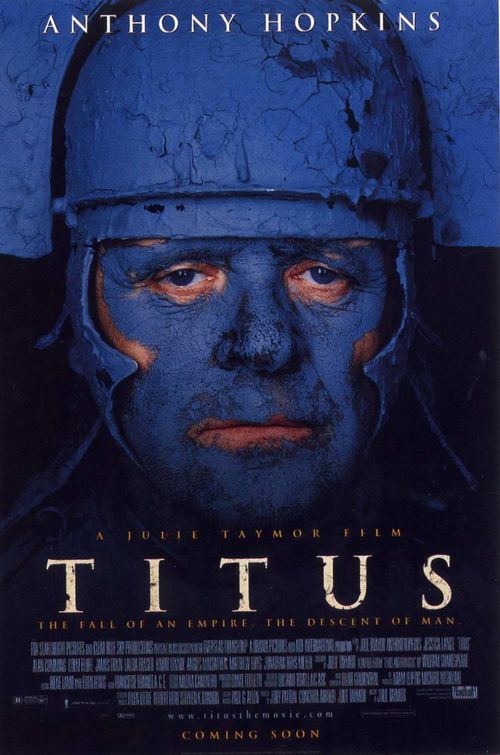
Titus. (1999) Julie Taymor
In a few months you'll be hearing quite a bit about The Tempest. Based on the director and her proven results with Shakespeare, in both theater and in film, I have little doubt it will be one of the great films of 2010. Time will tell, but Julie Taymor has already shown what happens when she tackles a screenplay and directs a movie for Sir William. She directs with the kind of fire and insight his works need to relay the furious and compelling nature of his emotive, astonishing language.
Not that I'm a Shakespeare aficionado, because I'm not. I readily admit I'm nowhere near smart enough to try and cop to that. I do, however, see more movies than most and I recognize sheer ambition and swoon when it comes my way. Titus is proof of what happens when Shakespeare lands in daring, ambitious hands. It is riveting to behold -- gargantuan, chaotic: FULL ON. I watched it again recently because I am excited for The Tempest, but what I found in Titus was the same brilliant work I saw years ago.
A little boy with an "unknown comic" paper bag over his head plays at a crowded kitchen table stuffed with all his crazy toys. A blaring TV with nothing in particular fills in a noisy background as his playing voice quickly rises, drowning out the blaring TV, turning violent. It's almost as if he suddenly hates the toys and needs to rebuke them for their sin. They, too, are out for blood and want to fight -- fight with each other and with him. He screams at them, pours his food all over them, crashes them into one another and his dinner. A toy soldier scratches at the surface of the table trying to crawl away in fear.
The boy is on a rampage now. Violence erupting his small being spills into the reality of the room, shaking the foundations of the whole house. The violence becomes too much as it pounds and pounds.
He realizes it has come to life. The house may very soon crumble. The growing, dark setting overwhelms him -- he is panicked at the thought of the toys and the violence he has created. The room shakes and finally explodes as he covers his ears in fear.
He is whisked away and carried down a hole ala Alice into Wonderland by a clown that doesn't look like a clown. Down the hole he goes but not before we see his saddest look, and tears streaming down his scared face. Did he really create this violence? Could his imagination become physical? Has it come back to haunt his very play? Is he innocent, as we might think, just a child doing what a child does, or has he brought malevolent harm that he wishes he could take back?
Down the hole he goes into the Roman world of Titus Andronicus, who will introduce him to similar perils, albeit political. The child will be a silent observer, a mute witness for the first half of this story, to blood upon unrelenting blood, until he can take it no more and must enter the story himself. He becomes little Lucius, the grandson of Titus the hero, the general who has come home with the spoils and loot of war, only to be spoiled and looted himself.
Is there a better way to launch the introduction to arguably one of Shakespeare's most disturbing and dark works than with this innocent bystander with a history of his own -- a child, no less, carried to Rome to observe? And when observing the most hideous and corrupt actions in human nature, could anyone better deal with resolving the violence he has seen?
Bringing the silent observer the way Taymor does and then turning him into the character of Titus's grandson is an affecting choice in the midst of this blood-thirsty world. We need someone there to remind us of innocence. We need someone there that can watch, while we observe.
In a matter of hours, in some questionably wrong but understandable choices of allegiance, Titus (Anthony Hopkins) goes from war hero to outcast, dispossessed from his country, cut off from his people and his family. Maybe for the first time in his adult life, he is utterly isolated, completely alone. To make matters worse his enemy Tamora, Queen of the goths (Jessica Lange) is strangely promoted from slave to Queen of the empire -- she will easily infect young King Saturninus against Titus, and his sons and daughter are going to pay the ultimate price in revenge.
In terms of the rest of the plot, it's the story of their feud -- it's the Hatfields vs. the McCoys dressed as warring politics in ancient Rome. In terms of Shakespeare and the way he tells the story -- oh! The language! I cannot describe how amazing it is. Time doesn't make any of this old language grow more "old," but greater, more rich, more poetic and able to dig in. It connects even with modern audiences and contemporary ears. This is a story that was originally read for its language -- you will be richly rewarded if you watch with the subtitles on.
In terms of what Taymor has done with all this, her approach is very similar to Baz Luhrmann's Romeo + Juliet, which starred Leonardo DiCaprio and Claire Danes only a few years before. The films have in common a blending of traditions -- they each carry an ancient/modern approach to the screen. But while the guns and shooting in Luhrmann's film come off as vain and gimmicky, the vehicles and costumes and the whole design of visuals in Titus are always an allegory that's tangible, within reach. It is as entertaining to look at as it is to consider.
In fact, I know I've talked about it already a hundred times this year, but going back a decade and watching Titus brings back memories of last year's masterpiece, Vincere. It is that grandiose, that daring, it is that willing to take risks, and has that ability to believe in itself (and achieve in itself!). These are all the reasons it brings success in such large measure. Even the imperial Roman art and neo-classical architecture are where the two films relate so well. Characters in both films, too, are intoxicating, as is the camera's ability, which is unyielding.
But Titus is written by Shakespeare.
And that is clearly what sets is apart.
Titus Andronicus, as played by Hopkins and Lange, is an incredible spectacle of blood-lust and power -- and the child that was so frightened of the violence he created brings one of the best, most artistic endings imaginable.
I'm so glad I was able to see this again, and now I'm more excited than ever for The Tempest. We'll see how Helen Mirren's female Prospera will add to the Taymor/Shakespeare tradition!
Monday, August 23, 2010
1981. (2009) Ricardo Trogi
What does it take to find a friend? What does it take to be a friend? What can you give, or give up, or give into in order to influence the acceptance of a friendship?
Ricardo Trogi (and you can pronounce his surname any way you want but you'll probably still get it wrong) has a stash of Playboys -- or so he says -- and suddenly the eighth grade click he wants in with are giving him their full attention. When you're young, you use what you have. Kids sharing Playboys probably go back to the invention of Playboys. Ricardo's problem is that he doesn't have anything -- the Playboys, the right clothes, a Walkman.
The character, director and narrator are the same. We see Ricardo as a boy, a simple materialistic, not-quite prepubescent teen who wants things he sees in catalogs but has to bug mom and dad for the money. As he navigates the monetary disciplines at home he also spins in a web of Junior High lies. The lies help him form bonds of friendship. Again, we go back to the strength of that tie.
The director/narrator looks back to a time when moving to a new school produces the most profound kind of social fear, when having your arm unnoticeably touched by a pretty girl caves you in to a months-long spree of hormonal rush, and when fear of being noticed in your family -- ie, mom and dad -- make you close your eyes at night and escape into dream lands of fantasy.
It's a fun story. And it is very playful, and quite cute, too -- but sometimes a little too much so. A little sap would have been good in places, but there's a lot of sap on the train with the rest of this fun. The film reminded me of a less-creepy Léolo or a happier, french-speaking Stand By Me, with a touch of the sibling rivalry of E.T. and a small hint of Roberto Benigni's bond with his son in Life Is Beautiful.
And while 1981 isn't exactly as good as any of the films I've just mentioned, it is worth watching, particularly for the last six or eight minutes which are entirely rewarding. Dead-on with real life, the way life works as a lying eighth grader who is bargaining in every relationship he has, the last few scenes close in such a strong way that it makes the proceeding 94 minutes worth the investment.
There's a curious, sad, and possibly quite true moral as Trogi shares about the Jr. Hi experience towards the end: "It happened 26 years ago and I still obsess about it. What was I thinking? The damn truth only works if everyone's telling it."
The quote feels like one of those truths where you wish it weren't true. The thought of it goes against faith in God, or the Bible, or even humanity in general. But you know what? Hate to say it -- he's right. If you cop to your pretend side and no one else joins in, you're not dragging things into the light which will somehow make your life more whole, real, or better -- you're only giving up yourself to liars who will eventually plow you down.
I'm walking away on a serious note to a film that really was light-hearted. I can't tell if that's me or the film. Maybe it's a little bit both.
Sunday, August 22, 2010
Paris. (2009) Cédric Klapisch
Titus will no doubt be written about this week.
Paris turned out to be a wonderful little movie about a sister that moves in with her dying brother, bringing her children to his home to take care of him while he awaits a possible heart donation. The film has a stellar cast, which is lead by Juliette Binoche, who, if she's ever turned in a clunker of a performance, I'm not aware of it. Over the last twenty(?) years, she simply amazes on every acting level. Romain Duris (Thomas Seyr in The Beat That My Heart Skipped), François Cluzet (Alexandre Beck from Tell No One), Albert Dupontel (Irréversible and A Very Long Engagement), and Mélanie Laurent (Shosanna in Inglourious Basterds) are only the beginning of other great names involved.
But I can't say enough about Binoche. She is, as always, engrossing. There are several scenes that are only between ten and thirty seconds where she barely says a thing, yet expresses at least six or seven kinds of emotion with the sheer power of her face and eyes. She is easily one of my favorite actresses on the planet, as she's constantly proven she can handle any role (Blue and Code Unknown are the obvious stand-outs but the recent Disengagement comes to mind too). And the thing that is so cool about Juliette Binoche is that she is not some kind of seductress or pin-up gal. She is simply a real woman, who finds these amazing real roles and puts everything she has into it. Love her. Love her!
The title of the film is the setting of the film, which is also a love letter to the city and its inhabitants. Klapisch gets up close and personal as we travel the city streets, running into all kinds of characters from every walk of life, and seeing them in parallel story telling -- lives that don't necessarily intersect, but bump up against one another nonetheless.
This is a good one to watch with your honey bunny.
Subscribe to:
Posts (Atom)


.jpg)
.jpg)