Sunday, February 20, 2011

Ashes and Diamonds. (1958) Andrzej Wajda


After the Nazis we were baited by the Russian bear
Our "liberators" wanted Poland for a thoroughfare...

-Steve Taylor, "Over My Dead Body"

The lines from the alterna-ccm song from 1984 kept floating through my head in regard to Ashes and Diamonds.

The third in Wajda's loosely connected trilogy of films based on Poland during the second World War, Ashes and Diamonds is set in May, 1945, in the same few days that their Nazi oppressors unequivocally surrendered to Allied Forces.

Poland is scarred, in battle-tattered shambles, and will stay that way for quite some time due to neglect from the oncoming Communist party which will annex the land as its own. As someone points out early in Ashes and Diamonds, the war might be over, but the battle has just begun.

A group of Polish patriots on a mission to assassinate a mid-level party functionary botch the mission, killing two of their own in the process. The rest of the story revolves around their guilt, their new course of action, and the small role they play in the larger story of Soviet annexation -- their startled country, where millions have already died, is caught in the throes of "liberation."

Maciek, the trigger-man, acts like a duty-bound soldier taking charge of the failed mission, but his interior thoughts are of a man not mentally prepared for the next phase. He's tired of the ever-present destruction, the waste he sees all around him; he no longer cares about Germany from the West or Russia to the East. He simply wants to go back to school, to be a student in his homeland and live a normal life.

While waiting for a second chance at the mark he originally missed, he has a few drinks at a bar and falls for the pretty bartender. To his surprise she stops by his hotel room that night, and they mistake lust for love in a time where both are nothing more than a fleeting thought. He wanders with her through the city in the night trying to decide whether to leave the assassin's life behind, or whether he can pull off the deed that's still to be done and not have to get on the next train out of town.

It was a forceful film in its day, a story resonant with the times and devastation that won't ever be forgotten. I'm not so certain the film is capable of translating to audiences today, especially audiences that are younger and foreign. Even the most educated and pure in the film buff crowd will have a hard time making it through Ashes and Diamonds. It's exceptionally made, especially for the time and place it was made in, with quite a few scenes that are nothing short of cinematic. But it remains a tough sell. It wouldn't be my first suggestion to the artsy hipster crowd trying to find out more about the end of WWII -- however, if a college kid were looking to write on Poland at the end of the war, this might be the best piece to track down.

I've been to Poland, briefly, but admittedly know very little of its history. The film seems to suggest that in 1945 only the Nazi and the Bear had any vision for the country. While there were small groups like the patriots in Ashes and Diamonds, it seems that most were only scrambling, hoping for resistance but more concerned about staying alive. It took decades of oppression and a visitation from a homecoming Pope to galvanize the populace for political reform -- but this is a film about a people who are lost, caught in the midst of a terrible affliction, practically burned blind by the things they've been witness to. They tremble at the notion of an approaching Soviet darkness, but the light of their freedom is decades away.

Friday, February 18, 2011

The Earrings of Madame de... (1953) Max Ophüls


This post makes five bloggings in a row with a threesome.

Oh, don't get me wrong. The Earrings of Madame de... is French, certainly, but made in 1953 and not that type of a film. But going back through my four previous B&W entries, there's Following, Notorious, Who's Afraid of Virginia Woolf?, A Place in the Sun, and now this: a film in which one central character is torn between two lovers, feelin' like a fool. If February blogging was meant for black and white as I originally intended, I guess it's also meant for red -- it is no surprise you'll catch VD* in this peculiar film month.

The thing that may set The Earrings of Madame de... apart from those films, or at least closer to Hitchcock's Notorious, is its carefully crafted lensing. A masterwork of cinematography, it's a feast for the eyes, with sweeping, long, mobile shots of characters popping in and out of frame, gently followed from one position with visual delight. The central character Louise, the madame in Madame de... is seen gliding down staircases, dancing around elegant ballrooms, surrounded by onlooking men who tend to gaze along with a grazing camera. She's the focus of the story, and the lens, too, which fixes on her beauty as she spoils it with her deeds.

Louise, a wealthy socialite referred to as the Countess, is frantically searching through closets and jewel boxes in the film's first long take. She's looking for something to sell -- she's spent too much, and it's suggested this isn't the first time. She'll have to pawn something to get out of debt, and keep the whole thing a secret to herself.

Several items she glosses over have worth. We can tell by the jewelry, the furs, and noticing the lavish decor. But she comes across an item that should have sentimental value, given as a gift from her husband the day of their wedding: a pair of earrings with a diamond heart -- costly, and gorgeous to behold. They should be treasured and held as a memento from the one most dear to her. Sadly, for whatever reason, they are not.

She's off to the jeweler, pawning sentimentality for cash, telling the workers in the house to be vague if her husband -- the General -- asks about her whereabouts.

The jeweler isn't interested in the purchase at first. He sees the earrings as belonging to the General, the Count and not the Countess. This may be culturally true, a fact she'll learn soon enough. She uses the appeal of her status and her stunning good looks, and finally a quick fainting spell to win him over to her reasoning; he quickly agrees to buy the earrings he once sold to the General for his bride. The money is on its way, but now she needs to make a little lie for the whereabouts of the earrings sold off. Her stories beget stories, and the story of the earrings begins.

The earrings are a sort of character of their own. They do a bit of traveling, out of the country and then back, touching the hands of a cast of lives who are intertwined and woven together. Their voyage and return sheds light on those who touch them along the way: the General is at the end of an affair and gives the earrings to his exiting mistress; the Countess is beginning an affair and receives the earrings from her man as a gift; and the Jeweler that sells the same earrings four times -- he's probably the happiest of anyone in the film.

"Coincidence is only extraordinary because it is so natural," says the General in reference to the jewels that mysteriously return. He might as well be describing the Countess, misplacing her passions in an affair with a foreign dignitary, Baron Donati.

It seemed like fate when she kept bumping into the Baron: meeting in the street after locking eyes weeks earlier at a train station, and later introduced to the Baron by the General himself. It's a case where events seem less random than somehow synchronized. But thinking that the Universe is aligning to bring you a love life is self-centered at best, delusional at worst, and one rarely considers that the events of fate could be aligning for your unhappiness, or even your end.

Along with the mistake of believing in fate, the Countess stops by church when facing emergencies, throwing fire escape prayers at the heavens. The prayers, like destiny, help little with her problems. There's either a God that's unimpressed with those wishing to avoid consequences, or, more likely in Ophüls' world, prayer and God are like destiny and are only constructs. The only thing found when Louise walks into a church is the gaze at her stroll by men who came there to pray.

Her husband -- the stern military General outside, the Count within, the firm "head of the house" -- might have had his own hypocrisy in a misplaced affair, but it won't stop him from ending hers.

In a few short months Louise has lost her place of standing. Everyone knows of her rendezvous. They know about the earrings, the Baron, and all the lies. She's humiliated, isolated, left to rot away the hours solo in a dimly lit bed. She's surrounded by wealth but willing to give it all up for love, surrounded by comfort but uncaring.

When he finally feels she's been put her in her place, the General, who has been gentle to this point but remains a military presence to be feared, turns the crank even harder on her unhappiness. Telling her humiliation is the easiest of things to get over, he cruelly assures her a fate that is sealed in more suffering, making her ever unhappy, even as he claims that unhappiness, "Is our own invention."

I have little patience with lovesick fools in film, those who think that love or the lack thereof is worth dying for, killing for, or killing yourself for -- that the only thing that matters is that one other person, like the the empty thought of those horrible words uttered by Tom Cruise in Jerry Maguire, "You complete me." That's a lot of potential drama dropped in the lap of someone else, and they can hoist it to foil you whenever they want.

Louise lives a false reality of that perfect lover that completes her. She thinks that she can't be whole on her own without another, and if that was ever the General, it certainly isn't now. When that notion of another is gone, when the lovers have all moved on, when there's no happy ending in context in sight, is there really and truly nothing left?

It's better to be complete in the first place and not find someone to complete you. Louise is one of many lovers in film (and, unfortunately, life) who thinks that two halves make a whole. She forgets that 1 X 1 = 1.

I won't hold this too hard against such a finely crafted film. The fact is that there are millions like this all around the planet, every day in real life, at your office or on the job. I guess if they exist, which they do, they ought to be present in a few films. The problem is that the films tend to reinforce their misguided thinking.

The Earrings of Madame de... is a beautiful film with misguided people at its core. Some of the best stories and films are a lot like this. It's a film I'd recommend, but encourage one not to buy into its notions. If your true love leaves you, it doesn't give you the right to go all Romeo + Juliet.

Madame de... has had a large awakening over the past few years, especially with its 2008 DVD release by Criterion. As is often the case with Criterion, an education awaits when delving into the features on their disc. Packed with enough in-depth extras to almost rival the film itself, the commentary alone by film scholars Susan White and Gaylyn Studlar is wonderfully suited to the Netflix crowd. Plumbing Freud, feminist film theory, philosophy, psychology and sociology, it's like a film class tailor made for DVD. These are two wonderful scholars that are wonderfully scholarly.

But for those willing to lay down cash for the whole package, there's a booklet containing the original novel, an excerpt from the book "Max Ophuls," by the fimmaker's longtime costume designer Georges Annenkov, and an introduction by Village Voice writer Molley Haskel, aptly entitled, "The Cost of Living." Haskel's writing is superbly written, feeling like a sort of ode to a film she's fallen in love with. Pointing out subtle nuances, especially in much dialogue I never picked up on, it also gives a bit of the history and background of the writers and makers of the film. Her writing is spellbinding -- it made me go back for another viewing, for all the beauty she finds in it.

* Valentine's Day.

Wednesday, February 16, 2011

A Place in the Sun. (1951) George Stevens

A Place in the Sun has its moments, but it has its problems, too.

Stevens won an Oscar directing the film in '51, and for the life of me, I can't see why. Most of the film's problems stem directly from the top, to the overseeing of production and technical aspects, the job of a film's director.

The film also took home an award that night for "Black and White Cinematography," and that, is just plain absurd. Also nominated in the B&W category that year were A Streetcar Named Desire, Death of a Salesman, The Frogmen and Strangers on a Train. I'm only familiar with two of those and it's been a long time since I've seen them, but I can't imagine their cinematography was any worse than A Place in the Sun; that it won suggests that promotional campaigns then might have been as fierce as they are now.

A Place in the Sun is so uninventive in its lensing as to leave actors' backs to the camera for minutes at a time with no narrative reason or rhyme. It also fails to bring light to quite a few of its darkened scenes, thinking that the lighting of a cigarette or the fact that there's a small bit of light in an open window is somehow a measure of success in dealing with nighttime shots. It isn't. Viewing these scenes today feels like the film was edited without looking at it; for it to receive an award for its visual presentation is laughable.

The story riffs on Sunrise, the 1927 silent by F.W. Murnau. Both films are about a man trapped between two women, with his responsibility leaning toward one but his sense of love and freedom leaning toward the seductive other. Both films have a rowboat incident in which the tense male lead has to decide whether or not to pitch his old flame overboard. Both are also about the fallout -- neither of the men following through with the crime -- but Sunrise is a tender, classy tale of temptation and betrayal and the ultimate test of loyalty, whereas A Place in the Sun is mostly meaningless schmaltz. It made quick cash for Paramount Pictures appealing to a mostly female fan base, but other than the women who saw it and are still alive, the film has been largely forgotten, and rightfully so.

For the record, even twenty-five years earlier Murnau knew how to light nighttime scenes. I've seen both films on the big screen, and I'll forever remember Sunrise as one of the all-time achievements in cinema -- nevermind the fact that it is a silent.

A Place in the Sun I hope to remember for Elizabeth Taylor, but even she might disappear into the lost jungle of my memory banks.

The reason I darted out of the house to catch the film on the big screen was that I'd just finished ripping on Who's Afraid of Virginia Woolf?, and truth be told I was feeling bad for Liz. She's had a hard life, at least lately, and I've never written about her before lambasting a film she starred in in the sixties. I don't know too much about Taylor other than knowing about her failed marriages (and who can possibly not know that?), and of the friend she was to Michael Jackson all the way to his early demise. I've got youth on my side in my lack of Taylorian knowledge, but as a film guy it's a turd in my closet.

She was radiant in this film. Gorgeous, intelligent, and headstrong, she filled the role as best it could be done. She was radiant.

I suppose there was a time when she was radiant in general. I'll try to keep this in mind for continued investigation as I check out films from when she was lovely and young, and not the drunk I so despised in Virgina Woolf -- a film I am still trying hard to simply forget.

It's not that A Place in the Sun is horrible from beginning to end. Like I said, it has its moments. It's just not the film I was thinking it was, with all the awards and accolades I've seen along the way.

But the last half hour, which goes on into eternity, made me constantly fidget in my seat like my pants were still wet from a short run in the dryer. It's a 120 minute film that could have have easily wrapped at 90 minutes and not lost any of the steam it had built up to that point. It was at that point in the story that the male lead, played by a rather boring and dull (read for the ladies: mystique!) Montgomery Clift, was arrested in the woods and carted off to jail. Hitchcock would have abruptly ended the film right there, and he would have been right in doing so. Instead we get Raymond Burr as a prosecuting attorney (wasn't he just an investigative cop a few scenes before?), and a whole new film about the courts and juries and the penal system and the death penalty. We transition from some type of a love story -- or, rather a "caught between loves" story -- to Dead Man Walking, and wow, is that last half hour a total waste.

Tuesday, February 15, 2011

Who's Afraid of Virginia Woolf? (1966)
Mike Nichols


Who would want to spend time with these people? They're so busy zeroing in on everyone else's defects in character they can't notice the gaping issues in their own lives, the clutter on their floor. If one of them approached me at the bus stop, or more likely in a bar, I'd know in two minutes I wasn't interested in any further conversation. Some people lack the ability to at least cover their digged up dirt. What is it that's sometimes said about first impressions being the only impression? It's a good thing everyone in Virginia Woolf already has a job, because they're all too calloused at this point to even remember the days of prepping for an interview.

Liz Taylor won a second Oscar for her restless role as malcontented Martha in this adapted theater production, a perfect post-VD* hangover film. It's a story that makes you want to forget rather than remember the significant other in your life; makes you want to stay single, break your engagement, call off the family vacation or get divorced before you get old and fall into relational zombification: drunk and distant unless hungry and ready to consume the human you live with.

Plot summary: George and Martha invite a couple over for the night. Everyone has too much to drink, and yes, once the liquid party begins all bets are off, and it is off to the races. The film takes place over a five or six hour period on a Saturday night, the get-together at George and Martha's actually being a post-party party beginning at 2 am. Though at one point they make a pot of coffee, no one sobers up, ever, and we're enveloped in the onslaught of discontented lives.

Martha gets mean when she drinks, but at certain points everyone has their moment; if they're not downright mean, they're still certainly ugly. So we have over one hundred thirty minutes of drunks who mock the cruelty they dish out while simultaneously trying to make sense of their existence through a stupor and a haze. They all thoroughly inhabit the crawlspace of their own humanity.

Does it go without saying at this point that I didn't enjoy the film?

One might respond that enjoying it isn't the point, but then again, what would said point be? That alcoholism is a bad idea? Or that staying married to the wrong person and living a lie is just as bad? Common sense tells us enough about this already, and any film that tackles the subjects should do more than stand in and represent. As far as the better films on the subjects go, see: Alcoholism: Tender Mercies; Bad Marriage: Revolutionary Road.

To give an idea of how much the film hates any mix of Cupid's arrow or sobriety in general, below are some of the great words of dialogue offered in only the first fifteen minutes of the film, even before the guests arrive at George and Martha's house. It only seems fair to list the quotes, as yesterday I listed quotes to illustrate the romantic tension between the spaces in Notorious. In Virginia Woolf, the words are searing, full of contempt, always bitter, always condescending. They're a poking of a finger in the spouse's open eye.

"What a cluck you are."

"Dumbbell."

"Fix me a drink."

"You make me puke."

"You are such a simp."

"You pig."

"Fix me another drink, lover."

"There isn't an abomination award that you haven't won."

"I swear if you existed, I'd divorce you... I can't even see you. I haven't been able to see you for years. You're a blank, a cipher, a zero."

"No more sickening sight than you drunk and your skirt over your head. Your heads, I should say."

"...subhuman monster..."

"Goddamn you!"

It's at this moment that the guests walk in.

One would think that when the guests arrive, George and Martha might straighten up. If there are guests in the home you might want to stuff it and at least give the appearance of being cordial for the sake of the guests' serenity. Not so here. Alcohol is constantly poured, and I'm sure that plays a part for the rest of the wretched night, but the truth is that George and Martha are so wound up in their world of spite and spitting that they're past the stage of social manners or even a form of suburban plasticity. After years of forming their relationship into an alliance of animosity, turning the house they live in into a war zone with only allegiance to themselves, they simply don't give a shit what happens at home anymore, whether isolated together or with guests in the house; they don't care who they shit on or show their shit to. They're addicted to their shit, and like an addict who has bottomed out, their shit is on display. It's with them everywhere they go, a stench to anyone they encounter.

There are plenty of reasons to hate the characters and thus, hate the film, too. There's an argument made that catharsis is reached in the final chapter of the story. I don't buy that argument. Even a death in the family wouldn't change the hearts of these worn out and hollowed out characters. If anything, it would amplify their hideous hearts of vile and venom.

* Yesterday was Valentine's Day, and I took that opportunity to blog on the romance between the spaces in Notorious.

2011 A&F Top 100


The gang at IMAGE/Arts & Faith have counted all the votes, and the 2011 list is now fully on display! Check out the latest iteration of the Top 100 Here.

I can't say enough about how this forum, these people, and lists such as this have shaped and changed me for the better. They have expanded my worldview, challenged me to a higher plane in my viewing habits, taught me about the morality of forms of cinema, and all the while let me grapple with words like "Christian" and "spiritual" along the way. This is a cutting edge group grounded in the traditions of faith and cinema, intentional about better viewing, better thinking, and better living. I am glad to be a part of this community, and I'll do and be my best to preserve the beautiful thing we have.

Voter turnout this year spiked from 44 to 65 votes -- another record turnout and more representative of the community as a whole, though over a thousand are currently registered.

This year we created a "three per director" rule to make way for several areas we may have overlooked in the past. Dreyer, Bergman, and Kieslowski are still represented, but the seven Bergmans on last year's list left a bit of a bad aftertaste. (Although I must admit, I kinda liked it.)

We created another rule that some of us have since changed our minds about, that all films must be feature-length. This has stricken Brakhage from the list, which, for a list that originated with the words "spiritually significant" attached, is a devastating loss. Through the absence of Brakhage and shorts, we've apparently also lost our link to the world of abstract film. It's my hope that this is a temporary issue which will be corrected in the next vote; the list lacks balance with the absence of a few of the shorts, and abstract filmmaking in particular.

The Top Ten basically stays the same from year to year, but two remarkable things happened in 2011: Ordet was dethroned for the first time in our history (and I am aghast, although it was dethroned by another Dreyer, so that does help the pain in some small way); and a new film came out of nowhere, cracking the Top Ten and landing at number six -- the first time I remember this happening. The reason for the latter is a multitude of voters who were introduced to the film in 2010 (myself included); the reason for the former is impossible to determine. (I think it was rigged.) (OK, I am joking when I say that, but I believe it must be some strange anomalous occurrence, that's the only explanation I can come up with.)

Another first: this year we took a vote on a separate list of a genre specific twenty-five. The idea is that we'll be doing this from time to time. Our first genre specific vote was horror; the list is Here, and I believe it is the finest list of horror films I've seen. I used to think I was a horror aficionado, but looking at the seven films I've not seen makes me think I might have been a bit haughty in that self-assessment. Regardless, this is the finest list of horror films I've seen from a bunch of Christian critics and bloggers.

The cherished and esteemed Stephen D. Greydanus has a perfect introduction to the new Top 100 Here, and the respected and appreciated Jeffrey Overstreet, a friend whom I've previously praised here, has the Intro the the Top 25 Horror Films Here.

I've added blog-spots for my contribution as well; I wrote three blurbs for the Top 100 and they're reprinted here at Filmsweep. I also scratched out a few sentences about the horror films, too, so check it out whenever you get the chance, and be certain to check out as many of these wonderful films as you can!

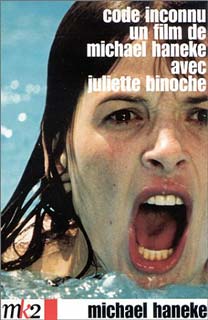
Code Unknown. (2000) Michael Haneke


A melting pot of social, racial and biological interactions, with injustice and violence and voyeurism thrown into the mix, Code Unknown is a film about owning up to the mystery of human relationships -- how we stumble to connect through the maze of our own expressions. The film's continual emphasis on cameras, and on the deaf and their sign language is a reminder that gestures carry just as great a weight; that symbols are as important as words.

On a business day on a crowded Parisian street, Anne (Juliette Binoche, outstanding as always), a local actress, is surprised by her lover's little brother, Jean, who has run from his father's home and needs the code to get into her flat. She loans him the key with a stern reminder that the place is small and that his stay will be short-lived.

On his way back to her flat he discards a wrapper on the lap of an immigrant woman sitting in the street. He is immediately challenged by a young black man, Amadou, about the rudeness towards the woman. Amadou seems interested in justice and demands that Jean apologize to the woman, who at this point seems to want to get away from the developing scene. The hardened kid refuses an apology, a street scuffle ensues and the police are quickly on the scene.

In the first key misfire in deciphering a social disruption (a sort of "code"), the police arrest Amadou and the immigrant woman is detained, and later put on the next plane out of France. Sometimes you speak for justice only to create a larger, more alienated mess. The scene cuts away suddenly, as do many scenes in the film, leaving you wondering how the strange event ended up.

The story picks up with Anne’s acting career -- she is constantly in front of cameras and directors (her photographer-lover Georges is out of the country snapping war photos for a feature in a respected journal) -- and several immigrant families and their isolation in a Paris that, for them, is harder to live in than they thought.

The fragmentation of society and the isolated lives within it are at the film’s central themes -- regardless of the social or economic status of the individual.

At one point Anne stands on an empty, dark theater stage in an audition for an upcoming production. For several minutes in a static, still shot, she gives her lines in character, giggling and laughing hysterically, absorbed in the lively role. At the end of her lines the room is silent and still. With the spotlight in her eyes, she can't see anything in the room. "Anyone out there?" she questions, and it feels like the central question of the film. Yes, the director and his assistant are still there. Yes, they've seen and are evaluating her scene. She waits like a refugee for an answer.

And yet in another brilliant moment the film counters the notion that we're alone, that someone will be there in the middle of our need. On the subway, Anne is later threatened and intimidated by some kids with nothing better to do but act like jerks to traveling passengers.

Their intentions are not known, but one of them gets a taste for barking at Anne and abusively follows her around on the car. When he gets nothing but the silent treatment, he goes so far as to spit in her face. A man she's never met takes a great risk and stands up to the kid. He stands the kid down, and when the kid gets off, Anne, who has been courageous up to this point, finally falls apart in tears. A stranger has just come to her aid.

There are particular things to watch for in the minimalist editing and camera movement in Code Unknown. The film is based on a series of one-takes which lends an honesty to the way the story develops. There's no deception in the image, and no soundtrack to manipulate the viewer. The well-acted scenes are relayed in a pure way; they live and die by the strength of the acting.

The camera also follows this route in aiming for full disclosure, almost moral in its use of tracking and still shots, in prolonged takes that are horizontal in motion in honor of human connectivity and concern. Watch for movement that sweeps from right to left, and back, until one of the final, lingering images, where an unknown code is lost while a key character gazes skyward.

As Georges says, when going through photos from a recent trip: "It's easy to talk about the 'ecology of the image,' and 'value of the non-transmitted message.' What matters is the end result." It sounds like the resolute words of our story-teller, director Michael Haneke, on his most honest and well thought-out film to date.

Dogville. (2003) Lars von Trier


What — or rather, who — is Grace?

Perennially controversial and once again in a mood to provoke, Danish director Lars von Trier has in Dogville constructed a minimalist tale of a bygone era on a simple symbolic stage. The film’s depiction of evil and our own response to it inevitably generates intense debate.

The story centers on runaway Grace, hiding out from both the mob and police in the small town of the film's title. Nicole Kidman, as Grace, brings one of her finest performances to the role. She, and her story of blending in and serving the town's people, are quite subtle — almost kind — at first.

But Dogville is a huge crescendo of a film, ending on the grandest scale possible, a Shakespearean-style tragedy of Biblical proportions that's willing to swallow whole anyone that gets in the path of Grace.

The director's well-known and worn out trademark from recent films is his misogynistic treatment of the leading women in his films. Take note: Dogville is no exception to this. But to this viewer von Trier makes a habit of being concerned with capturing the suffering and, in general, the abuse of grace as well. He is a consummate artist whose ambitions are often to wrestle with or against the sky, whether he admits there's anyone up there or not.

Von Trier, as the one who holds the Joker and stacks the deck, is sometimes compared to Werner Herzog in his probing of things natural and eternal. These are artists willing to strike first and ask questions later; they are sometimes despised for their willingness to take risks.

Dogville's greatest strength is in its ability to evoke so many (sometimes infuriating) views and perspectives. It spawns multiple readings, which are as varied as its viewers. Critics often talk about the film's political agenda, but there are quite a few interpretations that are overlooked: New Testament grace in light of Old Testament law; how far grace is willing to go before judgment steps in and takes over; blood ties of a prodigal daughter and the lengths a father goes in bringing her home; and the typical critic's view, which is American puritanism (then) vs. capitalist, imperialist greed (now).

The latter is obviously the anti-American angle, and the reading, judging from the film's closing credits, isn't undeserved. The song of choice (David Bowie's "Young Americans") that plays over the credits is like poking a finger in your face if you happen to live in what the film calls, "The US of A."

There's a lot to chew on here, but the subject remains the disposition of Grace. Some viewers may forget the meaning of the word when it begins with a capital G, but that may be the deepest meaning of all in this provocative film.

Ratcatcher. (1999) Lynne Ramsay


An art film disguised as social melodrama, Ratcatcher funnels Scotland's notorious garbage strike of the 1970s through the eyes of children in an impoverished Glasgow housing project. The film's beautifully captured images of these kids beset with hardship are remarkably honest, sometimes disturbing, and often haunting.

On the banks of an infested sewage canal running adjacent to their home, young James and neighbor Ryan Quinn are playing or fighting
-- it's hard to know the difference growing up in urban decay. The kids are prone to the typical adolescent problems one expects in a neighborhood like this; if growing up is difficult anywhere, then growing up here can be downright traumatic.

After their brief encounter, James isn't certain of his guilt or innocence in Ryan's death. He fled the scene too quickly to know for sure. What he does know is that he bullied the smaller Ryan, and when he fled the scene Ryan was in the cold currents of the canal, being drawn underneath to a quick and frightening end.

The guilt eats away at James, creating a rubbish in his heart like the clutter no trash man can take away. The bulk of the film follows James and a guilt constantly there behind his eyes, reflecting a conscience he somehow holds to in the midst of many crises. An alcoholic and unemployed dad inside the home and bigger-boy bullies outside, he needs to get away from a world he sees in a perpetually rotting state.

As the kids chase rats in the piled up heaps outside, James hops a bus to nowhere, no destination in mind. He finds a new, more prosperous housing project on the other side of town -- the kind his family wants to move into. Even the same sky with the same clouds seems prettier in new structures and open fields on the town's other side.

Ratcatcher is a film about learned behaviors, from James being bullied and then becoming a bully when he can, to street kids who create the same sexual tension they've seen at home, to a housing project left in disarray, where even the ever-present garbage symbolically speaks of a neighborhood left behind.

There's a neighbor kid, Kenny. He's a bit slower than the rest, not quite as bright. He functions as a sometimes comic relief in a film that desperately needs him. All of us have a Kenny in our lives -- the person who is often overlooked, the one that gets by in the joy of his own world, a world that when shared is seen as "different."

Kenny doesn't need much attention as he tends to his own quirky behaviors. He's also the "ratcatcher" in the film, and as such gives us an unexpected, delightful scene of imaginative reprieve from the spiritual and social squalor of trash-infested Glasgow.

Rich, raw visuals fill up Lynne Ramsay's debut directorial feature, lending poetic imagery to the hardship she depicts. Criterion's choice of subtitles helps with what would be unmanageable Scottish accents; titles are available on the disc as well as streaming at Netflix. This is a good thing -- the film is in English, but it's barely recognizable, which adds to the other-worldly feel of this neglected neighborhood.

Monday, February 14, 2011

Notorious. (1946) Alfred Hitchcock


So, it's Valentine's Day. Time to check out some black and white love.

Finding the love in this film, however, is less like waiting for a watched pot to boil and more like waiting for the same from a swimming pool. But a sizzler of a swimming pool it is.

Here are some of the awesome, awesome anti-love quotes that build to a stunning, intense, climactic attraction in Notorious:

Devlin: Why do you like that song?
Alicia: Because it's a lot of hooey. There's nothing like a love song to give you a good laugh.

Alicia: I like to make fun of myself. I'm pretending I'm a nice, unspoiled child, whose heart is full of daisies and buttercups.
Devlin: Nice daydream.

Alicia: The time has come when you must tell me that you have a wife and two adorable children, and this madness between us can't go on any longer.
Devlin: I bet you've heard that line often enough.

Alicia: That isn't fair, Dev.
Devlin: Skip it.

Devlin: Pretty fast work.
Alicia: That's what you wanted, wasn't it?
Devlin: Skip it.

Alicia: Well, you never believed in me anyway, so what's the difference?
Devlin: Lucky for both of us.

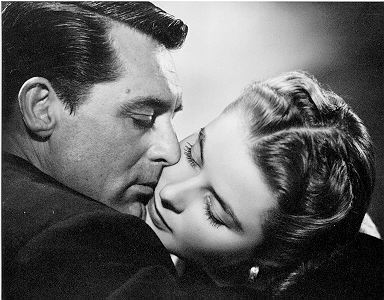
I'm certain the printed lines don't translate half as well as they do when performed by Cary Grant and Ingrid Bergman -- two well liked and well known actors playing "notorious" characters in a film by cinema's most admired and beloved director.

The romance in this film, or rather the built-up tension in the lack thereof, is, in the words of Jim Carrey in The Mask: "Sa-mokin." The chemistry between Grant and Bergman is of feverish intensity, but circumstances create a situation where only the wrong words can be said.

I always hated what I referred to as the "soap opera dilemma," which is that a bad situation could be 100% corrected if only just one line were spoken, but it never is. There's time for the line, but for some reason the info never gets relayed. In soap operas, the reason this happens is that people writing the show have to continue writing every day, and if they solve the problem today they'll get a bad case of writer's block tomorrow.

But here's a film that takes that space between the words and makes sense of it. There's always a reason the right words don't get said in Notorious, and the film is just as amazing for its perfect use of dialogue as it is for the dialogue left unsaid until the hopeful ending finally arrives.

It's plot is like a spy-thriller, a device Hitch fell in love with. Devlin is some type of Fed bringing Alicia, the loose, rich woman into an investigation against some post-war Nazis, where only she has what it takes to get inside. Her Benedict Arnold dad had connections with Germans setting up a company in Rio de Janeiro; she's to infiltrate the group by falling in love with one of its key players, but things nosedive when she falls instead for Devlin and the key player asks for her hand in marriage.

Last year I made a vow to myself to see more films by Hitch. I'll never aspire to cult status as a true film buff unless I make this so. I re-watched Vertigo and Rear Window, and for the first time took in North By Northwest, The Man Who Knew Too Much ('34), and Notorious. I'll freely admit that it took me a few viewings to really get into the world of Notorious, but I've fallen in love with this film over the past six months and can't get over what a masterpiece of cinema it is.

There's a shot in the middle of Notorious that begins at the top of a balcony with a long, winding staircase. You barely notice Ingrid Bergman on the floor below. The camera begins a long, steady zoom, as if gliding past the spiraling staircase, until you notice that it's got part of her back in the frame. You might wonder for a second why she's a little off center, not completely the center of focus. But the camera keeps zooming in, and now the picture is lopping off her head. She rests her hands behind her back, and we're not done zooming yet. Behind her back, her left hand is more and more revealed until finally, in perfect focus, the shot rests on a key in her hand, which is significant to the story in that moment. It is a breathtaking shot, to say the least. I didn't know they had cameras that could do this sort of thing sixty-five years ago, but it would still be an incredible shot by any of today's cinematographic standards.

It goes to show how the things from the past come more fully into focus over time, and how perfect they can be when we slowly let the picture zoom in on its aged, artistic majesty.

This is a wonderful film. It's an interesting love story, but it's best for the love in its spaces.

Sunday, February 13, 2011

Following. (1998) Christopher Nolan


Like Europa, blogged only a few days ago Here, Christopher Nolan's Following has all the main ingredients for the making of a modern film noir: a down and out writer, an investigating cop, a sassy blond dame, a gangster, a blackmailing, and a few double-crosses where characters are as quickly and easily betrayed as they are discarded. Shot in black and white on a shoestring UK budget, the writer/director's debut deals in what would later become standard in his stories: time-shifting mazes, non-sequitur paradoxes, and the schemes of powerfully weak characters voyaging to a certain elusive section in the dark corridors of the human psyche.

Nolan likes puzzles. There's no doubt about that. His films are like navigating that old brain boggler, the Rubik's Cube -- it can be done, but it's never easy, and you might have to twist and turn along the way. Even Nolan's 2010 blockbuster Inception gave us a summer popcorn movie plugged with references to Escher, lost labyrinthian corridors and the architecture of a dreaming mind in disarray. The Maze is a regular character that turns up in Nolan's stories; it's one of the reasons we look forward to new projects that bear his name.

The stories are always different; there's no regurgitation from film to film. But The Maze is always involved, one that characters endlessly grapple with and stumble around in. There are many different ways to put it on display, and Nolan always has a knack for a new entrance into it. Where Inception and The Dark Knight challenged the popcorn crowd with layered dreams, higher moralities and paradoxes -- and earlier films like Memento and Insomnia dealt with memory and its survival in time -- Following is the film that set these circular themes in motion. It's the smallest of Nolan's films, but feels unmistakeably Nolanesque, launching the vibe he would be known for: the weaving of layered schemes and stories together.

An unemployed and somewhat bored twenty-something, who fancies himself a writer, takes to the streets to find subjects for his own interests, and maybe he'll get some some writing done, too. He, who the script calls "The Young Man," and maybe lies about his name when he says it is Bill, becomes addicted to "Shadowing," his own term, which is following different people around. Any age, race or gender, he just wants to see who they are, where they're going and why. He makes rules to keep himself safe in the daily hobby, like never following a woman down a dark alley, or never shadowing the same person twice. It's when he breaks these codes of conduct that the hobby becomes more of a burden than he intended.

He's cornered and confronted by a man that he's followed into a diner -- Cobb, also the name of DiCaprio's thief-character in Inception. Cobb has noticed the fellow shadowing him, but he's been up to an interesting hobby himself -- he's taken The Young Man's idea of following strangers to an even higher level of danger. He quickly takes The Young Man under his wing.

Cobb isn't interested in simply following people around or guessing what they're like. He knows how to find out everything about them without ever saying a word. The answer, he says, is in home invasion. He teaches "Bill" that sneaking into someone's flat can provide an adrenaline rush like one has never felt before, and as a bonus you can steal things if you want to. Burglary isn't really the point though. The point, says Cobb, isn't found in any valuables within the house. The point is to see into their consumerist lives, and to take, so that they realize what they had.

When they end up thieving together, they aren't interested in jewels or gold or cash that might be hidden under a pillow. They're more interested in CDs from the family room stereo, or digging through a resident's underwear to leave at another victim's place. They're into mementos and family pictures, diaries and books with personal notes in them. "Stuff" is not the ultimate goal of these robbers -- it's privacy, and the knowledge that they've been there. They'll take only one of the two earrings in a woman's jewel box -- leaving just one behind only adds to the mystery.

At one residence they pop the cork from a bottle of wine, but barely drink a drop before being caught in the act of drinking it. They've got to act on their feet quickly to get out, but the couple in that place will remember them forever.

I've heard of people that need to break out of the structure of their isolationism, but this is ridiculous.

The idea of a burglar that isn't interested in material possessions almost sounds Robin Hood-ish, like stealing from the rich to give to the poor. I'm unconvinced of Robin Hood's nobility in the first place, but I can see the parallels in such a tale (depending on which version of the legend). However, there's nothing noble about these robbers and their habit of breaking into flats, even if only for a peak. It's voyeurism gone extreme -- social studies for the socially maladjusted, on an urban sprawling scale.

"You take it away to show them what they had," says Cobb -- but it's unconvincing when he speaks, like someone talking to a cop about a speeding ticket. Cobb's real motives remain elusive even at the end of Following, but Bill is just pathetic, useless, bored, and slightly dangerous in his boredom. He's an un-magnificent man in an un-magnificent life. He's going nowhere fast, following nothing that nourishes him, so why not follow the first thing that comes by on the street or in the local mall? The idea that people so easily fall into traps like Jonestown or Heaven's Gate is more understandable when considering a man that blindly follows.

There's a noted difference between Following and Nolan's, um, following films in the way-too-indie feel of the production. The first film from a debut director is obviously not going to have the production values of something like The Dark Knight or Inception, but it's the music in Following that bugged me most. It's lifted from public samples of some amateur software like Sonic Foundry, and in many scenes it sounds generic, or sometimes grating, or just filler. I imagine this is where most new filmmakers have to begin -- they don't any money so there's no orchestral composer on hand. Still, the samples aim for a Trent Reznor industrial-type background, and as easily seen in The Social Network, only Trent Reznor can be Trent Reznor. I don't think this film would have worked with more silence, so I don't have any answer to this, just an opinion of what didn't work as well.

The black and white visuals are edited tightly in and rather save the film from its audio implosion. There are a few holes in the story itself, a plot that doesn't hold up when fully thought through, but you don't necessarily think about it while you're caught up in the back and forth time shifts of the events. It is, in a way, like dealing with a less humorous black and white Pulp Fiction. You don't worry about missing holes, because you're being tossed back and forth in so many.

The ending is rushed -- I do think this 70 minute film would have worked a bit better at 80 minutes -- but it leaves its central character "The Young Man" grasping at straws, reminiscent of classic noir. It's not a perfect film by any means, but remains an interesting look into the beginnings of Nolan's universe -- where chaos and collision and moral mazes and memories, and even where the name "Cobb" comes from.

Thursday, February 10, 2011

Europa. (1991) Lars von Trier


I'm gonna have some splainin' ta do.

So before I talk about Europa and why I think it's worthwhile (or not), let me first approach the confessional booth like a dogme filmmaker breaking a vow of chastity:

I've been aiming to only cover black and white films this February. This film is not entirely black and white. It is, shall we say, mostly black and white. But splashes of color are gingerly brushed in as the mood of the moment dictates. (And together, the two styles are an engaging combo, I might add.)

The film is still in line with themes I've been aiming for this February. At least, it feels like it is in my head. The monster movies have been out there. Lynch is most certainly out there. And if in my last post I called Eraserhead the film I'm still most fascinated with, then Lars von Trier is the director I unapologetically remain most fascinated with.

Europa, called Zentropa when it came to theaters two decades ago, was a step into the big-time for von Trier. It was the third film in his first trilogy, but it would break out of Scandinavia in a way the first two films never could. Made with a bigger budget, a more polished film crew, and shot mostly in a foreign land (Poland) with 500 extras on the set, it would send the great Dane into notoriety at Cannes for one of his first great wins on the world's greatest film stage.

Poland in 1990 was a perfect choice for locations that looked like Germany at the end of the second World War. I was in Poznań playing music in the winter of 1990 and I assure you there were places that still looked devastated. I remember taking a taxi through the outskirts of the city late one night, and my view through the falling snow was that of dilapidated buildings, even 45 years later.

The location and the setting are worth mentioning because the strength of Europa is in its presentation -- not just that of a land that still looks wasted from war, but the way that place is captured and presented to its audience. The strength of Europa is in von Trier's urge to present an engaging film experience, mostly through sight and sound. The story, though good, is somewhat in the background to the actual experience at hand.

We meet Leo, an American in Germany, working for the Zentropa train line. During the war, Zentropa was used for transporting Jews in cattle trains to concentration camps. The war has ended, the German nation is in disarray, and these days much of the train's use is in transporting American officers first class as they watch out for "werwolfs" -- a resistance that won't end the fight even though the war is officially over.

Leo came to Germany as some kind of human symbol of peace and unification. He seems genuinely interested in lending a hand to the country. He's somewhat innocent, maybe naive in his desire to be a comfort to a traumatized land. He quickly learns that the war may have ended, but it doesn't mean there aren't sides that still want him for their cause. He falls in love with a woman who seems to flirt in the camp of the werwolfs, and like a sheep to the slaughter he feels a tug from both sides, when all he wanted was peace for all.

Europa might be about Germany and the war, and it might actually be about post-WWII Europe in general, but it has the look and feel of a classic American film noir. Well, strike the word "classic" from that last sentence. It's a noir, but updated with every trick in the book that a film can pull off half a century after classic noir. If you haven't seen Europa, it might help you to know that my recent viewing reminded me of another film that carries the same style: Sin City. Although that film is far more bloody and violent, it seems like it must have borrowed heavily from Europa.

The visuals are key to the enjoyment of this film, and that's what I remember from when I first saw it twenty years ago: Silhouetted lighting sets the visual tempo of a noir, but the modern is captured in subtle split screens, front projection against matted backgrounds, remote control cameras rotating on ceilings, and shots that seamlessly glide through windows, turning corners for an entirely different view. Walking platforms are often used as characters stroll along in color against archived film or black and white Poland in the background. The trick visuals and lighting are extraordinary in Europa, and it's fun to see von Trier in his youth and in his element. At this time in life he's still experimenting, still looking for the "zip." He's already trying to prove he's the greatest director in the world.

The shots are hypnotic, matching a hypnotist who narrates. This is one for the film school students still looking to be impressed.

Monday, February 7, 2011

Eraserhead. (1976) David Lynch


Of the thousands of films I've seen, and the many I've written about, this is the one that remains the strangest. And in the twenty years since I first started grappling with it, it's still the one I find most fascinating. Easily.

It's an art film that never lets up on fully immersing itself in a viewer. It submerges you into its world from the very first frame, and it simply never backs off from its opening dream-like moments.

It fuses fantasy and reality to a point where the two get a bit confused. Lots of films do this, but Eraserhead does it best. In disturbing little scenes, where fear comes to life and actually takes over the bulk of the script, the blending of the real and the outlandish is near lunacy, like a trip into the pit of the surreal.

Eraserhead is "too much" for some, but their distance from the film is telling: They were impatient, or it scared them. They thought it was artsy or self-indulgent. They only watched it once, and wanted to forget it, or they had no desire to interpret its meaning.

The plot is so simple you can spoil it and not ruin a thing:

1. Henry Spencer is invited by ex-girlfriend Mary X. to dinner at Mr. and Mrs. X.'s house.

2. Henry is told by Mrs. X. that during their time apart Mary gave birth, and it is his to care for. His responsibilities in the matter will begin when they are wed.

3. Mary and the baby move in with Henry. Mary is suffering from postpartum depression. She'll have no further sexual relations with Henry, and the baby's crying is driving her over the edge.

4. Mary moves back in with mom and dad. In her absence, Henry watches over the baby and has an affair with "The Beautiful Girl Across the Hall."

5. Abandoned with the child, Henry has nightmares, dreadful daydreams, hallucinations, and awful ideas, both about his own infidelity and the fate of a baby that is growing more sick every day.

6. Henry, in a sort of Abramic despair, in a predetermined act commits the film to true horror by doing the one thing Abraham couldn't -- an act that is either merciful or barbaric, depending on how you want to reason his involvement with the film's world.

The plot serves only to advance an interplay of image and ideas. The film may have a plot, but it's more about relaying a language of expression, particularly the expression of human experience through: sex, fidelity, parenthood (most specifically fatherhood), moral responsibility, fear of abandonment, the alienation of modernity, isolation, resentment, adultery, and what is described best in the Kierkegaardian sense as "introversion" -- knowing your own despair and not finding it in anyone other than yourself.

All of these are expressions of the film's greatest emotion -- fear.

Lynch uses several methods to achieve this language of expression. The first is in letting his actors funnel their character's inward disposition through outward manifestation. Characters seize, violently convulse and atypically smile for prolonged periods of time according to the psychology of the moment itself. In other films, we would credit the actors for relaying these feelings without necessarily showing them. In Eraserhead it is quite the opposite. Outbursts of inner fears come across so strongly that they shock us with their feelings on display. These are people who express everything, a shock to normal viewing expectations. Think about it: Do you say everything you always think?

In the early scene at Mary's house the emotions set the tone. The oncoming, inevitable discussion over the birth Mary gave is intense, and it's relayed through seizing and convulsing (both Mary and her mom), and wearing a constant fake smile to bring peace (dad).

Things seem so out of the ordinary because we're seeing the emotional, perhaps the spiritual, brought to a physical presence. Henry wouldn't continue chatting away with mom during Mary's seizure in the living room; likewise Mary and Dad wouldn't simply go on with life while mom goes into convulsions at the kitchen table. Henry might have thought the dinner looked a little undercooked, but the chicken wouldn't wave its legs at his disgust, and mom may be intrigued at the sexuality of her daughter but she wouldn't lunge to seduce Henry when she finally gets a chance to talk to him alone.

Lynch takes this expressionist acting to the extreme in the crafting of the film itself. Relying heavily on its gruesome imagery and its looming, terrifying sounds, the film is constructed and layered to attack viewer expectations. Every aspect of manipulation you've seen in any movie is amplified to extreme proportions -- purposefully so. It works because the bulk of the film is so quiet, suggesting that much of normal life is also quiet, but when the nervous system kicks in, it kicks in hard. (Have you ever found yourself falling asleep while tipping back in a chair?)

Freud would be happy with me, because my reading after a recent viewing is the same as it has always been, although perhaps I have incorporated a bit of depth over time. A subtext of sex runs through every portion of Eraserhead, beginning right at the start of the film with a sperm exiting Henry in the opening montage, floating endlessly in space until finding its way to a sort of ovum, where it is drenched in a liquid life, eventually bringing about conception. Henry's sperm -- gigantic, like everything else in Eraserhead -- is a recurring theme throughout the film: it's between Henry's sheets, representing masturbation after his wife's rejection; it's being stepped on in his dreams, like the ones that got away; and in a final scene in direct confrontation with Henry, one is standing up on end and hissing angrily at him -- while his child, which resembles the creature, taunts and laughs when he can't locate The Beautiful Woman Across the Hall for sex.

In Eraserhead, sex is portrayed more honestly than in much Hollywood fare: sure, it is a fascination, an object of desire, but it's also something to fear, and even fear its humiliation. It has the power to create, but its drive has the power to tear apart and ultimately destroy.

Suggestions of determinism in the sexual are found in an unknown figure called "Man In The Planet," a behind-the-scenes Dark lord who predestines events by flipping this or that switch in the universe -- he's the one responsible for driving the giant sperm to its final location for conception (a large hole of light lined with what appears to be pubic hair). There is a something, even someone at work behind the scenes. Whether he's a deity or an unnameable force we're uncertain, but whatever he is, he assigns Henry to his fatalistic role. The Man In The Planet guides the sperm, creates the birthing process, and throws the switch at the end which launches Henry into the furious motion of the dreaded grande finale.

Henry, the abandoned father, the alienated man in his dark, one room apartment, dreams of a glowing, dancing lady in the radiator. After climaxing with The Beautiful Girl Across The Hall, Lady in the Radiator sings about heaven. The placement of the song "In Heaven Everything Is Fine" is usually taken out of context, but we need to remember that it was sung shortly after Henry's infidelity, actually culminating in his adulterous climax. The sexual innuendo is endless in Eraserhead, but so too are the ramifications. Very shortly after the episode of adultery, Henry finds his own head cut off (his mind racing with the insane pace of the new world he finds himself in). His brain might as well be ground into erasers at this point, so naturally, in this film, it is.

I agree with a few online friends who have said the film changes as you age and have kids. Fatherhood and the fear of failure as a man stand out to me now that I have kids. I didn't read the film that way when I first saw it years ago, but since then have dealt with things like colic, crying, postpartum depression and restraining your anger in the heat of the night. Having a baby can truly be a maddening experience, especially if you're like Henry and are not prepared. The deformed creature, that crying baby, is monstrously ugly because it is perceived that way by unprepared parents. It's an intrusion, unwanted, and they're left to the daunting task of somehow keeping this sick thing alive.

Sonically, there are few films that rival Eraserhead. The sound in the film is overwhelming. Even thirty years later the sound is a mark of the film's genius. Easily remembered are: the space sounds when Henry's sperm is fully launched, the carnival music as Henry meanders along, the hissing radiator and ticking clock always present in the apartment, and the howling wind when the baby won't sleep at night. Perhaps the most jarring sound of all is ripped straight from earlier b-movie horror: upon noticing for the first time how sick the child is, a dramatic organ chord with bellowing pedal tones comes crashing out of nowhere, a jarring effect in what was once a quiet scene. The wrestling between silence and atmospheric fury sets the tempo for the visuals people remember.

There's a brilliant piece of writing on Lynch, from his early days in school, his struggle with his first films, and the making of Eraserhead. It's Here. It's been on the web for quite a few years, and seems to be reprinted from a magazine sometime in the early 80s -- it's fair to assume that the info there is accurate. It's one of the better pieces of writing about the film on the web.

At the site there's a capsule about Eraserhead that, to me, brilliantly sums up why the film draws the viewer in: "What Lynch does is to distort what is familiar; at first one perceives it as strange, but as one gradually comes to see its familiarity, one is forced to reevaluate what is usually accepted without question. By showing us the familiar in the strange, he makes us aware of what is strange about the familiar."

Sunday, February 6, 2011

The Elephant Man. (1980) David Lynch


Having had some fun recently in giving a contemporary reflection on a couple of landmark, classic monster movies, I felt my quest for the perfect Black and White February would be insufficient should it thematically end there. For now, I need to continue in this rich black and white tradition, a tradition which feels like it's not satisfied with one, lonesome monster. But I can't stay stuck in the thirties forever. Nor can I, for my own sanity, only burrow into "Creature Features." The time is right, so it seems, for me to go back to some films I've already seen; I'll start by digging into the monstrous and surrealist mind of David Lynch.

So here's a movie I saw as a child but haven't seen in thirty years. I first saw The Elephant Man with my mom and dad in a theater setting when I was ten. While I'd be lying if I said I could quote the family discussion that followed, I do remember that the film sparked a good deal of conversation around the house. Perhaps mom and dad saw the good reviews and the PG rating and thought it'd be good to take me. I wonder, when they took me, if they regretted their decision.

But I'm glad they did. I haven't revisited the film in three decades, but it has clearly stood out in my mind. One wonders if a memory might stand out because you were only a certain age and not ready for a particular event -- but in this case, I don't think so. I'm thinking very hard here, trying to delve into the deep corridors of my film mind, but I'm thinking this might have been the first serious "film lover's film" I'd ever seen. I know for a fact it was my first experience with Lynch.

The film really stands up to the test of time. It's quite remarkable, an amazing achievement in Story, although I'd have to research its historicity to know how well it stands up story-wise there. But it is lovingly rendered, and feels like a dramatic enactment of what history might have been; it at least feels like a factual approach.

It's a very quiet film where heavy use of space, sometimes intense space, and sound that can only be described as Lynchian (think: Eraserhead), exceeds the notion that a black and white or an aged film are somehow lesser than a new release. As a biopic or a melodrama, and perhaps somewhat as an art film, The Elephant Man still surpasses most films released on a given weekend.

It may be that I just saw Frankenstein, but one aspect it shares with The Elephant Man stands out. I noted in my recent blogging that the creature most often referred to as "The Monster" in Frankenstein isn't really the monster in the story after all. I was a bit hesitant about this, not knowing if I sounded out of place, but my understanding of the greatest monster in the film is that of mob mentality, a group of people running wild, a witch hunt with lit torches and barking dogs on a scent in the woods -- a people chasing only the fear of what they can't understand, and chasing the end result of an experiment gone wrong rather than the creator responsible for the many deaths. I think it is a fair reading, and I'm sticking with it for now -- especially in light of the human brutality that is monstrous in The Elephant Man.

Here we have John Merrick, whose mother at four months pregnant was trampled by an elephant, producing every kind of deformity one could think possible on a child at birth. We find Mr. Merrick in the beginning of the film in a Freak Show at the local carnival, being gazed at by paying onlookers. They are horrified, scared to death at his physical appearance, some sickened to the point of tears or even screaming in sheer terror and running away. This indecency alone would be enough to give a picture of the man's torment. But he was also locked up in the dark, beaten with a rod, and barely fed.

We don't know what drew Dr.Treves (a young and handsome Anthony Hopkins) to see the deformed young man in the first place. We know he went, even sneaking in the back to get a view that was different than other paying customers. The suggestion about him sneaking in is that he wants to see the young man for reasons that are out of the ordinary -- perhaps from a medical perspective, perhaps from a human perspective, but he's apparently not there to be an average horrified onlooker.

It takes Treves more than one attempt, but when he finally obtains a private showing, the tears immediately well in his eyes. It seems the human does trump the medical need to see, and it works on him rather quickly.

The bulk of the film is about Merrick's sickness, his trip to the hospital, Treves and others that provide care for him there, and the continual abuse of a man that can't seem to escape it, even in what should be the safe setting of his room in the hospital.

When he first arrives at the hospital, Merrick wears a bag over his head for the trip. The bag is a physical barrier between his face and public reaction to it. The man doesn't need more humiliation in his life. But how does the same bag emotionally alter Merrick? In "The Scarlet Letter," for example, a woman wears an "A" to publicly shame her, a physical sign for anyone to see her sin. Though Merrick has done nothing wrong, his life is viewed like the woman who wears that badge of shame. His shame has nothing to do with any deed or misdeed, rather it's public perception based solely on his physical appearance. If people could get past his appearance they'd find a caring spirit -- a warm, loving man with a golden, tender heart. The bag over Merrick's head functions as an emotionally protective device for his heart. It is, after all, a heart shattered by mass social destruction. The bag is less for the public and more for himself.

The bag has to come off at a certain point, though, especially when Merrick is seen and observed by hospital staff. There are still a few outlandish reactions, even in this setting -- one nurse bringing breakfast lets out an enormous shriek when seeing his face for the first time -- but overall, as time progresses, the staff know Merrick for more than the outward, for more than what the press starts writing about daily in the papers.

Eventually we get to scenes that are the core of the heartfelt story: Merrick, invited to tea with Treves and his wife at their upscale home across town; a visit from a local, well-known actress in the theater, who brings a gift of a classic novel, as well as the gift of kindness, lighting up the interior of his room; and Merrick himself, isolated in his new room but happy, creating a model of a cathedral he sees outside his window, and reminding himself of better days by glancing at a picture of his mom, propped up by his bed.

The kindness in the room is interrupted, of course, by strangers who will take advantage of any new thing they can profit from. But at a certain point it's the kindness that triumphs in The Elephant Man. It's what we remember when later thinking about the film, and in the story itself it even bleeds from a few doctors and nurses in a medical setting back to the midgets and freaks who find him residing with them once again. It is their kindness that saves him this time, showing an escalation of good that is happening in his life.

The thing that sets The Elephant Man apart from a film like Frankenstein, where it is all too easy to believe in nothing but the saddest aspects of humanity, is the continual kindness in scenes like this, which make us want to believe in a better humanity than just the kind that will look on Merrick with cruelty. One of the scenes that touched me most, and made me most want to believe in mankind, was a scene in which an entire booked theater came to standing applause for Merrick, as if recognizing one of the hardest lives that's been lived and admiring his will for not only survival, but for remaining a gentleman amidst all this cruelty. Still, the cynical side of me wondered if there were people in the theater audience, standing in applause, who were also present at the carnival paying money to see the freak show. There's good and bad in all of us, often there's a mix found at any one time.

Finally, speaking of "Freak Show," for some it may be hard to wrap the brain around the fact that this is a David Lynch experience -- the man responsible for Blue Velvet, Inland Empire and other disturbances along the way. It may be hard to understand that Lynch is involved when I describe the film's heart of flesh, or the kindness or belief in mankind I've talked about. While Lynch is known more for his avant-garde, bordering on dangerous filmmaking style, there is definite evidence of his presence in The Elephant Man, with his fingerprints all over the unorthodox feel of the opening and closing stanzas, relayed in highly stylized montages reminiscent of the opening and closing scenes of Eraserhead. Merrick himself is also somewhat reminiscent of the deformed baby at the center of Eraserhead, at least in the way the thing is depicted. But the grotesque nature of that creature seems to make him more revolting -- for a reason, which I will argue tomorrow when I blog about my reaction to that film -- whereas the grotesque nature of Merrick in The Elephant Man eventually invites us to see through the deformity, to the core of his gentle nature. Lynch is able to achieve different end effects from creations that are stylized quite similarly -- the mark of a genius in his field.

Thursday, February 3, 2011

Bride of Frankenstein. (1935) James Whale


Four years passed between Frankenstein and its first sequel, but the story picks up on the same savage night of the supposed destruction of the creature, in a fiery inferno sending his soul back to hell.

Then again, we 21st century media-savvy types (which is pretty much everyone, more or less) know that no creature dies in a first film, no matter how much its makers want you to believe it -- no matter how hot the burning mill, no matter how many citizens saw the structure burn to ashes. We of course know that no alien, no mummy, no Jason or Freddy or Michael will be dead when the credits have left a first film's screen. You can't have a second Creature Feature if you haven't got a creature to feature.

There is genius found in moments of Bride of Frankenstein. I love how they kept the creature alive, escaping the tormenting flames in a mote below the mill. And the final act is any film lover's delight.

I also thoroughly enjoy something as simple and fun as the opening credits, which piggyback off Frankenstein's use of "?" for The Monster, using "?" once again for The Bride. There are so many moments where Bride of Frankenstein gives its all in being just as good as the original, you've got to love it for its heart alone.

Author Mary Shelley, played by Elsa Lanchester (who also plays the impressionable Bride in the outstanding final chapter), sits cozily indoors with a couple of highbrow if not caricatured gentlemen, the wind whistling and the thunder crashing outside. One of the men, claiming the status of "England's greatest sinner," considers how warm and safe it is inside the house, while an angry Jehovah viciously thunders outside. "How beautifully dramatic," he says. "The crudest savage exhibition of nature at her worst without, and we... within..." He claims his head is unbowed to the thundering God outside. But who would fear a supposed God if kicking back by a comfy fire was all it took to protect you from his wrath?

The men talk highly of the creepy chills of Mary's original Frankenstein story. They narrate over images of the film (blogged about Here), a brief recap for the sake of the audience's memory from four years before. (There were no television premiers or TiVo in 1935.) They implore Mary to share the rest of the story, so she launches into the sequel, the story of the creation of the Bride. It's an almost perfect beginning to the film.

Almost, because as her story emerges there's an immediate disconnect from the original, quite noticeable within seconds. The medium of filmmaking changed quickly in four years, the times obviously persuading director James Whale to stuff oodles of musical score in the background. It's interminable presence is constantly noticeable, a never-ending standout out like a splinter in one's thumb. It nulls the tension so easily relayed without filler in the original film.

The writing and dialogue are so dark and crisp that seeing it 80 years later and complaining about the score seems unfair. But the problems don't end with the score. We're immediately introduced to a side character, Minnie, played by Una O'Connor, used mostly for comedic effect. She is agonizingly horrible, not funny for a moment. She brings camp to a film that wishes to reject her and her whiny voice and its shrieking screams. She is truly the most awful thing in Bride of Frankenstein, and watching her made me think the person responsible for casting her hadn't seen the original. Then I found out James Whale casted her.

There's but one line that may have worked for O'Connor as a decent foreshadowing to the rest of the story: "Oh what a terrible wedding night!" she cries, in regard to the botched wedding plans of Dr. Frankenstein and his bride. But after the brittle scream that escaped the woman just moments before this interesting sentence, all you wish is that the creature had killed her when he had the chance.

The film is a much bigger production than the original, but missteps like these keep killing it when it almost gains a foothold on tension.

Bride of Frankenstein desperately tries to deal with the same gripping religious themes the first film took on, and if these particular scenes were viewed on their own they might be as meaningful and powerful as they were there. But in the context here, with attempts at humor included (and a ridiculous scene of miniature royalty in jars, only there for a 1935 special effect), scenes of the creature tied to a stake and mocked like Jesus on the cross, or of him partaking in a sort of bread and wine communion with a blind old man he calls "Friend," are short-lived, momentary, mixing horror and camp horribly and accomplishing neither one.

Bride of Frankenstein follows two basic story lines until that final, superbly cinematic moment at the film's end. The first is the creature itself, captured and kept in a dungeon in shackles, easily escaping, and left to wander the countryside until meeting the blind old man. He's generally in trouble with all mankind until once again meeting up with his insane maker.

The parallel story follows Dr. Frankenstein, who at the beginning claimed to his would-be bride he'd had enough of trying to be a mad scientist: "I've been cursed for delving into the mysteries of life." But then he's lured by a colleague, the similarly crazed Dr. Pretorius, and the two carve out the ultimate plan for a race of living creations. A female version of the creature is a necessary first step, and hopefully the two will like each other.

With the grande finale culminating in the creatures, the psychosexual, symbolic gender relations and the tensions therein, I kept wondering if the film would have worked a bit better as a short film, or perhaps by simply adding this story to the original. But that is not the answer. The films each suit their length at 70 and 75 minutes respectively, and the idea of putting the bride in the original would have ruined what is already a masterpiece.

The bottom line regarding Bride of Frankenstein is that it was either over-developed, or just plain developed wrong, even though there are moments, particularly in its end, that are triumphant.

It's a mish-mash. A hodgepodge. A motley assortment that shifts between genius and utter stupidity. But it brought us one of history's most perfectly climactic moments when the Bride is finally and awfully revealed.

Sometimes you have to wade through the gunk to get to the cinematic gusto.

Wednesday, February 2, 2011

Frankenstein. (1931) James Whale


I haven't seen Frankenstein in decades, probably not since I was a prepubescent freckle-faced punk. The last time I saw it was most likely on the Saturday afternoon Son of Svengoolie show, on WFLD Chicago. It would have aired sometime in the early eighties, probably having commercial breaks featuring Svengoolie himself, the weirdo/host-in-a-coffin who had rubber chickens whipped at him every weekend and continually made references to Berwyn. (audio: "BEHR-winnn!")

Screenings like these, fun as they may be, unfortunately do more damage than good to the general perception of a film like Frankenstein. I always knew the novel, first published by Mary Shelley in 1818, was more significant than shows like Svengoolie and their like deserved. But having not seen the original film as an adult, I didn't realize what an achievement the story is on screen. It's not just a classic novel -- it's a classic in cinema, a film that obviously set a high standard not just for horror, but for motion picture Story.

Described by Shelley, both as the author and a written-in character in Bride of Frankenstein, as, "A moral lesson of the punishment that befell a mortal man who dared to emulate God," the opening scenes of Frankenstein are immediately concerned with a religious milieu much larger than an average monster movie: sin, death and the grave, the grim reaper, the cross, robbing the grave, and taking an executed man down from a cross. From there, the film compares and contrasts science and faith (spread across the film in many obvious references); immortality and the end-all mystery of death
(Dr. Frankenstein cries at one point, "Now I know what it feels like to be God!"); creation vs. recreation (is Dr. Frankenstein a creation, too? Does his Creator have an opinion on his creation?); and nature vs. nurturing (the switching of the brains, not present in the book but added into the movie, reminds us of just how little we've learned in the past eighty years about the brain and how it functions). Each of these themes are transcendent. They transcend the boundaries of time. You find themes like this in much great literature throughout history. Is it any wonder this story has been around for 190 years? How many other monster movies have come and gone since Frankenstein was originally brought to the screen?

The idea, too, that this is a monster movie intrigues me when I consider who or what the real monster might be. Is it the creator or the created? Is it the stirred up mob with their fiery torches and barking dogs, chasing an ugly, newborn giant in the woods, trapped in mob mentality, aiming their venom at the wrong object?

Does a monster even see itself as a monster -- does it recognize how it's seen? A speechless brute in this film, Frankenstein's creation can't speak for himself. But in Bride of Frankenstein, he does learn to speak in small words and phrases (contrary to the original book, where he went on for pages in philosophical musings). One of the first words the creature learns is, "Friend."

Frankenstein is a story about a blundering humanity that would rather worry about the afterlife or chase fear than connect. It's incredible how relevant this theme still fits today. In a two-party system with a judgmental church, The Monster remains that thing on which you project your worries and your fears.

With stunning cinematography that moves and brings the creature to life, and a musical approach closer to silent cinema than modern scares, Frankenstein's remarkable achievement in tension comes close to rivaling that of Murnau's Nosferatu, of the silent era. Though Orlock might be seen as a creature of blood and death and Frankenstein's Monster might be seen as a creature of death and the brain, both creatures revolve around temptations to become immortal, the idea that it is possible to be like God. Both creatures reflect the first lie told to man, their stories using thousands year-old themes, as old as the third chapter in the Book of Genesis.

I had no idea the film was this important in the canon of horror, nor could I have ever known what a great film it is even outside its genre classification. I'm glad I revisited it as an adult. I've found a new classic that I love.

Tuesday, February 1, 2011

A Black and White February. (2011)


This can be a colorless time of year, that is, the arctic hell of February in West Michigan -- where lake effect know is always closing in from Chicago, crossing the great lake and howling on our beaches in white-out, blizzarding chaos.

I love snow -- if I can ski in it. And really, I'm too broke for that these days. So snow takes on a new meaning for me, a meaning that might resonate with a few others, as well: layer upon layer of washed-out white, covering the parts of the asphalt you need to see to keep from slipping on ice and breaking your neck.

The other day, I was driving down the road taking my daughter to her gymnastics class -- or at least, I think I was on the road. I really couldn't tell. If I was on it, it certainly wasn't visible, in fact I couldn't even see the signs next to the road. Every once in a while I saw a traffic light, and I think I stopped for most of the red ones, but between a half-working defroster and the white-out itself, there wasn't much more in front of me than a blank page.

Even today I was driving in Grand Rapids listening to AM radio from Chicago, and they were finally calling for our annual dumping. One to two -- not inches, but feet! And if Chicago is getting one to two, you know West Michigan will be getting three to four more.

Daytime here is white. Nighttime here is black and white monochrome. Sometimes day is a little bit black and white, with tones of sepia or a gray mush mixed in.

Now the TV is on and there's a graphic in the lower right corner. It bounces between three items: "Winter Storm Warning," "Blizzard Warning," and "Gale Warning." Sheesh. I don't even know what a "Gale Warning," is, but it sounds Irish and ancient, harsh and terrifying. My eight year-old girlie, always on the cutting edge of the weather patterns (thunderstorms terrify her, so she tries to stay informed) tells me "gale" means "wind," so now I'm trying to figure out why they don't just call it a "Wind Warning." (It's my five year-old son that should come with a "Wind Warning.")

In honor of what they're calling today an approaching 10-16 inches of snow, which will easily make this the hardest and most biting month of the year -- typical for a mad month that, year after gruelling year, makes you long for long underwear, a robust fire and the days of your youth (days when the warm body next to you negated your need for an electric blanket) -- I'm declaring this a frenzied BLACK AND WHITE month at Filmsweep. I'll be concentrating my focus on B&W films I love, as well as ones that are new to me, and we'll see if there's love.

I'll begin with a couple of great horror films from the thirties, then take a sharp turn into new territory for some 40's Hitchcock and 50's Max Ophuls and Andrzej Wajda. I'll revisit old friends like Lynch and Nolan and von Trier, and find out why Jim Jarmusch has a knack for black and white crackling to celluloid life.

Will I be able to post only about black and white films for the month? Probably not. The A&F Top 100 is scheduled to go public on February 7, and I'll also need to get to a few new theater screenings. Plus, the Oscars are looming at the end of the month, and any decent modern blogger should give predictions and reactions, right?

Still, I look forward to making it a "mostly" black and white month here at Filmsweep, my warm little home on the web. I'm hoping that March will reward with color for the lengths I'm willing to go for February frenzied film.